Caofeidian lotus root planting by the capital's biggest grower ushers in a bumper harvest in its first year after relocation
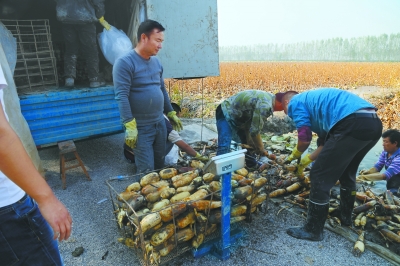
The first batch of pond lotus root is about to be loaded onto trucks and shipped to the capital.
It is another bumper harvest season, and the reporter has come to the 300-mu lotus root planting base of Ding Suoshan, "the capital's biggest lotus root grower", located in the Xinhaihu Ecological Park in Caofeidian. People speak of "golden autumn October", and in this "gilded" season, Ding Suoshan's lotus ponds have also shed their look of "how dense the lotus leaves grow" and changed into their autumn attire; and past the season for picking lotus seeds and admiring lotus leaves, the lotus root that had been silently waiting in the mud underwater, out of our sight, has finally reached its own season - on the path beside the lotus pond, a large truck from Beijing is waiting for the lotus root to come out of the pond and be loaded. The first truckload of lotus root shipped from Caofeidian to Beijing is about to set off from here.
Standing beside the lotus pond, Ding Suoshan watched the workers scoop the plump lotus roots out of the pond and load them into baskets one by one, his face beaming with the joy of harvest. He told the reporter: "The lotus roots have grown very well this year, with each root averaging about 2.5 kg. Judging from the loading of the first truck, this year's commercial lotus root yield is roughly between 1,500 kg and 2,000 kg per mu."
Zhu Guanglun, who has been in the lotus root business for more than 20 years, was busy loading lotus roots into baskets and weighing them. He picked up a lotus root four nodes long and told the reporter: "Having sold lotus roots for so many years, I have some understanding of lotus roots from all over the country. The climate and water quality here in Caofeidian are quite suitable for lotus root growth. The pond lotus root here has high yield and good taste. I once took samples for comparison, and compared with other places, Caofeidian pond lotus root can sell for six jiao to one yuan more per kg on the market, and it is basically in a state of supply falling short of demand." ⟧
Ding Suoshan, who followed his elders in growing lotus roots by Chaohu Lake from childhood, began renting land in Beijing to grow lotus roots in 1993. His business model of "harvesting lotus roots under the ice in winter and selling them off-season" not only filled a technical gap in lotus root cultivation in the north, but also made him the foremost lotus root grower in the capital. At the beginning of this year, in line with the general trend of Beijing-Tianjin-Hebei coordinated development, Ding Suoshan decided to move his planting base to Caofeidian.
On April 10, Ding Suoshan's lotus root planting base officially signed a contract to settle in Caofeidian. "The capital's biggest lotus root grower settles in Caofeidian" - for a time, the news that Ding Suoshan was going to plant lotus roots in former rice paddies attracted great attention. Speaking of moving to Caofeidian, Ding Suoshan said that moving his business to a completely new environment inevitably meant taking risks, and his biggest worry at the time was that the soil and water of the former rice paddies were somewhat saline-alkaline and not conducive to lotus root growth. For this reason, the lotus ponds were reasonably equipped with inlet and drainage pipes to ensure proper alkali leaching and unobstructed water use in the lotus fields. In response to the soil compaction of the rice paddies, measures such as deep ploughing of the land and water injection and rotary tillage were carried out, and a ring road around the lotus fields was also built to facilitate daily management and lotus root transport. Planting in spring and harvesting in autumn, today's harvest has already proved that Ding Suoshan's meticulous efforts have been rewarded. Ding Suoshan said that until today, seeing the lotus roots loaded and sold, he could finally truly breathe a sigh of relief: "Now I feel settled!"
Gazing at basket after basket of lotus roots coming out of the pond and being loaded onto trucks, Ding Suoshan talked about his development plans: "Next year the company's commercial lotus root planting area will expand from the current base to 1,000 mu to 2,000 mu in the surrounding area, and in terms of sales models we will open up four channels: farmers' market sales, supermarket sales, deep processing, and export. This year's harvest has given me great confidence, and I believe lotus root cultivation can achieve even greater development on this land in Caofeidian."
"I am full of hope for Caofeidian!" Looking to the future, Ding Suoshan's eyes shone with fervent light: "Sightseeing and tourism will surely become a development trend in the future. I hope to expand the development area, drive the broad masses of farmers in Caofeidian to prosperity through my own efforts, and also draw more people to Caofeidian."
Basket after basket of plump lotus roots, carrying the fragrance of the soil, were weighed and loaded onto trucks and set off on the road to the capital. A few hours later, they will be distributed to supermarkets in Beijing, bringing to the people of the capital the sweet flavor nourished by the soil and water of Caofeidian.