Migrant Worker from Nanchong Returns to Xichong to Grow Rare Trees and Becomes a Multimillionaire
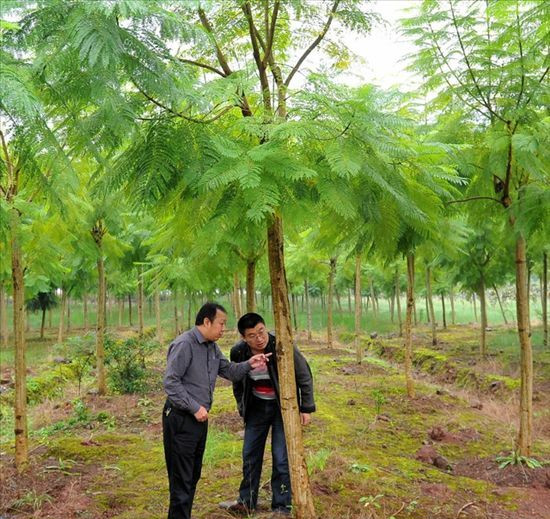
Technicians from the Xichong County Forestry Bureau and staff from the Xichong County Junrong Rare Tree Planting Professional Cooperative inspect the growth of jacaranda trees together.
Along both sides of the roughly 6-km village road from Renhezhai Village to Baishansi Village in Fengming Town, Xichong County, rare trees such as osmanthus, cherry blossoms, Malus halliana (Hall crabapple), red-leaf plum, jacaranda, red maple, magnolia and camellia trees stand in neat rows, lush and green.
These trees were planted by an entrepreneur named Li Tianjun, who spent more than 20 years making his way in Shenzhen and Guangzhou and invested more than 50 million yuan to plant them after returning to his hometown. In 1993, 19-year-old Li Tianjun from Guanya Township, Xichong County, went alone to Shenzhen to work; by 2013, the construction company under his name had an annual net profit of more than 20 million yuan. At that time, Li Tianjun had an idea - to return home and start a business. After returning to investigate, the thought that "planting rare trees is like saving money" arose spontaneously.
Over 10 Years, a Migrant Worker Becomes a Big Boss
In 1993, Li Tianjun went to Shenzhen to work on subway construction. "Coming to a strange city, my first thought was to make money and go home." Because he was born into poverty, Li Tianjun developed a spirit of enduring hardship and hard work from childhood, and after going out to work, he made a wish to accomplish something big. In 2003, having gradually accumulated capital, Li Tianjun established his first company - Guangzhou Tianjun Logistics Service Co., Ltd. Soon after, he also set up Guangzhou Junrong Labor Service Co., Ltd. and Guangzhou Mengziya Leasing Co., Ltd.; in 2013, with accumulated strength, Li Tianjun established Guangdong Junrong Construction Engineering Co., Ltd., mainly undertaking municipal subway, railway and expressway, industrial and civil building projects.
"I came up from the grassroots, so I care more about the quality of construction projects," Li Tianjun said. Although his company was established not long ago, because he had more than 10 years of construction experience in the building industry, it has successively undertaken a number of national key projects, winning unanimous praise from owners and supervision companies for good quality and high efficiency, and has repeatedly won the title of "Star-Rated Construction Enterprise."
As the company continued to develop and grow, Li Tianjun's construction company had 213 employees, completed an annual construction output value of more than 150 million yuan, and its annual net profit also reached more than 20 million yuan. As the company grew day by day, "returning to one's roots" became Li Tianjun's urgent wish.
Returning Home to Plant Rare Trees
In May 2013, Li Tianjun returned to his hometown, and the changes there brightened his eyes. "At that time I saw many people developing traditional forestry, and I thought, if I do it, I must be different. Even if it doesn't make money now, as long as it doesn't lose value, I'm satisfied." Li Tianjun said it was precisely this idea that gave rise to the investment philosophy that "planting rare trees is like saving money." After investigation, he decided to invest in rare trees with reliable quality and strong risk resistance. "According to market rules, the slower it grows, the higher its value." Li Tianjun said that although planting rare trees brings slow returns, since the trees are planted in his hometown, he is not worried about depreciation.
After designing the investment plan, Li Tianjun quickly communicated with the local government, invested more than 52 million yuan, leased 1,600 mu of land in Renhezhai Village, Foguisi Village, Sanyuanqiao Village and Baishansi Village in Fengming Town, Xichong County, planted 20 kinds of rare trees including red maple, red-leaf plum, magnolia and cherry blossoms, and established the Xichong County Junrong Rare Tree Planting Professional Cooperative.
On October 23, the reporter saw at Li Tianjun's planting base that more than 40 mu of jacaranda trees formed a lush, continuous stretch. "When this kind of landscape tree grows up, it can provide a very good shading effect. As long as it blocks the sunlight, there naturally won't be too many weeds. It is a rare landscape tree for urban greening." That morning, technicians from the Xichong County Forestry Bureau said this while inspecting the growth of the jacaranda trees together with staff from the Xichong County Junrong Rare Tree Planting Professional Cooperative.
"Now I can easily earn 2,000 yuan a month, equivalent to a year's income from farming at home in the past." Yao Chengxian, 67, a villager from Yaoshisi Village, Yihe Township, Xichong County, is an employee of the Xichong County Junrong Rare Tree Planting Professional Cooperative. Speaking of his current job, his face was full of smiles. "Before, farming, raising pigs and raising cattle brought an annual profit of only two or three thousand yuan. Now with farming, pesticides and fertilizer are very expensive, and by the end of the year you don't get much money." Yao Chengxian told the reporter that compared with the past, not only is his income higher now, but he no longer has to "depend on the weather for food." Now that he is older, he is very satisfied to be able to find a job here.
The reporter learned that the Xichong County Junrong Rare Tree Planting Professional Cooperative provides 30 jobs year-round, with an average monthly wage of about 2,000 yuan. At peak times, more than 200 local farmers participate in the work every day. Apart from the 52 million yuan in forestry investment, the cooperative also brings local villagers more than 4 million yuan each year in land rent and labor fees.
Developing Rural Tourism to Help Villagers Get Rich
"From 2016 to 2018, we will invest 200 million yuan to develop ecological forestry." Li Tianjun said that because the Xichong County Junrong Rare Tree Planting Professional Cooperative is located in a national modern agriculture demonstration zone, according to Xichong County's "13th Five-Year Plan," next the cooperative will rely on its current agricultural resources to develop rural tourism.
"At present our work is still planting trees rather than selling trees, and developing sightseeing agriculture and tourism." Li Tianjun told the reporter that the cooperative's focus is to expand the planting scale of rare trees and develop rural tourism, thereby driving local farming households to participate together and prosper together. To become a leading enterprise in greening and rural tourism, it cannot do without the support of local people. Implementing "gradient development" of trees, combining large and small trees, is bound to be a massive forestry project, so farmers must be mobilized to develop together.
"Output value management, forestry scale and management philosophy are the core foundations of ecological forestry development. Li Tianjun's return to plant rare trees fits Xichong's concept of building a green valley in western China," said the person in charge of the Xichong County Forestry Bureau. They will strongly support this planting model, combine sightseeing agriculture with tourism, and develop it into a pillar industry of Xichong.