How Tomatoes Made a Village Rich: The Wealth-Building Story of Tan Gaoyan, a Village Official in Xian County, Hebei
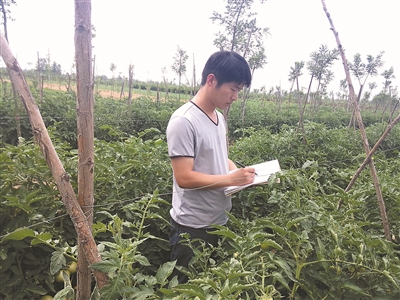
In the photo, Tan Gaoyan records the growth of tomatoes on site.
Tan Gaoyan, 33, is not tall, with a round face and a simple, honest smile. At first glance, there is nothing remarkable about him.
Yet he is the deputy secretary of Dananshao Village in Xian County, Hebei Province, and a provincial-level outstanding college-graduate village official. In the seven years since taking up his post in the village, Tan Gaoyan has been thinking constantly about how to help his fellow villagers get rich. "I just want to do something down-to-earth so that farmers truly benefit," Tan Gaoyan says in plain words, but his story is vivid.
Tan Gaoyan grew up in a rural village in Xian County. In 2006, after graduating from Tangshan College, he found a job in electrification management at a local steel enterprise, earning a monthly salary of 3,000 yuan, which was considered respectable at the time.
Yet Tan Gaoyan was like a transplanted plant whose roots still clung to the soil of the fields. He said that the enterprise where he worked was located in a township, and seeing the familiar rural surroundings often made him think of home.
Fate changed in 2008. Hebei Province recruited its first batch of college-graduate village officials. Tan Gaoyan applied and was accepted. In October of that year, he arrived at Dananshao Village, Shanglin Township, Xian County, and took the post of assistant to the village Party branch secretary.
To be a village official, one must first be a good villager. Tan Gaoyan's first task was to go door to door and learn about the village. At first, when he walked along the road in fashionable clothes, villagers would mutter curiously: "Where is he from?" When they heard he was a college-graduate village official, the villagers did not trust him, saying that young people just came to gild their resumes and would leave after two or three years. Some even asked: "Did you bring money for the village?"
Communication was difficult, but with wholehearted dedication, problems were no longer problems. Tan Gaoyan decided to "repackage" himself and put on plain clothes. Sometimes when he saw villagers plowing the fields with dust flying, he would insist on going up to chat about the harvest. Tan Gaoyan's hometown was only 25 km from Dananshao, but he did not often go home, staying in Dananshao every day, and when it got cold he would stay at the home of a village official.
After half a year, Tan Gaoyan had walked every corner of the village, drew a village plan, replanned the streets and houses, and formulated a detailed development plan for the village. The villagers' impression of this young man changed from unfamiliar to warm. Hou Guangchun, the 60-year-old village committee director, evaluated Tan Gaoyan this way: "Young as he is, he was extremely down-to-earth from his very first day on the job, and he has a real drive in him."
Tan Gaoyan understood that his fellow villagers all longed to be well-off, but were troubled by a lack of skills. "Why shouldn't I use the skills and knowledge I have to help the villagers get rich?"
Dananshao is a purely agricultural village and had been growing tomatoes for more than 30 years, but it had long been limited to scattered household planting and management, with poor returns. In 2008, the village's per capita net income was less than 3,000 yuan. Because the village had no trading market, villagers still had to drive three-wheeled carts to Hejian, Qingxian, Renqiu and other places to trade, and prices followed the local markets there.
Tan Gaoyan had studied engineering and knew nothing about tomato cultivation, but he was unwilling to watch his fellow villagers toil and suffer without making money. Taking cost, returns, soil and other conditions into comprehensive consideration, he proposed developing open-field tomatoes. Everyone agreed as soon as they heard it. Tan Gaoyan first regularized the mutual-aid society into a cooperative, then raised funds, leveled the dirt roads, and built a simple vegetable wholesale market.
Having a fixed trading site was still not enough. Villagers reported that the tomato varieties were not good, that the fruit split as soon as it rained, that it did not store or transport well, and that its appearance was poor.
Facing the expectant eyes of the villagers, Tan Gaoyan contacted the Beijing Academy of Agriculture and Forestry Sciences, purchased superior varieties, invited experts for regular technical guidance, and had the cooperative carry out standardized management. Hard work pays off. During the 2009 wheat harvest season, the more than 500 mu of tomatoes planted in the village enjoyed a bumper harvest, a sea of red with a refreshing fruity fragrance, and buyers from everywhere came one after another. Tan Gaoyan said that when open-field tomatoes ripen, greenhouse tomatoes have not yet reached the market, and the money is made from this time gap.
As production increased, the sales site became constrained. Tan Gaoyan spent half a month completing the market plan and construction budget. After study and demonstration by the village Party branch and village committee and a vote by the villagers' representative assembly, it was decided to expand the trading market. During this period, he stayed at the construction front line every day, coordinating the construction progress. From earth filling to ground hardening, from building rain shelters to installing lighting facilities, in order to save expenses for the village, he often worked alongside the villagers. Two months later, with 700,000 yuan raised, a high-standard vegetable market and its supporting works, covering more than 10 mu and accommodating hundreds of merchants, were completed.
The following year, the scale of tomato planting doubled. At the "Autumn Agricultural Products Online Matchmaking Fair" held by the Ministry of Commerce, transactions worth 2 million yuan were completed, and the village's annual income reached more than 7.5 million yuan. Truck after truck loaded with tomatoes set off from Dananshao for surrounding counties and cities as well as Beijing, Tianjin, Shijiazhuang, Harbin and other places. By 2011, the village's per capita net income exceeded 6,000 yuan.
Dananshao Village became famous. Three surrounding counties and cities and seven or eight townships came one after another to learn from its experience, driving more than 2,000 farming households to increase their incomes and become well-off. In 2012, Tan Gaoyan was elected deputy secretary of the village Party branch and received the provincial honorary title of "Outstanding College-Graduate Village Official."
Watching Dananshao Village change with each passing day, a sense of happiness welled up in Tan Gaoyan's heart. In Tan Gaoyan's view, his youth was destined to be tied to the countryside, and his life has become more brilliant and colorful because of this land.