Lazy Growers Produce Lazy Grapes, Bagging Technique Brings High Popularity
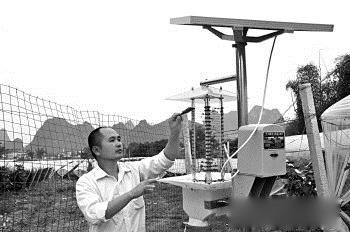
The photo shows management personnel cleaning insects from the tubes of frequency-vibration solar insect-killing lamps.
Nowadays, in an era when modern agriculture is all the rage, a "maverick" plantation has emerged in the grape-growing circles of Huangyao Town, Zhaoping County: they planted over 80 mu of grapes, not a particularly large area, and the investment was not small either, yet they are "lazy" about tending them and clumsy at fine-tuned cultivation. The methods they use are very "old-school," grape yields are not high, which puzzles their peers, yet now they are reaping a "full harvest." Read on--
A Vegetable Field "Transforms" into a Vineyard
With the golden autumn bringing refreshing breezes and gentle winds, the reporter drove to the Lizhuwan Ecological Vineyard in Huangyao Town, Zhaoping County, to explore the "lazy farming method" here.
"Original ecological grapes" are actually just "native grapes," grown without chemical fertilizers or pesticides. Under the grape trellises, the fruit hangs heavy, clusters upon clusters, tempting to the eye. At first glance, the appearance is unremarkable, but one taste reveals a lingering sweetness.
The person in charge of the organic ecological vineyard planting base is named Bai Yu. In November of last year, he transferred over 80 mu of vegetable plots from local farmers. After leveling the land, he erected concrete pillars, built film greenhouses, and began planting "native grapes."
Though called the "lazy farming method," in the end it is really about being "lazy" when it comes to using chemical fertilizers and pesticides. When it comes to the safety of the grapes, Bai Yu takes it more seriously than anyone. Once, when a manager touched pesticides, he flew into a rage over it!
That was not long after they started growing grapes. One day, Bai Yu came to the vineyard and found a packaging bag on the ground in one of the greenhouses. Judging by the markings on the bag, it was clearly for pesticides. With a dark scowl, he found the manager and would not let the matter go.
That time, grapes in one greenhouse had grown many small insects, and the leaves were curling. The manager simply could not catch them all. In desperation, he took matters into his own hands and sprayed pesticides. After the situation was explained clearly, Bai Yu's anger subsided. Later, he hired a specialized agricultural technician for year-round technical guidance. From then on, aside from appropriate amounts of biological pesticides, the kind of toxic pesticides with residues never entered the vineyard again.
Using Organic Fertilizer and Hanging Insect-Killing Lamps
At the original ecological vineyard, several workers were pulling weeds. Someone suggested spraying herbicide once, which would save effort and money. But Bai Yu would not have it; he was unwilling to damage the ecological environment. It is precisely for this reason that he hires more workers than usual, with as many as 20-plus people helping him at peak times.
"As long as the quality is good, the brand will surely make a name for itself." The reporter saw on site that the over-80-mu vineyard planted last autumn has now grown to over two meters tall, the green branches and leaves have begun slowly climbing up the trellises, and clusters of grapes glisten in the early autumn fields. "When planting the grapes, we used chicken manure, cow manure and other farmyard manure as a base to ensure the grapes have an ample source of nutrients." Melon and fruit vegetables are especially prone to attracting insects, grapes in particular. With the help of the Municipal Agriculture Bureau, this original ecological vineyard introduced 5 frequency-vibration solar insect-killing lamps, which became the "guardian deities" of this 80-mu ecological vineyard.
The soil selenium content in this vineyard ranges between 0.23 and 0.3 mg/kg, placing it in a selenium-rich soil zone. After more than a year of cultivation and care, and under the "protection" of the solar insect-killing lamp "guardian deities," the Wenke, Jufeng, Xiahei, Rose Scented and other grape varieties in the vineyard have now matured one after another.
The reporter saw on site that these 5 insect-killing lamps were placed among the grape trellises. Under the red bags, layer upon layer of dead mosquitoes, rice stem borers, corn borers, cotton leafworms and other pests had collected. Management personnel told us that frequency-vibration solar insect-killing lamps absorb solar energy during the day, and at night they continuously charge the lamp tubes and emit light, attracting many insects from the fields. In a single night, they can fill half a bag, and one frequency-vibration solar lamp can "escort" about 30 mu of vineyard.
"Original Ecology" Becomes a "Hot Commodity"
The green and organic brand has made a name for itself, and the value of the "original ecological grapes" has risen accordingly. Because this vineyard is located in Huangzhu Village and Yangshuo Village of the ancient town of Huangyao, only 1 kilometer from the Huangyao exit of the Guiwu Expressway, its uniquely advantageous geographical location drew an endless stream of city residents and tourists coming to pick "original ecological grapes" during the National Day holiday, letting Boss Bai earn a "full harvest."
Ms. Zhang from Guangzhou brought her family, a group of 4, on a self-driving trip to the ancient town of Huangyao in our city. The reporter saw at the grape planting base that baskets were being carried, grapes picked, weighed and bagged, and the vineyard was bustling. "The grapes here look good and taste pure, and picking them by hand is a unique experience." Ms. Liu, who drove over from the city proper, busily picked "Xiahei" grapes while telling the reporter that the high-quality grapes and the hands-on picking experience thrilled her.
At the grape planting base, almost all the grapes had been given a "protective cover," with each cluster wrapped in a paper bag. According to management personnel, the paper bags are for dust prevention, insect prevention, and to avoid direct contact with the sprayed limewater. "We don't spray pesticides, only apply organic fertilizer. Through these measures we ensure the quality of the grapes, green and organic. When city residents pick on site here, there is more loss, so it is 12 yuan per jin, while market sales are around 15 yuan per jin."
"A lazy person's lazy method. Although the grapes from our first season are not high in yield, the fruit is sweet and customers all like them, and they have even recommended quite a few friends to come." Bai Yu told the reporter that at first he worried the low yield would affect profits. But now the number of people coming into the vineyard to pick grapes is growing day by day, especially on weekends when it is even livelier, and he has truly felt the value of original ecology.