College students sell free-range eggs, using IoT to pass the trust test
Original title: Raising free-range chickens with IoT
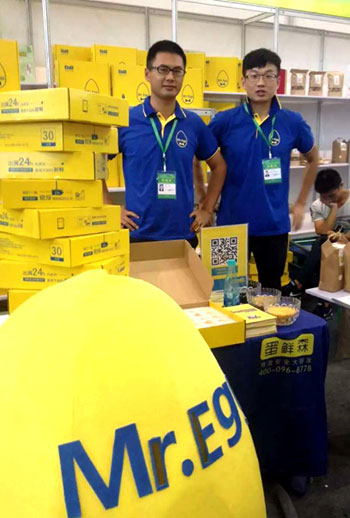
Feng Weijie and Chang Lei (file photo)
Nowadays more and more people are raising free-range chickens, and many chicken farmers use free-range eggs as their trump card for capturing the urban consumer market. Competition is also growing fiercer. How can urban consumers be willing to buy their free-range eggs at a slightly higher price? Two college graduates, Feng Weijie and Chang Lei, use IoT technology to make free-range eggs higher in quality.
Feng Weijie and Chang Lei are the entrepreneurs behind the brand "Danxiansen." They were college classmates and graduated in 2010 from Anhui University with a major in marketing. After graduation, Feng Weijie went to work at Guoyuan Futures, and Chang Lei went to work at Evergrande Real Estate. "We both had pretty good jobs and our salaries were not low, but we always wanted to start our own business and do something ourselves," Feng Weijie told the reporter. During his four years working at Guoyuan Futures, he came into contact with quite a few agricultural companies and also had experience cooperating with some companies, but none had ever matched his ideals.
"In 2014, I decided to choose the free-range egg project because the investment was not large and market demand was big, making it suitable for young people like us to start a business," Feng Weijie told the reporter.
In March 2015, Feng Weijie and Chang Lei contracted 180 mu of land in Xiaotuanshan, Mingchuan Township, Feixi County, built a chicken house covering more than two mu, purchased 3,000 free-range chickens and began free-range farming. All of this investment came from their salaries from the previous few years of work.
"Consumers can see the environment of our farm online and fully trust our products. This is all thanks to IoT technology," Feng Weijie said. When they invested in raising chickens this year, his partners began considering how to make consumers believe in their products. At the time, a partner working in network technology suggested using IoT technology so consumers could see the real-time environment of the farm at any time.
"This set of equipment cost 200,000 yuan to invest in, but the results achieved are obvious. Many customers learn through their mobile phones that our farm uses ecological farming, and the quality of the eggs is trustworthy," Feng Weijie said. From the start of sales of the first batch of eggs in September this year to now, monthly sales have been around 20,000 eggs.
When asked about Feng Weijie's sales experience, he told the reporter that the eggs from the farm now cost 2.5 yuan each, with 30 eggs per box, and consumers who order before 3 p.m. that day are guaranteed same-day home delivery. "Our current focus is on the mother-and-baby group. They have the greatest demand for eggs and also the highest requirements for egg quality," Feng Weijie said. By participating in farmers' markets and new-farmer activities, they promote in some large shopping malls in Hefei and let people taste the eggs on site. Through multiple events, they have won hundreds of members. "To sell agricultural products, first the quality must be good; second, they must be delivered quickly to customers; and also, customers must be able to promptly understand the production environment and procedures. Only in this way can you gain customers' long-term favor." (Staff reporter Liu Gang)