Agricultural insurance upgraded to lower premiums, landslide damage now covered
Insurance Regulatory Commission: Crop insurance premium rates in some regions drop by nearly half
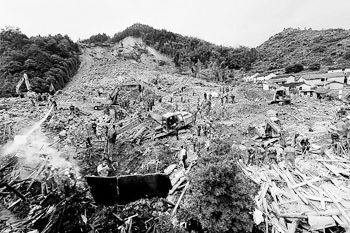
This is the rescue scene at the landslide disaster in Lidong Village, Yaxi Town, Liandu District, Lishui City, photographed on November 15. (Image source: Xinhua Net)
Data released by the China Insurance Regulatory Commission on the 13th shows that China's agricultural insurance products have now completed upgrading and restructuring, expanding the scope of insurance liability coverage, lowering insurance premium rates, with crop insurance premium rates in some regions dropping by nearly 50%.
He Hao, Deputy Director of the Property Insurance Supervision Department of the China Insurance Regulatory Commission, said that in 2014, agricultural insurance achieved premium income of 32.57 billion yuan, provided risk protection of 1.66 trillion yuan, covered 247 million farmer households (times), underwrote major crops exceeding 1.1 billion mu, with underwriting coverage approaching 50%, and underwriting coverage of major grain crops exceeding 65%. According to statistics from January to October this year, the premium income of agricultural insurance as a whole was 33.633 billion yuan, already surpassing the levels of last year and the year before.
However, he also pointed out that China's agricultural insurance still faces problems such as narrow insurance liability, low protection levels, and strict claims conditions, which farmers and various parties have strongly reported.
According to reports, at present, the upgrading of agricultural insurance products has been basically completed, covering 34 provinces (autonomous regions and municipalities directly under the Central Government), 15 types of crops and 6 types of breeding varieties, totaling 738 agricultural insurance products and 22 insurance companies.
"The upgrading of agricultural insurance means broadening the scope of liability coverage." He Hao said the upgrading of agricultural insurance products is mainly reflected in the following five aspects.
First, the scope of insurance liability has been expanded. On the basis of the original natural disasters, crop insurance has added major disasters such as drought and earthquakes, as well as geological disasters such as mudslides and landslides, and damage from pests, diseases, weeds and rodents; breeding insurance liability has been extended to all diseases and epidemics. Some regions have expanded coverage to include "snow disasters" and "wild animal attacks" based on local conditions.
Second, the protection level for major grain crops has been raised. In most provinces and municipalities across the country, the insurance amount has covered direct materialized costs, with the average insurance level increasing by 10% to 15%. For the small number of regions that have not been able to cover direct materialized costs due to various factors, insurance companies will develop commercial supplementary protection products.
Third, compensation standards have been raised and claims conditions lowered. Absolute deductible clauses have been abolished, while compensation standards for crops at different growth stages and in total crop failure situations have been raised.
Fourth, insurance premium rates have been lowered. With major agricultural provinces as the focus, insurance premium rates have been reduced, with crop insurance premium rates in some regions dropping by nearly 50%.
Fifth, the social management function has been strengthened. The harmless treatment of dead livestock and poultry in accordance with government regulations is set as a prerequisite for obtaining insurance compensation. Through economic means, farmers are guided to voluntarily carry out harmless treatment of dead livestock and poultry, preventing dead livestock and poultry from entering the market. (Reporter Wang Jingshuo)
Related links >>>
Authoritative interpretation: Agricultural insurance products now include major disasters such as drought and earthquakes
According to a report by Economic Information Daily, He Hao, Deputy Director of the Property Insurance Department of the CIRC, said the first feature of this upgrade is the significant expansion of insurance liability scope. "For example, on the basis of the original natural disasters, crop insurance has added liabilities such as drought and pests and diseases, and listed earthquakes as a primary liability, which no other property insurance product has. In addition, geological disasters such as mudslides and landslides, as well as damage from pests, diseases, weeds and rodents, have also been included in the insurance scope. Breeding insurance liability has been extended to all diseases and epidemics. Some regions have also expanded coverage to include snow disasters and wild animal attacks based on local conditions."
After the upgrade, the protection strength of agricultural insurance products has been greatly enhanced. In most provinces and municipalities across the country, the insurance amount has covered direct materialized costs, with the average protection level increasing by 10% to 15%. In addition, raising compensation standards and lowering claims conditions have become a major highlight of this upgrade. The upgraded products have abolished absolute deductible clauses while raising compensation standards for crops at different growth stages and in total crop failure situations. At the same time, insurance premium rates have been lowered. With major agricultural provinces as the focus, guidance has been provided to all localities to lower insurance premium rates based on risk characteristics, risk distribution and operating conditions in recent years. Crop insurance premium rates in some regions have dropped by nearly 50%.
According to CIRC data, since the central government implemented the agricultural insurance premium subsidy policy in 2007, China's agricultural insurance has developed rapidly. In 2014, agricultural insurance achieved premium income of 32.57 billion yuan, provided risk protection of 1.66 trillion yuan, covered 247 million farmer households (times), underwrote major crops exceeding 1.1 billion mu, with underwriting coverage approaching 50%, and underwriting coverage of major grain crops exceeding 65%. Experts believe that the upgrading of agricultural insurance products marks the further improvement of the agricultural insurance product system, will greatly enhance the standardization and normalization level of agricultural insurance product management, and will have a profound impact on expanding agricultural insurance coverage, safeguarding the legitimate rights and interests of insured farmers, improving the agricultural insurance system and mechanisms, and giving full play to the functions of agricultural insurance. (Li Tangning)