Rapid pesticide residue test can be completed in just 16 minutes
Original headline: Shenzhen spends 50 million yuan to build a vegetable basket testing defense line
1,000 edible agricultural product screening points to be built before the end of 2017, with the first screening pilot set at Haijixing
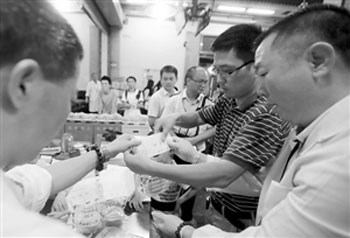
Staff conduct sampling, record information, prepare samples on site and seal them.
A joke circulates online: "Chinese people have completed their chemistry education through food. From rice, we learned about paraffin; from pork, we learned about clenbuterol; from salted duck eggs, we learned about Sudan red; from silver ear fungus, we learned about sulfur; from milk powder, we learned about melamine."
This joke lays bare the awkward current state of food safety in China. These chemical substances, which originally had nothing to do with food, have truly appeared in ordinary people's food, harming everyone's health.
To keep these chemical substances out of citizens' vegetable baskets, relying solely on traditional laboratory testing is not enough. Therefore, establishing a large number of rapid, convenient, accurate and sensitive rapid screening points for the safety and quality of edible agricultural products has become a necessary safeguard.
The Shenzhen municipal government took the lead nationwide in launching the "Edible Agricultural Product Quality and Safety Guarantee Project," the most critical task of which is: to establish 1,000 rapid screening points for the quality and safety of edible agricultural products before the end of 2017, building a testing defense line.
Hearing is not as good as seeing. This reporter recently visited Shenzhen's first edible agricultural product quality and safety rapid screening pilot - the Haijixing International Agricultural Products Logistics Park - for an on-site investigation, revealing how vegetable basket safety is "screened" out!
On-site report
Organophosphates screened out in 16 minutes
The greatest risk factor for vegetables and fruits to consumers is pesticide residues. According to the current "National Food Safety Standards" issued by the Ministry of Agriculture and the Ministry of Health, the residue limits for 322 pesticides in 10 major categories of agricultural products and foods total 2,293 values.
The traditional quantitative method for detecting pesticide residues is not only costly but also takes a relatively long time, requiring at least 24 hours to produce results.
When people buy vegetables, they usually want them fresh. By the time test results show they are substandard, the vegetables have long been eaten, and recall is too late.
Rapid screening of high-risk items can quickly and effectively identify substandard agricultural products and destroy them immediately.
This reporter noted at the rapid screening laboratory in the Haijixing market that rapid pesticide residue detection technology can produce results in as little as 16 minutes.
This technology uses the acetylcholinesterase inhibition method, used to detect the two major categories of fruit and vegetable insecticides mainly used on the market: organophosphates and carbamates. Because this technology has the characteristics of being rapid, sensitive, easy to operate and low in cost, it is listed as a nationally recommended standard method and is also the most mature and most widely applied rapid detection technology.
Law enforcement officers seal Vegetable samples taken on site and send them to the Haijixing market rapid screening laboratory, where 2 testing personnel conduct rapid screening of pesticide residues in the samples.
Tester Lao Pan first places the sample into an ultrasonic device and shakes it for 3 minutes to make the pesticide blend more fully, then drops the sample onto test paper, covers it with a lid and waits 10 minutes, and finally opens the lid and lets it sit for 3 minutes, waiting for the color to appear.
"If the test paper turns blue or light blue, it is qualified. If it turns white, the overall pesticide level exceeds the standard and it is unqualified." Lao Pan believes that this rapid screening step is the most effective. Although it is not as comprehensive as quantitative testing, its advantage is speed! If it fails after 16 minutes, the product can be immediately confiscated or destroyed to prevent it from circulating.
Staff from the Agricultural Product Supervision Division of the Shenzhen Food and Drug Administration told this reporter that in the next 3 years, Shenzhen will build 1,000 rapid screening points in 400 farmers' markets, 600 large supermarkets and agricultural product distribution units, respectively conducting rapid screening for harmful residues in crop products, livestock and poultry products, and aquatic products.
What the 1,000 testing points "screen"
Crop products
Two major categories of pesticides: organophosphates and carbamates.
Livestock and poultry products
Growth promoters and veterinary drugs for livestock and poultry such as clenbuterol.
Aquatic products
Antibacterial drugs such as malachite green and nitrofurans.
Pilot results
Rapid screening model initially established
The wholesale volume of Haijixing International Agricultural Products Logistics Park accounts for 60%-80% of Shenzhen's total consumption. This means that Haijixing, Shenzhen's largest "vegetable basket," is the leading priority in edible agricultural product safety supervision.
Therefore, setting the first screening pilot at Haijixing can effectively explore a supervision model and accumulate replicable regulatory experience for the future 1,000 screening points.
"The agricultural product supervision sections of each jurisdiction bureau were only established this year, and edible agricultural product quality supervision work is relatively weak." This reporter learned from the Agricultural Product Supervision Division of the Food and Drug Administration that through the pilot work at Haijixing, the work responsibilities of each department were clarified, the supervision targets, supervised varieties and supervision work methods for edible agricultural products were defined, the working relationship between administrative law enforcement units and technical testing institutions was straightened out, and a daily work model for edible agricultural product quality supervision in Shenzhen was initially established.
This pilot work also improved the supervisory work capacity of grassroots law enforcement personnel, familiarized them with filling out various law enforcement forms, producing on-site records and collecting relevant evidence, and made clear "whom to supervise, what to supervise, and how to supervise." At the same time, it also improved the on-site sampling efficiency of technical testing units.
Problems exposed
Three major loopholes urgently need repair
One month of pilot work also exposed three major loopholes in the current state of edible agricultural product supervision, such as unclear sources of agricultural products, lengthy on-site sample preparation, and obstruction of law enforcement work.
During sampling inspections, more than 90% of business stalls could not provide purchase invoices and certificates, and the purchase invoices and certificates provided by a small number of stalls were only simple handwritten records with inconsistent formats, different items and incomplete content, unable to provide standardized information such as the name, quantity, purchase date of edible agricultural products, as well as the supplier's name, address and contact information.
The system of requiring certificates and invoices is difficult to implement, which will have a serious impact on the traceability of agricultural products and the investigation and handling of substandard agricultural products. Staff from the Agricultural Product Supervision Division of the Food and Drug Administration gave this reporter an analogy: if cowpeas from a certain city in a certain province exceed standards, or if Hami melons from a certain city in a certain province carry relatively high risk and frequently fail inspections, then sampling inspections can be conducted specifically by place of origin, without wasting time sampling all cowpeas and Hami melons from every origin.
Second, sampling of edible agricultural products sounds very simple, but in practice it takes a very long time. According to this reporter's on-site timing, the longest fruit sampling took a full 1 hour.
The reason, objectively speaking, is that the on-site sample preparation conditions are inadequate and the sampling tools are too simple, which affects the conduct of sampling work and work efficiency.
According to feedback from the Agricultural Product Supervision Division, the stalls currently do not have water, electricity or corresponding facilities, which is not conducive to sample preparation and cleaning.
Finally, the resistance of merchants is common, which also means that future sampling inspection and law enforcement work needs to be gradually standardized. During the sampling process, one fruit merchant kept complaining, "Why sample us? Why not sample others?" Although law enforcement personnel determine sampling randomly according to market stall conditions, they still need to patiently explain the sampling inspection work to her again and again.