Why are bottled grains so expensive? Prices can actually increase 10-fold
Original title: Xinyi: "Creative online farmers" sell agricultural products in new and creative ways
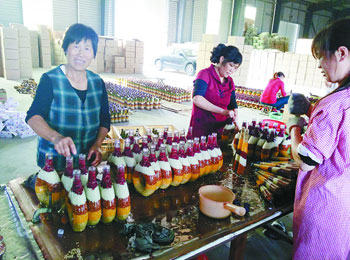
Workers are bottling (Image source: Urban Morning Post)
Recently, another order of 1,500 grain crafts from Jiangsu Xinyi Hongyang Guogu Crafts Company was sold to Thailand. Simple grains such as rice, mung beans and soybeans, after processing and being placed into specially made bottles, see their prices increase 10-fold.
Company owner Huang Jian, a farmer by background, told this writer that ordinary vegetables, fruits, grains, colored salt, colored sand, flowers and plants, once processed, become decorative crafts used for hotels, guesthouses and home decoration, and are sold through the internet to more than 20 regions including Southeast Asia, the Middle East, Europe and America, with annual sales revenue of more than 60 million yuan.
In the "Internet Plus" wave, Xinyi is rapidly forming a new group: "online farmers." They come from different backgrounds and have different educational levels; there are college student entrepreneurs as well as genuine farmers. The stories of these "online farmers" are stunning, inspiring and full of creativity, and are truly admirable. Moreover, in some regions and industries, "online farmers" use "wisdom" to pry open Belt and Road markets and have become the "main force" in the production and sale of agricultural products.
Paulownia wood, after machine processing and hand polishing to shape it and then branding with labels, is made into healthy neck-support pillows that sell well online, priced at 40 to 80 yuan, with annual online sales of about 1 million yuan. That is how Boss Chao of the Chenggong Woodware Factory in Fuzhuang Village, Gangtou Town, Xinyi City, sells his products.
With e-commerce having developed to today's level, competition is extremely fierce. Without eye-catching products, one will quickly be drowned out among the shops of tens of millions of practitioners. Therefore, choosing accurate and good products is the key to success.
"At first, I browsed online and found that very few people were selling them, so I tried taking some photos of small rabbits and put them online for sale. As a result, sales were very good, and demand exceeded supply." said pet shop operator Ms. Huang. Ms. Huang, around 40 years old this year, found that few local shops sold small white rabbits online, so she collected some cute-looking and distinctive rabbits, then groomed and dressed them up, gave them special names, and put them online for sale. This casual move brought her generous returns. Each year, online transaction volume on her Taobao shop alone can reach more than 100,000 yuan, and the shop ranks in the top ten among similar shops. Online contact and offline transactions reach more than 500,000 yuan in transaction volume each year.
In some other industries, wonderful stories are also unfolding.
As autumn and winter arrive, 50-year-old farmer Shi Sichao of Xinduan Village is busy "changing the outfit" of his Taobao shop.
A village old man designing trendy faux fur women's clothing? To most people, this "distance" seems a bit far. But Old Shi said: "Our village is a 'Taobao Village' specializing in faux fur clothing, and I have even opened a Tmall 'flagship store'!"
Old Shi's family opened its online shop in 2010, and in Xinduan Village, Mohe Street, they were among the first to "eat crabs." In order to sell the clothes, he explored ways and went to Hangzhou to find professional models. Although the cost was not low, it looked stylish, and together with production by professional photographers, orders quickly came in, with 200 items sold a day. Due to the large volume of business, his family also specially hired 4 customer service staff, using 4 computers at once, and even buyers from Taiwan, China came to their small shop to hunt for bargains.
Farmer Liu Kuile of Xin'an Street, in order to improve the price advantage of lilies, invented and created his own method. Over three years, he actually solved the technical problem of lily bulbs being able to be planted multiple times. One lily bulb can be reused three or four times, reducing costs by 80%, with each one costing only a few mao. Not only that, through cooperation with Taiwan, China businessmen, he used his own lily base as 60% of the shares to establish Chennong Technology Company, and in addition to occupying most of the domestic lily market, it exports to Japan, South Korea and other places.
"Creative online farmers" are becoming a new force leading new farmers, developing new rural areas and supporting new agriculture. Eighty percent of villagers in Xinduan Village have "gone electric," opening more than 800 online shops, with annual sales of 86 million yuan and per capita annual income of 30,000 yuan. More than half of the faux fur coats and jackets sold online domestically come from here. Last year, this village was rated among Jiangsu Province's first batch of "E-commerce Demonstration Villages."
At present, rural online merchants in Xinyi have reached more than 10,000, and from January to September this year, online retail sales reached 1.819 billion yuan. Xinyi City Mayor Wang Chengzhang said, "'Online farmers' have injected internet genes, innovation genes and cultural genes into rural areas, bringing entirely new elements and strength to the transformation of traditional agriculture. They are the future and hope of rural areas." (Man Dongguang)