El Niño to hit at year's end, need to guard against catastrophic floods similar to 1998
Original title: World Meteorological Organization: El Niño will be stronger at year's end
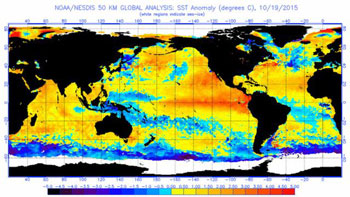
Global El Niño phenomenon (file photo)
The latest report on the global El Niño phenomenon released on the 16th by the World Meteorological Organization, a specialized agency of the United Nations, states that a mature and powerful El Niño weather event is expected to peak at the end of this year, and its intensity may be comparable to the strong El Niño phenomenon of 1997/1998.
WMO Secretary-General Jarraud pointed out at the report's press conference that monitoring shows that over the past 3 months, sea surface temperatures in the central and eastern tropical Pacific have already been 2°C higher than normal, exceeding the El Niño threshold by about 1°C, indicating that this El Niño is at a very significant level. It is predicted that this El Niño will be the strongest El Niño event the world has seen since the strong El Niño of 1997/1998.
The meteorological organization's latest report shows that the El Niño event affecting the globe has already shown its power in some regions. Affected by it, in October multiple African countries faced the threat of drought, with northern Ethiopia and eastern Sudan and other areas facing a severe food crisis. By mid-October, drought in California in the United States had caused the death of more than 100 million trees, accounting for about 20% of California's forests. In addition, from January to September this year, the global average surface temperature reached its highest value since meteorological records began, and 2015 could become the hottest year in history. Therefore, the coming winter may become a warm winter due to the influence of El Niño. In China and some other countries, the average temperature has already "sent" this signal, with the average temperature in October at 11°C, and some areas 2 to 4°C higher than the same period in normal years.
Jarraud also stated that countries' preparations for responding to El Niño events are better than in the past. On the basis of recommendations from national meteorological and hydrological departments, some countries expected to suffer the most severe impacts are deploying relevant plans, focusing on implementing disaster management strategies in agriculture, fisheries, water and sanitation and other sectors, in order to save lives and reduce economic losses and damage.
The El Niño phenomenon refers to the phenomenon of large-scale sustained abnormal warming of sea surface temperatures in the central and eastern equatorial Pacific Ocean. It often causes climate anomalies in multiple regions around the world. Historically, mature El Niño events usually reach maximum intensity from October of that year to January of the following year, persist for most of the first quarter of the following year, and then gradually weaken. (Reporter Wang Xinjian)