Off-season farming of red drum yields over 20,000 yuan in net profit per mu
Red drum (Sciaenops ocellatus) has strong disease resistance, grows quickly, has a high survival rate, and tolerates low oxygen and low temperatures, making it very suitable for high-density farming. After 2005, the farming area of red drum in Zhuhai, Guangdong, once expanded rapidly, seemingly poised to compete with sea bass. However, in the past three years, aquatic product market prices have fluctuated greatly, and farmers often succeeded in raising fish yet could not sell them at a good price; at market time, the fish price was sometimes even lower than the farming cost. In recent years, many local farmers have mostly suffered losses farming red drum, causing many farmers to switch to other species this year, and the red drum farming area has therefore shrunk severely.
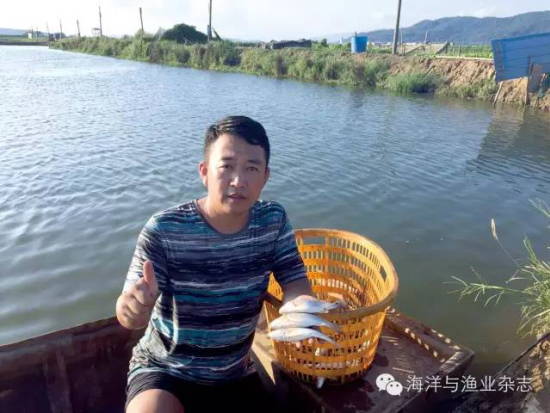
Niu Damiao
During an interview in Zhuhai, a reporter from Ocean and Fishery learned that Niu Damiao of Jinwan District, Zhuhai, still favors the red drum farming industry, and this year farmed nearly 80 mu of red drum. Niu Damiao told the reporter: "Prices have been poor these two years, mainly because the market time is too concentrated, and fish traders also impose fairly strict restrictions on marketable size, causing the price to be pushed down again and again. I now adopt the method of delaying the release of fry by 4 months and harvesting fish in July and August of the following year, avoiding the peak concentrated market period before the Spring Festival, so the fish can sell at a good price."
Nursery rearing is the key to success or failure
In view of the continuous low prices in recent years, Niu Damiao had long harbored the idea of delaying fry release and staggering the market period. But he actually put it into practice in July 2013. That year, neighboring farmers still chose to release fry in mid-to-late March when spring was warm and flowers were blooming, but he avoided March, the so-called best fry release period, and did not order a batch of fry until July, when the last batch of red drum fry came out of Fujian, and had them transported back to Zhuhai for farming. Disappointingly, however, the survival rate of the fry during nursery rearing was not high, and they almost all died. Niu Damiao did not give up on the idea of delaying fry release and staggering the market period. He summed up the experience of this failure and planned to try again the following year.
"The main reason for the first farming failure was that the temperature was too high during fry transport, so the fry died from stress and discomfort, and in addition, it was the first time to release fry in July, and the work of putting the fry into the pond was not done well." Unwilling to admit defeat, Niu Damiao ordered another batch of 2.5 cm fry in late August 2014 for farming. Drawing on the lessons of last time, this time he paid special attention to controlling temperature and time during transport, did a good job of pond water fertilization and water quality regulation before stocking the fry, and carried out more refined "nursery rearing" of the fry. In Zhuhai, in summer, more freshwater flows in from mainland rivers, causing seawater salinity to be very low, sometimes even 0, so attention must be paid to measuring various water quality indicators and adjusting the pond water to a certain salinity before releasing the fry. The stocking density is 100,000-150,000 fry/mu. At this time the fry are relatively weak and small, and require finely fed high-protein feed, with the best feed being fish meal.
Nursery-reared fry
"Whether fry release and farming in July and August can succeed depends mainly on the survival rate of nursery rearing. Fry that survive the nursery rearing period can basically be raised to maturity. But at this time the survival rate of nursery rearing is far lower than in mid-to-late March. Based on experience from these two years, the survival rate is generally 50-80%." After about 3 months of nursery rearing, the fry grew to a size of about 1 liang. At this time the north wind rose, the weather turned cooler, and the salinity of the water at the local river-sea junction gradually became saltier, making it suitable for pond division and farming. In late November 2014, Niu Damiao divided the nursery-reared fry among 4 ponds for farming at a stocking density of 10,000-12,000 per mu.
In winter, pay attention to keeping warm and controlling feed
"Red drum is a euryhaline fish, but care must be taken to ensure that the water salinity is above 3‰; the higher the salinity, the better. Raising red drum over winter does not require building winter sheds, but in winter the pond water depth must be increased to ensure the pond water temperature, and the overwintering water temperature must not be lower than 0°C," Niu Damiao told the reporter. Winters in Zhuhai are relatively warm, and it happens to be the saltwater intrusion season, so these conditions are relatively favorable for red drum to overwinter. It should also be noted that in winter, when air and water temperatures are lower, fish are less active in activity and feeding, so feeding should be reduced, pond patrols should be increased to observe water quality and fish school conditions, and feeding should be carried out according to the weather and the health of the fish, with regular application. It is not suitable to feed too much, so as to avoid waste and water pollution.
After February, as the weather turns warmer, red drum begin to feed actively. Generally, a feeder is used to feed at fixed points twice a day, in the morning and evening, and the feeding amount is estimated from the number and body weight of the fish in the pond. Niu Damiao especially reminds that red drum have a habit of cannibalism, and if feeding is insufficient, red drum will bite each other to death. Generally, feed at less than 30% of fish body weight. After feeding, observe the leftover feed within 1 hour, and appropriately adjust the feed amount according to feeding conditions, with most fish eating to 80% full being best.
In spring, when temperatures rise, attention should be paid to preventing parasitic diseases, such as trichodinids, dactylogyrus, and ichthyophthirius. Red drum have relatively few diseases, so prevention should be the main approach. Attention should be paid to filtering and disinfecting the farming water, not feeding expired or spoiled feed, and strictly controlling water quality, paying attention to pond patrols to promptly discover problems and take measures.
Off-season farming, net profit over 20,000 per mu
"Fish could be harvested in June this year, but the price was not good, so I did not harvest until July 2, when the fish price was 8.9 yuan/jin. The substandard fish (those under 7 liang) totaled more than 500 jin, fish from 7 liang to 2 jin accounted for more than 90%, and fish over 2 jin accounted for less than 10%. Since there were basically no red drum coming out of ponds in July, fish traders no longer graded by size and bought all fish uniformly at 1.5 jin/fish." Niu Damiao revealed that farming this way achieved a survival rate of over 90%, a yield of 10,000-12,000 jin per mu, and a farming cycle of 10 months, 2 months longer than the normal farming cycle of 8 months. The cost is slightly higher than ordinary farming, at about 6.8 yuan/jin.
It is reported that, apart from price risk, the market also imposes many restrictions on the size of commercial adult fish. Adult fish with a size of 0.7-1.5 jin/fish sell best, while fish smaller than 0.7 jin or larger than 1.5 jin cannot fetch a price. When adult fish reach marketable size, farmers have no choice but to sell even if the fish price is poor. If adult fish are not marketed and remain in the pond for continued farming, the feed consumed each day will only increase, and the larger the fish, the less price they can fetch. Under the traditional practice of releasing fry in March and marketing adult fish before the Spring Festival, it is easy to encounter low fish prices due to concentrated marketing. However, Niu Damiao used the method of delaying fry release and staggering the market period for farming. Calculated at a yield of 10,000 jin per mu, the income per mu of red drum in 2015 was 21,000 yuan, a fairly considerable profit.