Xiaoshan District, Hangzhou, Zhejiang: Making agriculture strong
Developing various forms of appropriately scaled agricultural operations is the only way to agricultural modernization. We must focus on raising land output, resource utilization and labor productivity, accelerate the cultivation of new types of agricultural operating entities such as family farms, specialized large-scale farmers, farmer cooperatives and leading enterprises in agricultural industrialization, and build a three-dimensional, composite modern agricultural operating system suited to national conditions and the stage of development, one based on household family operations, bound together by cooperation and association, and supported by socialized services, so as to raise the level of intensification, scale, organization, socialization and industrialization of agricultural operations.
-- Excerpted from the "Comprehensive Implementation Plan for Deepening Rural Reform" recently issued by the General Office of the CPC Central Committee and the General Office of the State Council
"How big is your farm?"
"Oh, ours isn't called a farm; it's called an agricultural technology company."
"Besides strawberries and fruit tomatoes, what other products do you have?"
"Our products aren't strawberries and fruit tomatoes, but 'technology packages,' integrated solutions..."
Well, two questions in a row, and both times we got shot down.
In an inconspicuous mountain nook in Jinhua Town, Xiaoshan District, Zhejiang Yangtian Agricultural Development Co., Ltd., or "Yangtian Agritech" for short, is quietly stirring up an agricultural revolution -- "operate with the mindset of an investor, execute with the logic of industry." The plant factory here is overturning your understanding of agriculture and blowing your mind.
Just what kind of testing ground is Yangtian Agritech?
On-site observations
Inside the plant factory, strawberry babies don't grow on the ground -- they "lie in bed"
"Where do strawberries grow?"
"On the ground, of course!"
If you've ever picked strawberries, you'd surely answer with such confidence.
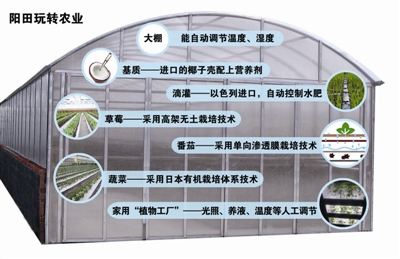
At Yangtian Agritech, however, the strawberry seedlings we saw were "lying in bed" -- in a greenhouse of more than 1,000 sq m, row upon row of strawberries were placed on supports either 60 cm or 80 cm above the ground, their leaves vividly green and dripping, some already bearing small flowers. Look more closely, and the dark substrate piled on the racks is not soil, but "crushed, sterilized coconut shells, matched with nutrients. Specially imported from Sri Lanka."
"Strawberries have no skin or shell. You love eating them, and bugs love eating them too. Going soilless and using supports is all about reducing or even cutting off pest damage."
According to Zhu Hanliang, chairman of Yangtian Agritech, each row of "elevated racks" here has two pipes, supplying heat and water and nutrients respectively, directly to the plant roots. "It's not 'whatever you give, the plant absorbs'; it's 'whatever the plant lacks, then you supplement it.'" The supply uses digital automatic control, and the nutrient ratio differs at every stage of plant growth. According to the introduction, what controls water and fertilizer is drip irrigation technology introduced from Israel, ensuring consistent concentration at every outlet.
The growing greenhouse is very smart: it can monitor and record data changes in the greenhouse 24 hours a day, and high-tech equipment adjusts temperature and humidity through automatic window opening, irrigation and other means, so that crops can grow in the most suitable environment.
"In a plant factory like this, the fruiting period of plants can be predicted to within 5 days, and yield can also be accurately foreseen." According to estimates, this technology can raise strawberry yield from 2,000 kg per mu to 5,000 kg.
In another greenhouse inside the park, fruit tomatoes are grown, also not in soil, but on a layer of white film one cm above the ground. Beneath the white film there is also a layer of transparent film, called a "one-way osmotic membrane."
"The one-way osmotic membrane looks unremarkable, but its role is huge." Zhu Hanliang introduced that tomato roots can grow through the one-way membrane, fully absorb the water and nutrients from the drip tubes below, and the membrane can also reflect light to absorb sunlight and resist bacteria and pests.
According to the introduction, the one-way osmotic membrane cultivation technology is a world-leading technology introduced from Waseda University in Japan, and can improve the sugar content, yield and quality of tomatoes.
Startup story
Contracting wasteland, three MBAs plunged headlong into the "agricultural gate"
The founders of "Yangtian Agritech" are 3 MBAs from Zhejiang University, classmates in the same class. Before this, all of them had done things unrelated to agriculture, thriving in their respective fields.
Why choose to plunge into the "agricultural gate"? "At first, it also came from a simple idea -- 'I wanted my family and friends to eat safe, delicious agricultural products.'" said general manager Lou Gang.
They acted as soon as they decided. They took a fancy to more than 100 mu of wasteland in Huajiadian Village, Jinhua Town, Xiaoshan. There, surrounded by mountains, with fresh air, a township road runs through, and transportation is convenient.
In July 2012, Zhejiang Yangtian Agricultural Development Co., Ltd. was formally established. With no office space, they rented an assembled container and set foot on the road of a second startup.
The inefficient, extensive operating model of traditional agriculture definitely would not do! After years of weathering the business seas, the startup team wanted Yangtian to "operate with the mindset of an investor, execute with the logic of industry."
Drawing on their respective networks and resources, they searched globally for the most advanced agricultural technologies, absorbed, organized and standardized them, and formed a technical system with Yangtian characteristics.
They created their own "Jiale Man" brand, positioned at the mid-to-high end. The brand's strawberries are supplied exclusively to high-end supermarkets such as Hangzhou MixC, with 12 strawberries selling for 108 yuan, and prices are even higher during the Spring Festival. Even so, they are often snapped up by customers as soon as they hit the shelves! "My teacher Ma Yun has already eaten our strawberries for three years; he is a loyal fan of ours." said general manager Lou Gang with a smile.
They positioned Yangtian as a supplier of integrated solutions for modern protected agriculture -- forming Yangtian's most advanced technology, equipment, after-sales service and other content into "technology packages" to provide to agricultural production bases and large-scale growers. The "Yangtian model" was soon piloted and promoted in **Urumqi, Kashgar, Ili, Korla and the **Construction Corps, Anhui and other places, and achieved great success. At present, their demonstration sites are in 8 provinces nationwide.
According to the introduction, Yangtian Agriculture, founded three years ago with an investment of 3 million yuan, now has a market value of 100 million yuan.
Growth secrets revealed
Technological innovation is the core competitiveness of enterprise development
Yangtian Agritech has always treated technological innovation as the core competitiveness of enterprise development.
In 3 years, it brought in 42 technical personnel, whose main daily work is to research, sort out, absorb and standardize the world's top agricultural technologies from Japan, Israel, the Netherlands and elsewhere. Today, Yangtian Agritech already has more than 10 technology patents.
This year Yangtian Agritech also specially established an academician workstation, with 3 academicians of the Chinese Academy of Sciences formally signed on; they often bring research topics with them.
3 experts hired from Japan at high salaries are also honored guests of Yangtian Agritech. Mr. Jun Hiroi, a graduate of the University of Tokyo, is the Japanese technical head of Yangtian Agritech. Every year, he spends half his time at Yangtian, helping Yangtian optimize technology, train employees, and also going deep into the fields to guide paired farmers.