Southern sugarcane planted in northern Liaoning: large temperature differences make it sweeter
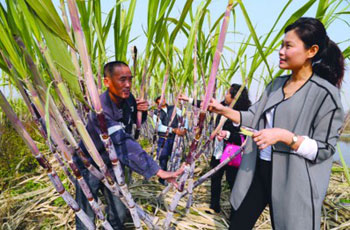
In the photo: On October 15, Yu Hongwei (first from left) helps friends who came after hearing the news select ripe sugarcane in his own sugarcane field
I heard someone had transplanted sugarcane from the south to northern Liaoning. Curious about such a rare thing, the reporter also wanted to find out. On October 15, the reporter came to Yu Hongwei's sugarcane field in Xiaoming Village, Xiaoming Town, Diaobingshan City, and saw a large expanse of ripe sugarcane, red with a purple tinge, each stalk round and thick. Villagers who had come after hearing the news were happily cutting and tasting it.
"It's all grown at home, absolutely no pesticides. Eat as you like, chew as you like, there's plenty." Yu Hongwei warmly greeted the villagers and friends who came to cut it.
According to Yu Hongwei, his sugarcane field is 3 mu in total, with about 960 sugarcane seedlings planted per mu, and 4 tiller seedlings kept per plant, so each mu can produce nearly 4,000 stalks of sugarcane. Despite the severe drought this year, the plant height still reached more than 2 m.
Sugarcane is a subtropical plant, and there has long been a saying that sugarcane does not cross the river. "Can southern sugarcane be grown in the north?" Faced with the reporter's doubt, Yu Hongwei said knowledgeably: "In northern Liaoning, summer sunlight is longer and the temperature difference between day and night is large, which helps the accumulation of nutrients and the conversion of sugar in sugarcane. The juice and sugar water are even richer than in southern sugarcane, the cane skin is extra tender, and it reaches the market 20 to 30 days earlier than southern sugarcane."
"Of course, after all, it is a southern plant grown in the north, so it has many fewer nodes than in the south, but the length of the nodes is an advantage." Yu Hongwei added with some regret.
Yu Hongwei also enthusiastically promoted a new use for his sugarcane: "Plant one sugarcane with its four root systems in a flowerpot and let it grow into a plant to decorate a home living room, a hotel lobby, or a shopping and entertainment venue. That is a absolutely beautiful southern landscape."
Yu Hongwei, 44 years old, is a man who loves to think things over. For many years, he has spent his spare time on planting and breeding, and he says dealing with the black soil is a pleasure. Transplanting southern crops to the north has been his dream for many years, and growing sugarcane became his first choice. In August last year, Yu Hongwei rented a farm of nearly 100 mu southwest of Xiaoming Village in Xiaoming Town and started raising Tibetan fragrant pigs and forest frogs and running a fishing pond. The farmland of the farm had long been in Yu Hongwei's plans. This year, Yu Hongwei carefully selected 3 mu of land to trial-plant sugarcane. From the transplanting of sugarcane seedlings on April 15, he controlled temperature and humidity successively with plastic film and arch film, and by late May it had entered field management similar to that of northern crops. Every day Yu Hongwei carefully "cared for" these "guests" from the south. The base fertilizer was fermented chicken manure from the breeding farm. If insects appeared, they had to be handled entirely by hand, and pesticides were absolutely not used. At the busiest time, there were more than 20 workers picking off insects.
After about 6 months of nourishment from the fertile black soil of northern Liaoning, the sugarcane Yu Hongwei planted had reached the moment of harvest. Since the field opened on October 7, pickers from Tieling, Shenyang, Anshan, Fushun, and even Changchun and Siping, after hearing that sugarcane is produced here, have all come curiously to have a taste. Yu Hongwei was immersed in the sweetness of people picking in the sugarcane field.
The reporter asked how the market was. Yu Hongwei confidently estimated: calculated at 6 yuan to 8 yuan per stalk, after deducting costs, earning 8,000 to 10,000 yuan per mu is no problem.