Luyang advances rural agricultural industrialization to build an idyllic dream for farmers
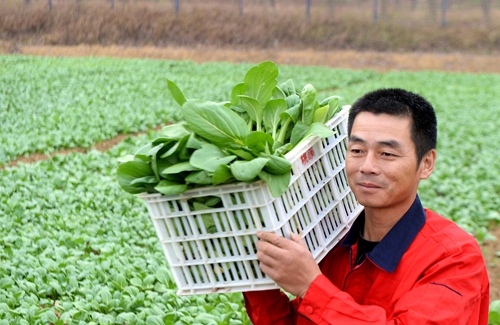
Zhang Lixin busy working in the fields
Citizens picking in the fields
Early in the morning, Zhang Lixin was busy working in his vegetable plot. This plot of more than 1000 mu of vegetable land is located at the San Shigang Taoxi Farm in Luyang District, Hefei City, and all of it is planted with seasonal vegetables. Since planting began in 2010, organic fertilizer has been used throughout the whole process, and this year finally brought a full harvest. This winter, these seasonal vegetables will be delivered to the dining tables of Hefei citizens weekly according to customer orders.
"Only by growing it yourself do you understand that every grain on the plate means hard work"
For Hefei citizens, San Shigang peaches, watermelons, and Anhui's largest high-appearance flower sea are all too familiar in daily life. Facing today's crowds of visitors, Taoxi Farm Chairman Zhang Lixin is full of emotion. At the beginning, with the hot-headed drive of "as long as it is grown well, there is no fear it won't sell," he never expected to encounter a major problem in the farm's first year of operation. "We began planting fruit tree saplings in 2010. That year Hefei suffered a major drought, and all the peach saplings in the field died," Zhang Lixin said. The next year they replanted, and finally in 2013 the trees bore fruit, and with the township government taking the lead, the first Peach Blossom Festival was successfully held. However, along with the joy of harvest came new problems. Because they insisted on zero chemical fertilizer, zero hormones, zero herbicides, and zero preservatives, many ripe fruits rotted in the field before they could be sold. "The shelf life of fruit is too short. Take mulberries for example: 70% rotted in the field. This year, more than 40% of peaches were also wasted. It really hurts to see." Zhang Lixin realized that if agricultural products are to win consumers' favor, not only must quality be guaranteed, but there must also be good sales methods. "The purchase price of agricultural products is low, while labor costs are high. Selling agricultural products is truly harder than reaching the sky, so new business models must be opened up."
Missing the safest and most original taste of childhood
Zhang Lixin was born in the countryside. Now, whenever he eats together with others, he especially misses the taste of the eggs, cabbage, and tomatoes he ate back then. "People's living standards are getting better and better, and they pay more and more attention to food safety, but wanting to eat the safest and most original taste of childhood is not so easy." Zhang Lixin felt that enormous business opportunities were hidden in this. In 2012, in the eastern part of Taoxi's ten-thousand-mu farm, he opened up more than 1000 mu of farmland, invited experts from the Anhui Academy of Agricultural Sciences, and personally prepared the land, applied fertilizer, selected seeds, and sowed them, busying himself happily just to eat a mouthful of safe vegetables. The spinach and cabbage planted last month have now grown leaves, and after several autumn rains, the seedlings shot up rapidly. Zhang Lixin told reporters that the farm grows 1000 mu of seasonal vegetables, with more than 30 varieties. The seasonal vegetables currently growing include spinach, radish, lettuce, cilantro, and other varieties. "The vegetables we grow do not use pesticides; we all use physical pest control," Zhang Lixin introduced. They also use excavators to dig and plow the fields. Excavators can dig to a depth of half a meter to one meter, making the soil looser and more conducive to water retention. "These seasonal vegetables have been exposed to the sun, and also to the stars and the moon. They have gone through wind, frost, rain, and snow. They are vegetables with vitality, and this is also why we define these vegetables as 'vitality vegetables.'" To solve the difficulty of selling, Zhang Lixin specially launched a "membership system" for "vitality vegetables." This December, after Taoxi's ten-thousand-mu farm's "vitality vegetables" go on the market, citizens can apply for a "fresh vegetable card." Taking the annual card as an example, 2000 yuan allows one to enjoy a delivery service of 300 jin of vegetables for one year, with no express delivery fee. "Basically, delivery is once a week, 6 jin each time, including 4 to 6 seasonal varieties."
From "Peach Blossom Festival" to "vitality vegetables," Luyang District builds a rural idyllic dream
In 2014, the No. 1 Central Document was issued, creating new opportunities for the development of rural tourism. China's overall rural development is in a transition stage in which multiple business forms develop side by side. In this process, rural areas, especially those relatively close to cities, naturally make rural tourism (including sightseeing agriculture, leisure agriculture, and rural vacations) an important form and main content of rural industrial structure adjustment. How to take advantage of the "east wind" of rural tourism development? San Shigang Township in Luyang District carried out large-scale upgrading of the rural tourism industry, creating a series of rural tourism brands such as the "Peach Blossom Festival," "Picking Festival," "Cuigang Market," "Dongqu Food Village," and "Taoxi Flower Sea," realizing the ecological transformation of suburban agriculture. Through the tourism industry chain of "flower viewing, dining, market strolling, sightseeing, and fruit picking," it looks back at the countryside from the spiritual realm of urban people, arousing childhood yearnings, and further strengthening the rural economy and driving farmers to increase income and become prosperous.