Hainan University female professor takes off her qipao to raise chickens and ducks in Chengmai, leading villagers to scientific prosperity
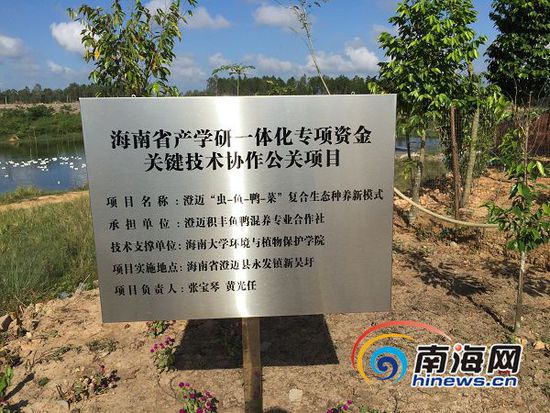
In the second half of 2014, the Chengmai Fish-Duck Mixed Culture Professional Cooperative partnered with Hainan University to apply for Hainan Province's industry-university-research integration special fund, building on the original fish-duck mixed culture to establish an "insect-fish-duck-vegetable" composite ecological farming and breeding new model project.
Huang Guangren, a skilled farmer from Yongfa, Chengmai, is also the leader of the fish-duck mixed culture model.
The "insect-fish-duck-vegetable" farming and breeding base located in the Xinwu area of Yongfa Town, Chengmai County.
In a qipao, standing on the podium, she is a poised and elegant university professor. With her trouser legs rolled up and a straw hat on her head, stepping into ponds and chicken coops, she transforms into a down-to-earth farmer. Her name is Zhang Baoqin, associate professor of entomology at the College of Environment and Plant Protection, Hainan University, a doctoral candidate in entomology at the Institute of Entomology, College of Agriculture and Biotechnology, Zhejiang University, and a "farmer" with a simple agricultural dream.
In the mid-1990s, Zhang Baoqin, who lived in a small mountain village in Fuzhou, Fujian, chose to attend the then South China University of Tropical Agriculture (now merged into Hainan University) after the college entrance examination because of its lower tuition, studying plant protection. Having grown up in a rural area, Zhang Baoqin has always held a special natural affection for agriculture and farmers. "I have always had a dream in my heart, which is to use the knowledge I have learned to return to agriculture, help farmers become wealthy, and benefit the local community. This is also the promise I made in my heart when I took the Party oath in college."
Last year, when Zhang Baoqin learned that more than 4,000 farmers engaged in fish-duck mixed culture in the Xinwu area of Yongfa Town, Chengmai County, a demonstration site for fish-duck mixed culture in Hainan Province, had run into a development bottleneck in the breeding industry, she resolutely decided to join their ranks, bending down to rural areas, providing technical guidance for farmers' breeding, and determined to lead everyone onto a path of healthy and green breeding toward prosperity.
Where is the technology? The fish-duck mixed culture demonstration site has hit a breeding bottleneck
Adjacent to Haikou, the Xinwu area of Yongfa Town, Chengmai County, has a beautiful ecological environment, abundant water sources, and many mountain ponds, making it suitable for breeding. Twenty years ago, local farmer Huang Guangren ended his career as a migrant worker and returned to his hometown to engage in breeding. After difficult exploration, he led more than 4,000 local villagers out of a breeding path mainly based on the fish-duck mixed culture model. Farmers raise ducks on the surface of their own mountain ponds and use the duck droppings to feed various fish beneath the water. For more than 10 years, this breeding model has developed at an annual growth rate of 10% to 15%, becoming a highlight of structural adjustment in the Yongfa Xinwu area and the largest fish-duck mixed culture demonstration base in the province.
At present, the number of breeding households in the Xinwu area alone has reached 1,250, with more than 10,050 mu of water surface, an annual duck output of more than 10 million, more than 4,500 people engaged in breeding, a total output value of fish and duck products of 320 million, and a net profit of more than 40 million. Fish products are mainly supplied to processing plants and exported to Europe, the United States and other countries after processing, while duck products are mainly sold throughout the province and to Guangdong, Guangxi and other places. After promotion, the fish-duck mixed culture model has radiated to multiple surrounding cities and counties.
"We became wealthy through breeding, but we also encountered many troubles." Huang Guangren, head of the Chengmai Jifeng Fish-Duck Mixed Culture Professional Cooperative, admitted frankly that in recent years, the costs of feed and labor for breeding have continued to rise, the profit margin for breeding households has become increasingly small, and coupled with the public's growing attention to food safety, product quality urgently needs improvement. "Now the purchase price of ducks has remained at 4 to 5 yuan per jin, and breeding households have an average annual income of 40,000 to 50,000 yuan. It is difficult to increase scale and income further." Huang Guangren said everyone urgently hopes to improve the breeding model through technological upgrading, expand scale, raise food safety standards, and break out of the bottleneck. "The eutrophication of breeding water bodies and the deterioration of the breeding environment are also things we worry and fret about." Huang Guangren said.
Relying on science and technology to change the status quo is a principle all farmers accept. Where is "science and technology"? Huang Guangren and local breeding households once sought cooperation with breeding enterprises, hoping to reduce feed feeding and use fewer drugs, thereby both lowering costs and improving the meat quality of fish and ducks, but all gave up due to immature technology. "We were thinking, professors at universities are 'science and technology.' Professors can explain clearly on the podium and do things clearly in the field, and can help us find good prescriptions." Huang Guangren said everyone's wish is to increase annual income by another 20,000 yuan.
In this way, after searching many times, Zhang Baoqin became the person in the hearts of local breeding households to lead everyone out of the breeding bottleneck. Because her undergraduate major was directly related and because she had long cherished an agricultural dream, Zhang Baoqin gladly accepted the breeding households' request for help.
The female professor takes up the baton: taking off her qipao and putting on a straw hat to transport manure, raise insects, and do breeding
Limited profit margin, poor breeding environment, food safety problems, lack of research capacity... After on-site investigation, Zhang Baoqin wrote down in her survey notebook the difficulties facing the breeding households. In order to truly help the farmers, she conducted research, looked for materials, ran to government departments, and began constantly rushing about to seek a new ecological farming and breeding model.
In the second half of 2014, the Chengmai Fish-Duck Mixed Culture Professional Cooperative partnered with Hainan University to apply for Hainan Province's industry-university-research integration special fund, adding new ecological factors on the basis of the original fish-duck mixed culture to build an "insect-fish-duck-vegetable" composite ecological farming and breeding new model project. "Animal manure and waste garbage are used to produce high-quality insect protein, which is fed together with coarse grains to chickens and ducks, and vegetables are grown on the water surface to improve the water body." To this end, Zhang Baoqin took off her qipao, put on work clothes, and put on a straw hat, first leading everyone to transport animal manure to raise insects. "At the time everyone thought it was incredible." Huang Guangren said local growers were half-believing and half-doubting this professor's approach.
In order to let the breeding households see the difference between the old and new breeding models, Zhang Baoqin divided breeding areas in the 22-mu experimental breeding base, releasing 30,000 fish fry and raising 2,000 chickens and 2,000 ducks, with half fed ordinary feed according to the traditional breeding model and half fed coarse grains and insect protein. "Manure raises insects, turning waste into treasure, and mixed with coarse grains to feed chickens and ducks. Insects contain high protein and also antimicrobial peptides. After chickens and ducks eat them, they are less likely to get sick and do not need medication." In the breeding base, Zhang Baoqin skillfully did farm work while observing the growth of the chickens and ducks. In order to improve the breeding water body, Zhang Baoqin then led everyone to start growing vegetables on the water surface. "The vegetables can be sold and can also be fed to chickens and ducks, and the food produced is green and healthy." Zhang Baoqin said.
Walking in the "insect-fish-duck-vegetable" composite ecological farming and breeding base, the reporter could hardly smell the stench of chicken and duck manure. "I add microbial agents to the breeding base, which can deodorize and ferment, and improve the resistance of chickens and ducks." Zhang Baoqin said that with technical means, many breeding difficulties can actually be solved, and comprehensive benefits can also be increased. "Turning waste into treasure, breeding high-quality and low-cost insects as feed, reducing feed feeding by 5% to 15%, improving the disease resistance of chickens, ducks and fish, reducing the use of antibiotics, and also increasing income by growing vegetables on the water." Zhang Baoqin said that through this new farming and breeding model, it is possible to both produce high-quality green food and increase farmers' income, maximizing the comprehensive benefits of the food chain.
Fulfilling the Party admission promise: using what she has learned to lead farmers to prosperity and benefit the local land and water