Raising pigeons is really novel, how can you raise them to make money?
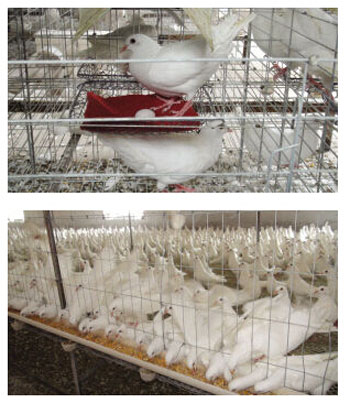
A fine-bred snow pigeon.
Developing an economy by raising pigeons is not a new business model for many provinces and regions in the mainland, but for the vast **, it has become a business model worth promoting. In recent years, some farmers in southern Xinjiang have started raising pigeons and have achieved considerable results.
Invest 70 million, annual income 10 million
In an ordinary village in Langgan Township, Shufu County, **, the tens of thousands of pigeons raised by Yang Ju are growing vigorously.
Yang Ju originally did some auto parts business, but once in the mainland, he happened to see a lively scene of people lining up to eat pigeon, which made him think that his hometown also had the habit of eating pigeon, only it had always been scattered raising and scattered eating, with not a single large-scale breeding farm.
Yang Ju decided to enter the pigeon-raising industry. Since 2012, he and his brother have successively invested more than 70 million yuan to build a modern pigeon farm covering more than 35,000 sq m.
Does raising pigeons actually make money? Is such a large investment risky? Yang Ju analyzed that the economic value of pigeons is reflected in four aspects: first, breeding eggs; second, meat pigeons; third, pigeon manure; fourth, they can be processed into beverages, protein, and so on.
The more eggs breeding pigeons lay each year, the more meat pigeons are hatched, and the more considerable the economic benefit. "A pair of breeding pigeons produces 10 clutches of squabs a year, with two eggs per clutch, and 14-15 squabs per year. The market price of each squab is between 18 yuan and 20 yuan. After deducting breeding costs, the annual net income of each pair of breeding pigeons is about 80 yuan," Yang Ju said. In 2014, Yang Ju's farm sold more than 30,000 pigeon eggs, plus more than 700,000 squabs sold, plus other various sales income, with annual income reaching more than 10 million yuan.
Pigeon manure, as the best base fertilizer for growing flowers, sells for about 2,700 yuan per ton. The market price of each egg is 8 yuan. The deep refining and processing of pigeon feathers and feed protein will be an even larger source of income.
Pigeon raising drives a region to prosperity
In order to increase the production of breeding pigeons, Yang Ju adopted some of his own breeding methods: "Replace the real eggs and hatch them artificially for 18 days, then put them back into the pigeon cage after the pigeons have hatched." Yang Ju said: "Through this method of swapping eggs for hatching, a pair that produces 6-7 clutches of squabs a year can increase its annual output to about 10 clutches." The grain fed to the pigeons and the water they drink are also managed according to scientific feeding.
With development, Yang Ju also used a company plus farmer model to expand breeding. This way of driving farmers to prosperity attracted the attention of the Autonomous Region Economic and Information Commission and the Guangdong Province counterpart support ** work team.
In 2015, farmers in Maigaiti County, Langgan Township in Shufu County, Tashenmilike Township, Zhanmin Township, Maigaiti County, Hongguang Farm, Bachu County and other places also began raising pigeons under the guidance of the work team. The 500 pairs of breeding pigeons raised in June of that year by 8 farming households including Wufuer Keremu in Maigaiti County bred more than 1,500 squabs by the end of the year, with direct income reaching more than 20,000 yuan. For villagers mainly engaged in farming, this is a good income. Calculated at 50 pairs raised per household, without affecting farming, these farming households can each increase their annual net income by at least 8,760 yuan or more.
How big is the pigeon market pie
If pigeon farming becomes widely popularized, where is the market outlet? Yang Ju believes that residents of **, especially in southern Xinjiang, already have the habit of eating and raising pigeons, but previously no industrial scale had formed. In the mainland, especially in southern regions such as Guangdong, the health-preserving habit of people lining up to eat pigeon has already become extremely common. In his view, both inside and outside Xinjiang there is a huge market for pigeon sales.
At the same time, judging from **'s direction of developing a "courtyard economy" to solve the employment of urban residents, the pigeon-raising economy is also one of the industrial methods extremely suited to driving farmers to prosperity. Relevant professionals say that after steady development in recent years, the pigeon-raising industry has gradually moved toward maturity, but any breeding industry, no matter how mature, must continuously withstand the test of the market. Investors must calculate the economic accounts comprehensively and develop at the right time according to their own economic strength and local conditions.