New Zealand Angora rabbit farming leads Wuling Mountain people to prosperity
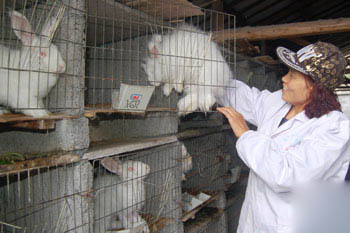
The Angora rabbits raised by Fu Xingqiong
The rabbit wool sheared by Fu Xingqiong
Fu Xingqiong was once an ordinary migrant working girl, and in the eyes of local villagers she is also a strong woman. In 2006, she brought her family and children back to her hometown of Zhuoshui Ancient Town, used her savings from working away to buy an agricultural vehicle, and also set up a cement brick factory, becoming a boss. In 2010, in order to expand her business, she used a spoil ground to build a breeding base for meat rabbits and Angora rabbits. Through 3 years of breeding-driven development, her family's rabbits not only "burrowed" into the homes of nearby neighbors and villagers in the district, but also "ran" to the pens of farmers in the southeastern Chongqing districts and counties of the Wuling Mountain area as well as in Hubei, Hunan, Guizhou and other places.
The migrant working girl becomes a "rabbit mama"
In 2006, Fu Xingqiong, who had worked away from home for nearly 10 years, quit her job and returned home, investing 300,000 yuan to buy an agricultural vehicle and build a cement brick factory. During this period, she also went to other places to investigate the breeding situation of Angora rabbits.
In 2010, Fu Xingqiong invested more than 100,000 yuan to build a rabbit shed with a capacity of 2,000 rabbits on a spoil ground, introduced 300 New Zealand Angora rabbit breeding stock from other places, and additionally bought 200 meat rabbits to raise. During the breeding period, Fu Xingqiong took "extra care" of these little rabbit babies, eating and living beside the rabbit shed, afraid that something might go wrong.
"Rabbits breed very quickly, one litter every 2 months, and one female rabbit gives birth to about 10 per litter. The young rabbits basically increase month by month, and after half a year they grow into adult rabbits; in less than a year there are over a thousand large and small rabbits," Fu Xingqiong said.
Through 3 years of development, Fu Xingqiong established the "Qianjiang District Qunda Angora Rabbit Breeding Professional Cooperative" and the "Qianjiang District Rabbit Industry Association". At present, Fu Xingqiong's rabbit breeding base has 1,800 high-quality Angora breeding rabbits and 1,000 meat rabbit breeding rabbits on hand.
Li Xiaoqing of the Qianjiang District Science and Technology Association said that driven by Fu Xingqiong, in recent years the number of rabbit-raising farming households in Qianjiang District has reached more than 150, and there are more than 50 rabbit-raising households in nearby Pengshui, Youyang, Xiushan, Wulong as well as Enshi in Hubei, Longshan in Hunan and Kaili in Guizhou, with annual sales of breeding rabbits reaching 100,000.
Traveling far to three provinces and municipalities to learn technology
"In the first year of raising rabbits, I also encountered many difficult problems. I lacked knowledge of disease prevention for young rabbits, and the cooling measures for Angora rabbits in summer were not handled properly, causing some losses." Fu Xingqiong said she had once fallen into difficulty and thought about giving up.
In order to learn solid techniques, under the organization of the Qianjiang District Women's Federation, Fu Xingqiong actively participated in breeding technology training held by the district animal husbandry bureau, and usually also used the "science popularization online library" to study.
In 2011, through the introduction of the science and technology association, Fu Xingqiong chose to visit Shandong, Henan, Rongchang in Chongqing and other places at her own expense in the four seasons of spring, summer, autumn and winter to learn Angora rabbit breeding technology.
"A newly built rabbit shed site must have reasonable planning and a ventilated and dry environment." Fu Xingqiong said that a humid environment will breed all kinds of bacteria and parasites. Feed is also very particular; once rabbits eat moldy and spoiled feed or green grass covered with dew or mud, they are prone to bloating and diarrhea.
Angora rabbits also have the habit of fearing heat but not cold. When high temperatures occur, water should be sprayed inside the rabbit shed to cool it down, and open-air rabbit sheds should have a canopy for shade. After shearing in winter, good cold protection and warmth work should be done for young and baby rabbits.
Building a rabbit product processing base
Fu Xingqiong has a yellowed notebook, which records all the detailed registrations of breeding rabbits distributed in recent years. Farmers buying breeding rabbits buy at least more than 10 and at most 200.
In addition, if villagers encounter poor market conditions for meat rabbits and rabbit wool, Fu Xingqiong said she can purchase them at a protective price so that villagers do not bear the risk.
"To raise one Angora rabbit, the wool must be sheared 5 times a year, each time more than 6 liang can be sheared, and more than 3 jin of wool is sheared in a year. At the current market price of 200 yuan per 1 kg, after deducting breeding costs, one Angora rabbit can create 200 yuan in net income." Fu Xingqiong said this is a relatively profitable project in the current breeding industry.
Fu Xingqiong also combined this with the national targeted poverty alleviation work, taking the development of Angora rabbits and meat rabbits as a poverty alleviation project in the Wuling Mountain area. She said she will recycle rabbit wool and meat rabbits and build a deep-processing base for rabbit products in the Wuling Mountain area.