The entrepreneurial story of Qu Jiyong, a leader in giant salamander farming
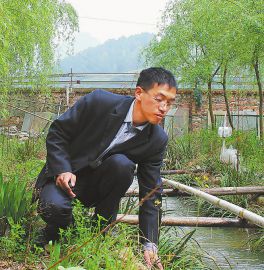
Matun Village in Guiding County, Guizhou Province, is a mountain village in Qiannan Prefecture. In this small mountain village that seems to move at an extremely slow pace, because of giant salamander farming, the villagers' production and business operations have risen and fallen several times with the shifts of the market.
At the turning point of every rise and fall stands the same "guide" - the post-80s entrepreneur Qu Jiyong. Standing 1.60 m tall, wearing a pair of glasses, and slight of build, behind him are one astonishing choice after another on his entrepreneurial path, along with the recognition and praise society has given him: "2009-2010 Guizhou Province Outstanding Local Talent," "2010 Qiannan Prefecture 185 Project Wealth-Building Leader," "2013 Qiannan Prefecture Outstanding Science and Education Talent."
Growing braver with each setback, he successfully embarked on the path of giant salamander breeding
In 2002, after graduating from Yongzhou Vocational Technical College in Hunan, Qu Jiyong was determined to start a business. His father had died early, and the family was poor. He borrowed 30,000 yuan from relatives, cleared 50 mu of wasteland on the mountain in front of his home, and successively planted bamboo fungus, flowers, and figs, and raised bamboo rats and pheasants, all without success. In 2005, 50,000 yuan in debt, he ended his seventh business venture and became a cautionary tale used by villagers to discourage their own children from starting businesses.
Failure did not knock Qu Jiyong down. In 2005, after the Guizhou Provincial Department of Human Resources and Social Security launched the "One College Student per Village Program," he immediately enrolled in the rural economic management major at Guizhou Radio and TV University to build up knowledge for starting a business again, and afterward he went to Shenzhen to work. In 2007, Qu Jiyong, who had been searching all along, heard that someone in his hometown was raising giant salamanders, and he immediately rushed back to Matun Village.
Guiding County is a nationally famous hometown of giant salamanders. At that time, the price of adult giant salamanders had soared to 1,800 yuan per jin, and a fry about 10 cm long cost 900 yuan. With fry prices so high, what if they could not be kept alive? And if they were raised to adulthood, what if they could not be sold? Facing much uncertainty, Qu Jiyong resolved to give it a try. He borrowed more than 40,000 yuan, bought more than 40 fry, and began raising giant salamanders, then expanded the farming scale. Finally, Qu Jiyong achieved his first success on the entrepreneurial path and earned his first pot of gold.
In 2009, Qu Jiyong passed an exam and became assistant to the village director of Matun Village. He decided to breed giant salamander fry to change the excessively high market price of fry and enable more villagers to afford to raise giant salamanders.
Few people had mastered imitative-ecological giant salamander breeding technology, so Qu Jiyong went to Hanzhong City, Shaanxi Province, to learn from a master. What could he do if no one would teach him the techniques? Qu Jiyong set up a giant salamander breeding QQ group, and the group gathered giant salamander farmers from all over the country. Although they were unwilling to teach their techniques, by chatting together every day, bits and pieces would inevitably come up in casual conversation. With patience and care, plus poring over books, Qu Jiyong ultimately mastered giant salamander breeding technology.
He had learned the technology, but in putting it into practice, he still could not get past the two hurdles of funding and risk. To carry out imitative-ecological giant salamander breeding, building the site alone required several hundred thousand yuan.
One day in the second half of 2009, Qu Jiyong took his elderly mother to a relative's home early in the morning to visit. It turned out that Qu Jiyong was going to mortgage his own house and tea garden for a loan of 150,000 yuan, and that day the local rural credit cooperative was coming to assess his loan qualifications. In this way, under tremendous pressure, he sold 40 giant salamanders and finally scraped together 300,000 yuan, and in 2010 built a 1.5 mu imitative-ecological giant salamander breeding base.
After buying 20 breeding salamanders averaging 6 jin each at a high price, Qu Jiyong guarded the breeding base day and night. During the critical breeding period, he got up every one or two hours at night to check on the giant salamanders. To better observe the giant salamanders hidden in water caves, he bought an underwater camera.
In October 2011, the breeding salamanders finally produced more than 500 eggs, of which more than 100 hatched into giant salamander fry.
By 2012, Qu Jiyong's breeding base could breed more than 2,300 giant salamander fry a year. He sold them all to local farmers at 200 yuan each and established a cooperative, driving more than 300 farmers to raise giant salamanders. He became a wealth-building leader in the villagers' eyes.
Extending the industrial chain, giant salamander noodles sell well on the market
The market changes in an instant.
In 2012, giant salamander prices kept falling, from more than 1,800 yuan to more than 500 yuan each, then 300 yuan, 200 yuan...
According to statistics, as of the second quarter of 2013, Qiannan Prefecture had more than 122,000 commercial giant salamanders in ponds. Among these, Guiding County had 94,000 commercial giant salamanders in ponds, ranking first in the prefecture. At this point Qu Jiyong was lost, and where should the road ahead go?
An accidental opportunity gave him hope. One day after the 2013 Spring Festival, his wife Xu Shiqin bought a pack of purple sweet potato noodles for their young son. When Qu Jiyong saw it, he thought: if purple sweet potato can be made into noodles, why can't giant salamander meat be made into noodles? That could effectively use local giant salamander farming resources and extend the industrial chain. After market research, he decided to process giant salamander children's noodles.
Starting in May 2013, Qu Jiyong began experimenting in the intervals between farming giant salamanders. Over nearly a year, he used up more than 3,000 jin of flour and more than 300 jin of giant salamander meat, and finally developed noodles with a suitable mixing ratio that do not break easily and tolerate boiling. Soon, he invested more than 400,000 yuan to build a production line with an annual output of 1 million jin of giant salamander children's noodles, longevity noodles, and nutritious noodles, registered the "Qianmeng" trademark, and could consume about 100,000 jin of giant salamanders each year.
Today, Qu Jiyong's "Qianmeng" giant salamander noodles have entered markets in Guizhou, Shaanxi, Shanghai, and other places, and won the "Golden Diamond Award" of China's catering industry.
"My dream is to make the giant salamander industry bigger and stronger. As long as you have a dream, you must act on it, otherwise it will always remain just a dream," Qu Jiyong said.