A returnee from overseas grows mandarins back home, fresh ones ready to taste by mid-August
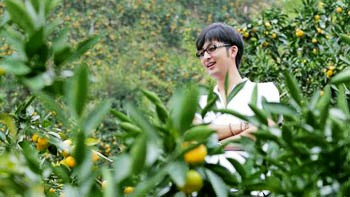
Lin Dongdong talks about mandarins
Panoramic view of the mandarin orchard
What were you doing at 25? Were you in university doing postgraduate study, or grinding away at a nine-to-five office job? Lin Dongdong, 25, says, right now I'm growing mandarins in Yongquan, Zhejiang.
After Lin Dongdong graduated from high school in 2009, his parents sent him to study in the UK. His parents, who had spent half their lives in farming, had originally hoped he could escape the farming life, find a respectable job and take a different path. Yet the experience of studying abroad and soaking up foreign ways made Lin Dongdong realise that agriculture was in fact a gold mine. So, while still studying in the UK, he decided to return home to become a farmer and help his father grow mandarins.
Citrus only has a six-month harvest season each year, so the first thing Lin Dongdong thought about was extending the mandarin sales period and boosting returns. "We work with the Chinese Citrus Research Institute to build a greenhouse, and by controlling its temperature we get the trees to flower and fruit earlier." Right now, the mandarins in Lin Dongdong's greenhouse ripen even earlier than those in places with higher temperatures such as Yunnan and Fujian, and can be picked from mid-August every year.
From a time when he couldn't even tell which mandarin tasted good, to now talking about mandarins fluently, Lin Dongdong says his goal is to "let everyone in China know that my family's mandarins taste good."
With the quality of the mandarins up, it was only natural to think about selling them. Lin Dongdong, back in his home village, found that his neighbours and fellow villagers were still selling mandarins in the most traditional way: "Because the older generation can't get online, and don't know how to use WeChat, their sources of information tend to be television. But young people like us can look up a lot of new knowledge and new technology in this area through the internet, WeChat and so on." So he mobilised the villagers to sell together through e-commerce platforms, and just like that the mandarin sales volume multiplied several times over.
As the person in charge of the brand, Lin Dongdong has set himself another task this year: how to make good-quality mandarins sell for more value. He says: "Now in Tokyo, Japan there's a sky-high-priced fruit shop, where one fruit, say a cantaloupe, sells for over a thousand yuan, and one mandarin sells for over 30 yuan each, but their quality is very, very good. We hope that one day our mandarins can reach that kind of quality and sell for that kind of high price."
Young people go out to work, leaving behind only the elderly, the weak, women and children - this is the general situation in rural China today. Yet young people like Lin Dongdong, who choose to return to traditional agriculture, bring new hope to the countryside. "I just hope that young people like us, who have knowledge and education, can help our hometown change its economy, change our hometown's traditional growing methods, turn our former traditional agriculture into the modern agriculture we have now, and raise our farmers' incomes."