Liu Yiping's Potato Dream Spreads Across Mountain Villages
He shares the same name as a former prefecture Party secretary of Honghe Prefecture. He once "fled" because of the poverty of Daheishan. Liu Yiping, now 36 years old, was born in the Daheishan Miao Village in Kafang Town, Gejiu City. Now he has changed his perspective, becoming a broker of ecological agriculture, and has thrown himself back into the embrace of Daheishan. The mountain's green cloak has not changed, but the villagers' wallets are growing fuller by the day. Of the 13 companies and economic entities he has founded, 7 are related to local ecological development. Liu Yiping has a special affection for his ecological "golden mountain."
In June 2007, Liu Yiping organized and established the Gejiu City Organic Food Development Association and served as its president; in July 2008, he founded the Gejiu City Kafang Daheishan Potato Professional Cooperative and served as its chairman; in August 2009, he founded the Gejiu City Daheishan Yiping Breeding Professional Cooperative and served as its chairman; in July 2011, he founded the Gejiu City Daheishan Biological Medicinal Materials Professional Cooperative and served as its chairman; in May 2013, he founded the Gejiu City Pingguo Economic and Trade Co., Ltd. and served as its executive director; in 2014, he was awarded the honorary title of "Prefecture-Level Good Rural Youth"; in 2015, he was awarded the honorary title of the 9th "National Rural Youth Leader in Getting Rich" by the Communist Youth League Central Committee and the Ministry of Agriculture.
The "Longzhong" Strategy for Wild Bee Breeding
On the afternoon of October 23 this year, in Huobachong Village, Kafang Town, Gejiu City, surrounded by green mountains, Liu Yiping and village committee director Yang Jianwen finally sat down together. The topic they discussed was how to integrate the local tradition of wild bee breeding with modern processing, so that Liu Yiping's "company" + Yang Jianwen's village "wild bee breeding base" + "villagers" model could produce better and more stable economic benefits.
"Our village's wild bee breeding professional cooperative was established in September this year, and we have even registered a trademark," Yang Jianwen said. At present, the problem the cooperative needs to solve is the honey processing technique. "Relying on traditional methods certainly won't work. Due to a lack of experience, when people cut the honey, they often cut the pupae to death as well."
Liu Yiping said: "There's no need to worry about that. We will invite experts to provide guidance. You are also at a disadvantage when it comes to beehives. Traditional beehives do not retain heat. In winter, the bees fly to the banks of the Red River to spend the winter, and many of them may not necessarily come back. We can first advance funds to provide heat-retaining beehives for the villagers to use, and they can pay after there are returns."
After discussing the relevant intentions for cooperation, Yang Jianwen said he would convene the cooperative members to discuss the matter, and once a decision was made, he would "finalize it" with Liu Yiping.
With that, Liu Yiping completed yet another base inspection.
As a child, Liu Yiping, like other mountain children, had the experience of being stung by wild bees and diving into the grass. But it was these tiny bees that led him to find a path of ecological development that could bring wealth without clearing forests or cutting down trees. His "Yunnan Jixin Ecological Agriculture, Forestry and Tourism Development Co., Ltd." has already built a factory for processing ecological wild honey, and is only waiting for wild bee breeding bases to be developed.
"In places with the best ecology, the villagers are often very poor. I want to develop ecological industries so that the villagers and we can become prosperous together," Liu Yiping said.
A Potato Dream Spread Across Mountain Villages
As late autumn sets in, a large patch of Panax notoginseng on the mountain in Mile Village Group, Feijia Village Committee, Baohe Township, Gejiu City, has also reached harvest season. On the afternoon of October 23, fewer villagers than usual came from Daheishan Village Committee in Kafang Town, Gejiu City, to work here harvesting Panax notoginseng.
Wang Lianfen, a villager from the Xiaoqing Village Group of Daheishan Village Committee, explained the reason: "Everyone has gone back to tidy up the corn fields to prepare for next year's potato planting. In a couple of days, I also need to go back to tidy up the corn fields."
This year, Wang Lianfen's family earned a net income of more than 40,000 yuan from 30 mu of potatoes. The family added a tractor and also built a chicken coop. These changes at home made her very happy.
Plant potatoes in winter, then interplant corn in spring. Harvest potatoes in summer and turn them into cash in their pockets, then harvest a large amount of grain in autumn. This way of working, loved by the villagers of Daheishan, has lasted for 12 years.
Achieving both money and grain income was Liu Yiping's pioneering achievement.
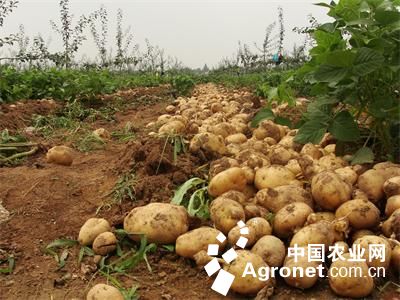
Liu Yiping once went to work outside the province because his hometown was poor. Many years later, firmly determined to return home and start a business, he went back to Daheishan. In 2003, he contracted 200 mu of land in the Miao Village Group of his hometown, introduced the cold-resistant and drought-tolerant potato variety "Hezuo 88," and organized villagers to plant it. He also carried out organic food certification and used his advantages as a broker to make Daheishan potatoes one of the main suppliers of processing raw materials for Yunnan Province's most famous "Zidi" potato chip company, even exporting them to Vietnam and turning them into "international potatoes." Over several years, he drove 20,000 mu of potato planting in Kafang Town, Gejiu City, making it a major local industry.
Xu Yongcai from the Qincaishan Village Group of Daheishan Village Committee told the reporter: "Liu Yiping not only led the villagers to become prosperous and increase their incomes, but also cultivated the villagers' concept of scientific planting, such as scientific seed selection, interplanting techniques, plastic film mulching techniques..."
The "Loss-Making" Philosophy of Planting Panax notoginseng
With the potato industry already developing steadily, Liu Yiping handed over the "Gejiu City Kafang Daheishan Potato Planting Professional Cooperative" that he had founded himself to the management of the Daheishan Village Committee. He then advanced toward his established ecological economic goals: ecological wild bee breeding, and the biological medicinal material Panax notoginseng.
3 years ago, he chose to plant 200 mu of green, pollution-free Panax notoginseng demonstration land deep in the Kafang mountains at an altitude of 1,800 meters.
According to his own practical experience and understanding, the higher the altitude at which Panax notoginseng is planted, the fewer the pests and the less pesticide used. This can achieve green, pollution-free production.
Recently, another patch of his Panax notoginseng land reached harvest season, but he encountered another slump in the Panax notoginseng market price.
He made a decision: he would not sell the Panax notoginseng, and moreover, as early as 3 months before harvest, he stopped applying pesticides.
He plans to use the Panax notoginseng he grew to develop traditional Chinese medicine decoction pieces. He said he can control the production and management of these biological medicinal materials and achieve pollution-free standards.
But this brings with it a large amount of tied-up capital, and stopping pesticide application 3 months before harvesting Panax notoginseng also directly affects its yield.
"Doing this is temporarily a loss, but once the deeply processed green, pollution-free traditional Chinese medicine decoction pieces are made, they will have great added value. This kind of ecological economy has more long-term significance and broader prospects," Liu Yiping said.