Tiny edible fungi pave the way for farmers to prosperity
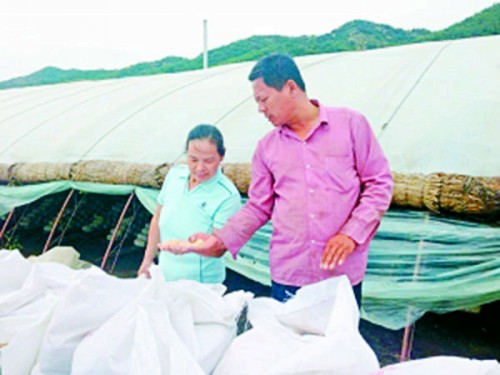
The photo shows Zhan Jiazhuang (right) instructing workers on oyster mushroom cultivation techniques.
The reishi mushroom spore powder in health supplements and the fresh mushrooms and wood ear fungi on the dining table may all be produced in your hometown - the edible fungi of Yingkou are of such good quality that you may not even know it. But Liu Zhihai, who has been growing edible fungi for 26 years, is an expert, so in May this year he deliberately came from his hometown of Jilin to Huangyakou Village, Jianyi Town, Dashiqiao City, and invested about 70,000 yuan to set up a reishi mushroom cultivation greenhouse.
For developing edible fungi cultivation, what advantages does the eastern mountainous area of Yingkou have? Liu Zhihai told reporters that edible fungi have high requirements for climate conditions and need a large temperature difference between day and night. He picked up a reishi mushroom and turned it over to the underside, telling reporters that this is the base plate of the reishi mushroom, and its color is golden yellow with relatively good quality. If the same reishi mushroom were cultivated in the Shandong area, it would be smaller than this one, and the base plate would be grayish-white and soft. Jianyi Town has a longer frost-free period than Jilin, so the collection period for reishi mushroom spore powder is longer. In Jilin, the collection period is from mid-July to the end of August, while in Jianyi Town the collection period can extend from mid-July to the end of September, nearly a month longer. Not only that, Jianyi Town is rich in oak wood resources, and oak wood is precisely the preferred raw log material for edible fungi cultivation.
With suitable temperature differences and temperatures and abundant raw materials, Liu Zhihai exclaimed that he had found the right place. This year, in a greenhouse covering more than 300 sq m, he cultivated 16,000 sticks of reishi mushrooms, with products exported to South Korea, and he expects to make a profit of 190,000 yuan this year from reishi mushroom spore powder plus reishi mushrooms. Talking about his plans for next year, Liu Zhihai said with a smile: "Next year, I'll build as many greenhouses in the yard as I can." But he also said that although Jianyi Town's natural conditions are good, its reputation is still not sufficient. This year, his base attracted customers from Xiuyan and Fushun to visit and inspect, and many nearby farmers have also been drawn to his project.
Zhan Jiazhuang of Huangyakou Village, Jianyi Town, has also deeply experienced in recent years the advantages shown by the small mountainous environment in edible fungi cultivation. He originally ran an auto repair shop in Dashiqiao City with two brothers. Last year, he responded to the town's call to return home and start a business, founded the Jingu Edible Fungi Professional Cooperative, put up 10 greenhouses, and planted 200,000 sticks of oyster mushroom spawn, which is what we locals often call fresh mushrooms.
"Growing fresh mushrooms in the mountains, how are the sales?" Hearing the reporter's question, Zhan Jiazhuang answered proudly: "No need to worry at all; what I worry about is not having enough goods. Now the Dashiqiao area alone needs more than 1,000 kg a day, and over in Anshan and Haicheng the goods are not even enough." He told reporters that Panjin is one of Liaoning's main mushroom production areas. Although the cultivation volume of edible fungi in the eastern mountainous area cannot compare with Panjin, most farmers in the mountainous area use freshwater cultivation, and the spawn sticks contain no sawdust, mostly corn cobs commonly seen in the eastern mountainous area. The oyster mushrooms that grow are short-stemmed and thick-fleshed with good quality, and many out-of-town wholesalers do not mind the distance and specially come to his place to get goods. Zhan Jiazhuang hopes to encourage more farmers to join the ranks of oyster mushroom cultivation, make the Jianyi oyster mushroom brand famous, and lead his fellow villagers to prosperity.
At present, more and more farmers in the eastern mountainous area of our city have seen the business opportunities contained in the edible fungi industry. An edible fungi industry belt radiating from the three villages of Huangyakou, Xiangfang and Yulong to the surrounding areas is taking shape, and the planted varieties also cover oyster mushrooms, shimeji mushrooms, wood ear fungi, reishi mushrooms and more. Farmers in the eastern mountainous area are relying on patient cultivation to let tiny edible fungi hold up the "golden umbrella" of prosperity.