Crab export tests: all 75 items passed
Shen Jianguo, who raises "Subiao" brand Changdang Lake crabs, has a signature line: "Exports need 75 tests? No matter how many more, I'm not afraid."
Starting in September, Shen Jianguo began turning down all kinds of invitations from relatives and friends to go out, and his reasons were always the same: too busy. This kind of refusal will continue all the way to New Year's Day. And rightly so, for a crab farmer, there is no busier time than harvest season.
80% of the crabs are exported, and what's even more impressive is that he sets the price
Every year, while some farmers are still asking around and worrying about where to sell their crabs, Shen Jianguo's "Subiao" brand Changdang Lake crabs have already locked in about half of their sales volume by the end of August, while the crabs are still molting. Moreover, he sets the base price every year, and customers can decide for themselves whether to accept it. These customers come from thousands of li away: Taiwan, China, Hong Kong, China, Japan, Singapore. Exports take up about 80% of the company's crabs each year, and only the remainder is sold domestically, with delivery service only and no storefronts. So even in Changzhou itself, it is very hard to find his crabs for sale on the market.
Unlike the vast majority of farmers who come from a "rural" background, Shen Jianguo was a staff member in the Jintan agriculture and forestry system in his early years, so he could be considered professionally trained. He gave up the iron rice bowl within the system and plunged headlong into the crab farming industry because of an accident: in the 1980s, a customer wanted to buy crabs, and Shen Jianguo, following his leader's instructions, went from pond to pond searching, only to find that although Jintan had so many lake surfaces, not a single person was farming crabs.
Shen Jianguo was certainly not the first to eat crabs, but he was definitely among the first in all of Changzhou to both farm crabs and sell them overseas. Doing crab exports requires real expertise. The European Union and Japan are well known for how detailed and strict their testing standards are for fresh agricultural products. Japan in particular can be called harsh. Facing Japan's 75 test items, Shen Jianguo was very calm: "75 items? No matter how many more, I'm not afraid!"
The test results were of course within expectations: all passed.
For his crabs to reach the dining table, they must go through one more step than others
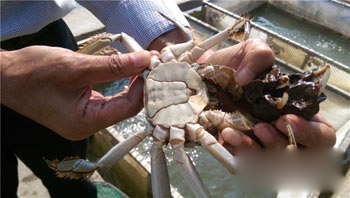
Being able to stay in the crab export business for 30 years is of course because of high quality. Shen Jianguo believes that high quality is not what people usually call green shells and white bellies, but is reflected in two aspects: first, being delicious, and second, being safe. Shen Jianguo said he has seen crabs raised by some peers and, to be honest, some are even better in quality than his own, but they are not "clean" enough. If crabs are to leave the farm perfectly clean, they need one extra step: being placed in a holding pond with uninterrupted oxygenation for 24 hours. During that day and night, the crabs keep absorbing oxygen, eating, and moving, and at the same time slowly expel the dirt from their gills and intestines. Crabs like this have snow-white gills and no mud in their intestines. After customers take them home, they only need to rinse them under tap water and they can go straight into the pot to be steamed or boiled.
That being the case, why are other farmers unwilling to hold the crabs for 24 hours? It is very simple: once the crabs expel the mud and become clean, they also lose weight, and weight directly determines a crab's "market value."
The 24-hour holding technique was first figured out by Shen Jianguo, and seasonal holding and micro-bubble aeration technology were also first proposed by him. Now over 60 years old, Shen Jianguo treats raising high-quality crabs as his lifelong pursuit. Today, he and his Jiangsu Changdang Lake Aquatic Products Technology Co., Ltd. are carrying forward this technology and teaching it to more farmers, hoping everyone can raise high-quality crabs.