Red-heart pomelo lifts Fengdu farmers' dream of escaping poverty and achieving prosperity
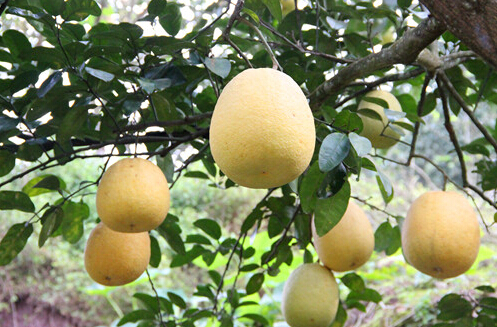
The pomelo trees are laden with red-heart pomelos
Fengdu red-heart pomelo has a cultivation history of more than 100 years. In the 1990s, starting from 25 mu of experimental fields, Fengdu opened the prelude to the great development of red-heart pomelo. After years of careful cultivation, in main producing areas such as Sanyuan, the red-heart pomelo has propped up half the sky for local farmers in escaping poverty and achieving prosperity, and the brand and reputation of Fengdu red-heart pomelo have become increasingly well known.
Red-heart pomelo becomes farmers' "money tree"
Another bumper harvest year, another year of fragrant red pomelo. In late autumn in Sanyuan Town, fruitful harvests are everywhere. By the roadside, red-heart pomelos can be seen piled up like small hills. In front of and behind houses, huge red-heart pomelos bend the branches, making tourists envious and also enriching the villagers.
Zong Pingfang is a villager of Maliu Village, Sanyuan Town, and also a typical poor household. Because her two daughters were attending university, the family relied on her husband's income from odd jobs and fell into a predicament of being unable to make ends meet.
"Since my daughters started high school, the family's income has not been enough to cover expenses. Before this year, the whole family still lived in an old earth-structured house halfway up the mountain," Zong Pingfang said.
Sanyuan Town has long had a tradition of planting red-heart pomelo. In 1992, Zong Pingfang's family began planting red-heart pomelo.
"At that time, red-heart pomelo did not yet have such a big reputation, and the varieties were not very good either. At first, we only planted one or two trees, grafting and improving them while expanding the scale, and in the past two years they have begun to generate returns," Zong Pingfang said. In 2008, Maliu Village developed red-heart pomelo on a large scale, distributing seedlings free of charge and providing technical training, and she also got on board this ride.
Today, Zong Pingfang's family has planted 4 mu of pomelo trees, with forty or fifty trees already bearing fruit.
Behind Zong Pingfang's house, in dry land and beside paddy fields, golden pomelos hang all over the branches.
Zong Pingfang told this writer that one mu of land can plant more than 30 pomelo trees, which bear fruit after 3 to 5 years. In a normal year, one tree can produce thirty or forty red-heart pomelos. A large one weighs close to 3 jin and can sell for more than 8 yuan, while even the smallest can sell for two or three yuan each. At an average of 5 yuan per red-heart pomelo, one tree can sell for about 200 yuan, and one mu of land can bring in an income of six or seven thousand yuan. With good management and care, it can be even more than that.
"Last year, this one tree alone sold for more than 800 yuan, and this year it will be no less than 600 yuan," Zong Pingfang said, pointing to a red-heart pomelo tree beside her. This year, with the money she had saved from planting red-heart pomelo, she bought a small three-story building by the road, and with the support of village officials, she also opened a small supermarket.
Hu Zhibo, Party secretary of Sanyuan Town, said that the fame of Fengdu red-heart pomelo is spreading farther and farther, and more and more people are coming to Sanyuan Town to buy red-heart pomelos. Poor people like Zong Pingfang will see their days become more and more prosperous.
Opportunities brought by the development of red-heart pomelo
Vigorously developing red-heart pomelo has brought villagers not only the economic income from selling pomelos, but also continuously improved infrastructure and unprecedented development opportunities.
Long Yingguo, 45 years old this year, was originally a registered poor household. His group, Group 2 of Miaoba Village, was also one of the earliest local bases for red-heart pomelo planting. Previously, like other villagers, he made a living by growing crops and worried every year about his two daughters' university tuition. But now, Long Yingguo is not only a major local red-heart pomelo grower, but also a major beef cattle breeder.
"In the past, the rural roads were not only hard for people to walk on, but cars could not get in or out, so nothing was easy to do," Long Yingguo said. Because the previous inconvenient transportation restricted local economic development, growing a few crops brought no economic income, and buying fertilizer and such all relied on carrying things on one's shoulders and back.
"In the past two years, in order to develop red-heart pomelo, our village has built village roads almost to people's doorsteps, and the industrial paths in the fields have also been hardened. When selling pomelos, customers drive themselves to pick them under the trees," Long Yingguo said. Since transportation improved, he had been thinking about how to increase income and become prosperous, and he successively planted more than 100 red-heart pomelo trees.
Red-heart pomelo growers all know that to grow red-heart pomelos with good taste and good appearance, farmyard manure must be applied. In 2013, Long Yingguo set up a beef cattle farm, using the cattle farm's manure to fertilize the pomelo trees, which not only ensured the quality of the red-heart pomelos but also prevented cattle manure from causing environmental pollution.
Last year, Long Yingguo's beef cattle farm sent 9 beef cattle to market, selling for more than 100,000 yuan, and red-heart pomelos sold for more than 20,000 yuan.
"Based on the current market, the output value of red-heart pomelo is expected to be more than 30,000 yuan. At present, the farm has 19 feeder cattle and 10 calves. My family's planting scale and breeding scale will both gradually expand, and I will certainly be able to build a career," Long Yingguo said.