Wood Ear Mushrooms Become the "Black Gold" That Enriches Farmers in Shangzhang Shanyin Village
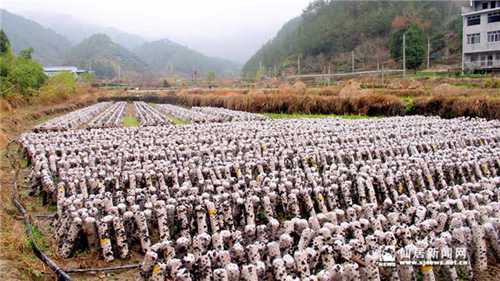
Currently, in Shanyin Village, Shangzhang Township, our county, the black wood ear mushrooms planted at the end of September this year are in their first harvest period. The villagers' phones keep ringing nonstop. Before November has even arrived, vegetable vendors from the county central market, Pan'an, Jingning and other places have already called to ask when this year's black wood ear mushrooms will be ready for harvest.
"Because our black wood ear mushrooms are good quality, reasonably priced and crisp in taste, after cooperating for a year last year, they came to us on their own this year. The vendors in Pan'an, for example, only want ours now. But affected by the weather, this year's harvest is far worse than last year's," said Zhou Yuanquan, the village's former party secretary, helplessly. The sharp drop in black wood ear mushroom production this year is a great worry for the villagers.
Even so, the villagers of Shanyin Village remain enthusiastic about growing them. "Even if this year's harvest is poor, we won't give up growing black wood ear mushrooms. This year we'll wait for Professor Chen to come and help us find the problem, and then make double the money back next year," the villagers said one after another. In their eyes, black wood ear mushrooms are the "black gold" for getting rich.
From Raising Fish in Rice Paddies to Growing Black Wood Ear Mushrooms in Rice Paddies
Shangzhang Township is a mountainous township of nine parts mountain, half a part water and half a part field. The villagers of Shanyin Village live off the mountains, preserving the natural rhythm of spring plowing and autumn harvest. Under the government's guidance, Shanyin Village chose ecological agriculture as the breakthrough point for farmers to get rich, vigorously developing ecological agricultural varieties suited to the village's actual conditions: raising fish and soft-shelled turtles in rice paddies, high-mountain bayberry, chestnuts, organic rice, honey peaches, pears, grapes... Here the fragrance of melons and fruits fills the air all year round, and the industries that enrich and increase the income of farmers have grown ever more diverse with the guidance of science and technology. A path of sustainable agricultural development with mountain-area characteristics is flourishing.
Since 2013, changes have come to Shanyin Village. The bare rice paddies of the slack farming season are gone, replaced by segments of black wood ear mushroom spawn embedded in the fields.
It turns out that starting in 2013, Shanyin Village, as a third-batch provincial-level science and technology demonstration village for new rural construction, began taking the "Demonstration and Promotion of the Construction of an Ecological Edible Fungus Circular Industry Chain" as the village's main science and technology demonstration project. To ensure the smooth implementation of the project and achieve the due economic, social and ecological benefits, Professor Chen Zaiming, a science and technology special commissioner from Zhejiang University stationed in Xigang Township of our county, was entrusted by the county science and technology bureau to make comprehensive, scientific and detailed arrangements for Shanyin Village's black wood ear mushroom cultivation.
"In 2013, villagers in our village who were interested in growing black wood ear mushrooms also went many times to Jingning, Longquan, Pan'an and other places to investigate, and all felt that the benefits of black wood ear mushrooms were good," introduced Zhou Wenchao, the village clerk. Under such circumstances, in the first year, the village collective began trial cultivation with a try-it-and-see attitude. What the village cadres never expected was that the 35,000 segments of black wood ear mushroom spawn they planted brought in an income of more than 100,000 yuan. For farmers idle at home during the slack season, this was undoubtedly a good way to get rich.
Under the guidance of Professor Chen Zaiming, in 2014 the villagers of Shanyin Village were highly motivated, and the number of fungus bags increased to 100,000 segments, which were distributed to the farming households.
That year, Zhou Yuanquan planted 4,500 segments. Thanks to sound management and smooth sales channels, in 2014 Zhou Yuanquan and his wife earned 15,000 yuan. "This is something we never even dreamed of before. Rice paddies can also grow black wood ear mushrooms, and the benefits are so high." Zhou Yuanquan, who had gotten his first taste of success, was grinning from ear to ear. This year, Zhou Yuanquan's cultivation scale has expanded to 12,000 segments. At present, there are already 8 black wood ear mushroom growers in the village like Zhou Yuanquan.
It is understood that this year, the number of fungus bags in Shanyin Village has reached 300,000 segments, with a total planting area of 30 to 40 mu. Compared with other places, the black wood ear mushrooms harvested in Shanyin Village are much darker in color and more substantial. Although they started late, the black wood ear mushrooms grown in this village are in short supply on our county's market.
Good Mountains and Good Water Give Birth to Good Wood Ear Mushrooms
On the morning of July 11, when the reporter walked into the inoculation room, 36 m long and 20 m wide, they saw segment after segment of fungus bags stacked together, row after row, quite a spectacular sight. In front of each wooden inoculation box there was no one, only electric fans swinging hard and blowing. Zhou Yuanquan explained: "Because the inoculation temperature must be kept below 25°C, the inoculation workers generally work at night and rest during the day."
To ensure the fungus bags are sterile, before inoculation the inoculation boxes, inoculation tools and spawn bags must be disinfected, and the workers' hands must also be disinfected with Xinjie'er solution. At the same time, to guarantee quality and quantity, the inoculation work was all done by seven inoculation workers from Jingning County, Lishui, over the course of a month.
"Whether the black wood ear mushrooms grow well in the later stage depends to a large extent on whether there are contaminating bacteria in the fungus bags," Zhou Yuanquan said.
Starting from September 20, villagers have one after another placed the black wood ear mushroom spawn segments into the rice paddies that had just been harvested. The farmers, who have been busy on and off for nearly a month, can now sit back and wait for the harvest. Black wood ear mushrooms are not afraid of sun or frost, nor do they need pest control, and their relatively long growth period allows the villagers to keep harvesting until mid-April next year.
In fact, black wood ear mushrooms need a large temperature difference to grow well. They can grow quickly at temperatures above 15°C and stop growing below 5°C. The climate conditions of Shanyin Village are just right for the growth of black wood ear mushrooms. Being purely natural and pollution-free is the greatest advantage of the wood ear mushrooms cultivated in this village.
After two years of implementation, the black wood ear mushroom growers have summed up a relatively complete set of cultivation and management practices, and at the same time improved economic benefits. It is understood that ordinary dried wood ear mushrooms from this village generally sell for 30 to 40 yuan per jin, while the better ones can reach 60 yuan per jin, and the wholesale price of fresh black wood ear mushrooms is around 3 yuan.
The villagers did the math for us: "One mu of field can hold 6,000 to 7,000 segments of fungus bags. Last year the net profit per segment of fungus bags was about 4.5 yuan, so one mu of field can increase income by at least 20,000 yuan."
Although the construction of Shanyin Village's "ecological black wood ear mushroom circular industry chain" has just started, and the villagers are at a critical stage of growing their way to wealth, with the on-the-ground application and guidance of science and technology, Shanyin Village will surely become a phoenix.
Science and Technology to the Countryside Benefits Farmers, Supports Wood Ear Mushroom Cultivation
"Actually, we also have to thank the science and technology bureau for being able to reach such a scale. The relevant leaders of the science and technology bureau attached special importance to our village's black wood ear mushroom industry. Not only did they help our village apply for science and technology projects and strive for science and technology funding from higher levels, they also specially connected us with Professor Chen Zaiming of Zhejiang University to provide technical support for us growers and solve the practical problems we encountered in the growing process. Starting from 2013, for three consecutive years, we have had 250,000 yuan in science and technology support funds each year for equipment investment. It is precisely because of the strong support of government departments that we have the confidence to grow black wood ear mushrooms well," Zhou Yuanquan said with emotion.
With the expansion of the planting area, Shanyin Village has strengthened its management of black wood ear mushroom cultivation and its investment in equipment and sites. This year, the village built nearly 2,000 sq m of iron sheds for black wood ear mushroom inoculation and fungus cultivation. At present, the fixed assets used for the black wood ear mushroom cultivation project in the village have reached more than 2 million yuan.
Walking to the village's black wood ear mushroom production base, a plaque reading "Zhejiang Provincial New Rural Science and Technology Demonstration Site" hangs high on the porch. Material mixers, bagging machines, bag-notching machines, sterilization boilers, sterilization pools, inoculation boxes... all kinds of huge automated machines stand prominently before one's eyes.
According to Zhou Yuanquan, the raw material preparation, crushing, sterilization and inoculation of black wood ear mushrooms are all carried out through these machines, and some of the machines have achieved automation. The roof of the adjacent cultivation shed can effectively lower the temperature inside through automatic spraying, and the shed's good light-blocking and ventilation properties also improve the resistance of the mycelium.