Free-range native chickens in a yellow pear orchard recover costs in a short time
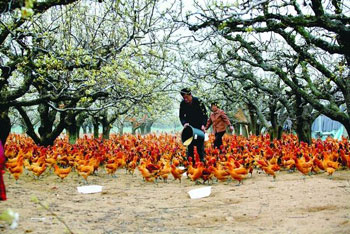
In late autumn, the corn has long since been harvested and stored away, and the wheat has already sprouted inch-long new shoots. At the yellow pear planting base of the Chuangyi Planting and Breeding Professional Cooperative in Yuanlu Village, Longwang Township, Funan County, 200 mu of late-autumn yellow pears bore fruit for the first time this year, and the harvest season has only just begun.
200 mu of yellow pears bear fruit for the first time
Walking about 400 m west from the Longwang section of Provincial Highway 202, the crowing of roosters rises and falls from the pear grove from afar. Looking toward the grove following the crowing, the bagged late-autumn yellow pears appear indistinctly among the dense branches and leaves.
"This is the first year of fruiting, with the highest yield per mu reaching 2,000 jin, and the current wholesale price is 2.5 yuan per jin." Dai Xianchun, head of the Chuangyi Planting and Breeding Professional Cooperative, told this writer that these 200 mu of late-autumn yellow pears were planted in November 2012 and have begun to show returns this year. Judging from the current harvest situation, this year's total output should be around 200,000 jin. Now, the cooperative hires more than 30 workers every day to pick and pack, and the picked yellow pears generally sell out the same day, with demand exceeding supply on the Lu'an market.
"This is the first year of fruiting, and only six or seven fruits were kept on each tree, in order to ensure the normal growth of the trees." Dai Xianchun introduced that these 200 mu of late-autumn yellow pears are only four years old and have just entered the full fruiting period. Few fruits were kept this year, and next year's output is expected to exceed 1 million jin.
Selenium-enriched yellow pears sell well
At the Chuangyi Planting and Breeding Professional Cooperative, workers are busy loading the packed late-autumn yellow pears into boxes printed with the words "selenium-enriched yellow pears," while a truck with a Lu'an license plate waits nearby to be loaded.
"A buyer from Yu'an District ordered more than 5,000 jin of yellow pears. They are being loaded now and can enter the wholesale market tonight." Dai Xianchun told this writer that, unlike Miaoji, Lucheng and other townships, which mainly target the Shanghai fruit wholesale market, the cooperative's yellow pears are mainly sold to cities within the province. Previously, he signed a letter of intent for late-autumn yellow pear sales with the Sijilv Ecological Agriculture Professional Cooperative in Yu'an District, Lu'an City. The wholesale price of selenium-enriched yellow pears is 3 yuan per jin, and that of ordinary yellow pears is 2.5 yuan per jin. Because organic fertilizer was used throughout the growth of the yellow pears, in addition to being large, brightly colored, and having small cores and no grit, their sugar content is as high as 13.8. Among them, the selenium content of selenium-enriched yellow pears reaches 20-22 micrograms per kg, 10 times that of ordinary pears, with very obvious health benefits, and they are very popular on the Lu'an market.
It is understood that the Sijilv Ecological Agriculture Professional Cooperative specifically marks basic information such as the brand and place of origin of Dai Xianchun's late-autumn yellow pears on the packaging boxes, making it convenient for consumers in the Lu'an area to identify them.
Three-dimensional planting and breeding brings high benefits
While planting late-autumn yellow pears, Dai Xianchun also intercropped watermelons and raised native chickens among the trees, recovering the land transfer cost in a short time and also creating relatively high economic benefits.
During the interview, Dai Xianchun received calls from out-of-town buyers from time to time ordering native chickens and native chicken eggs. "Most of the more than 70,000 native chickens raised under the forest were sold around the Mid-Autumn Festival, and the native chicken eggs will take some time before they come onto the market." Dai Xianchun told reporters that the 4,000 breeding chickens previously selected can be mated before the Chinese New Year, and after the New Year the hatched chicks will have the roosters selected for free-range raising under the forest, while the hens will be raised intensively in cages, mainly to produce native chicken eggs. Now, native chicken eggs are in very short supply on the southern market, and many buyers call every day to place orders, with some even asking to pay part of the deposit in advance to buy native chicken eggs at a high price.
It is understood that starting in the spring of 2013, Dai Xianchun intercropped watermelons in the yellow pear base, and the operating cost could be recovered that same year. "The watermelons, peppers and scallions intercropped this year were in short supply throughout the market period, bringing an extra income of 3,000 to 4,000 yuan per mu. After deducting the land transfer cost and labor cost, there was still a considerable surplus." Dai Xianchun said.