For beef cattle, quality depends on pasture; master the techniques and you will have more confidence in farming
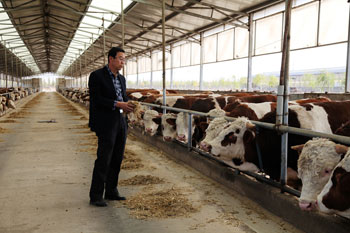
He succeeded in experiments on improved crossbred cattle farming in Gansu's Xiza, corn green hay preparation, and innovated silage technology. He undertook trials and demonstrations of 23 key tasks and forward-looking tasks, including national and Gansu's "beef cattle crossbreeding combination screening" and "cow-with-calf nutrition supply technology," introduced new breeds including Germany's "Fleckvieh," America's black "Angus," and Japan's "Wagyu," carried out "two-way" and "three-way" crossbreeding of "Zhangye beef cattle," and simultaneously carried out breeding of a new "cow core herd" group of "Zhangye beef cattle," making a positive contribution to the breeding of the Zhangye beef cattle group. He is Zhu Yueming, chairman of Zhangye Wanhe Forage and Livestock Industry Technology Co., Ltd. and station chief of the "Zhangye Comprehensive Experimental Station" of the National Beef Cattle and Yak Industry Technology System. The farm he founded covers an area of 6500 mu, with 22 standardized double-row cattle barns, 9 forage silage and ammoniation pits, and a warehouse and feed processing workshop of 1900 sq m. It has 8000 beef cattle on hand and 15000 marketed per year, making it the city's largest demonstration enterprise for beef cattle breed selection and standardized breeding. From a layman to a veritable livestock expert, he has spent 27 years practicing the life ideal of getting rich through science and technology and leading his hometown people to start businesses and strive for a moderately prosperous life.
Zhu Yueming, now 53 years old, was originally a recruited cadre in the economic committee of Chang'an Township. A plain life sparked his idea of starting a business. In 1988, at the age of 25, Zhu Yueming gave up his job and embarked on the path of entrepreneurship. After several years of accumulating funds through work, in 1997 Zhu Yueming began raising sheep in his own backyard, from the initial dozens to several hundred, gradually reaching scale. In 2002, he discovered that the Shigangdun wasteland was vast and suitable for breeding. In order to expand the scale, Zhu Yueming began developing 1100 mu of wasteland and registered and established Zhangye Wanhe Forage and Livestock Industry Technology Co., Ltd., raising funds to build sheep sheds and silage and ammoniation pits, and raising more than 2200 meat sheep. In 2004, it was listed as an agricultural science and technology breeding demonstration farm supported by the Ministry of Agriculture.
The good times did not last long. In 2006, affected by the market, meat sheep breeding declined, and over the year he nearly lost all his previous accumulated funds. "The peers who had come together to reclaim wasteland and do breeding all ran away, leaving only my family. If I gave up, my life would be over, so I could only grit my teeth and move forward." Zhu Yueming recalled. At this life-and-death moment, Zhu Yueming's two younger brothers, who originally worked at a bank, gave up their jobs and joined the company's team. With the support of family and the injection of funds from his younger brothers' buyout of their working years, the company's development gained new hope.
Failure is the mother of success. With the lessons of previous failures, Zhu Yueming concluded that beef cattle breeding requires large investment but is relatively less affected by market fluctuations, and having his own pasture would reduce breeding costs, so the company decided to begin raising beef cattle and reclaim large areas of wasteland to plant forage and livestock feed. In 2007, Zhu Yueming led his team to expand the breeding scale while building a forage and livestock base. The construction of the ten-thousand-head beef cattle farm project of Wanhe Forage and Livestock Industry Co., Ltd. that he founded was fast, built and put into production in the same year. At the same time, the farm had a high degree of standardization, reasonable planning and layout, and complete hardware facilities and equipment. It was designated as the leading enterprise for the city's beef cattle development and also provided an experimental platform for experimental research on the beef cattle industry. After two years of hard work and development, the company's breeding scale grew larger and larger. In 2008, it was approved by the Ministry of Agriculture and the Ministry of Finance as the supporting unit of the "Zhangye Comprehensive Experimental Station of the National Beef Cattle and Yak Industry Technology System," and Zhu Yueming was hired as the station chief of the "Zhangye Comprehensive Experimental Station of the National Beef Cattle and Yak Industry Technology System." In order to give play to the role of this platform, Zhu Yueming led the company to establish long-term production, study, and research cooperation relations with China Agricultural University, the Lanzhou Institute of Animal Husbandry and Veterinary Medicine of the Chinese Academy of Agricultural Sciences, Northwest A&F University, and Gansu Agricultural University. From March 15 to 17, 2014, the team of post expert Yan Ping and the team of Zhu Yueming at the Zhangye Comprehensive Experimental Station jointly carried out a beef cattle backfat measurement experiment at the Zhangye Comprehensive Experimental Station. Before the experiment, station chief Zhu Yueming introduced in detail the beef cattle production model of the experimental station, focusing on cow-with-calf production, beef cattle fattening, and calf rearing. Subsequently, the post and station jointly selected 51 Xiza crossbred beef cattle aged 17 to 18 months for the backfat measurement experiment. On the basis of measuring body weight, veterinary B-ultrasound was used to measure the backfat thickness and ribeye area of the 51 Xiza cattle, and the fat content of the beef cattle was calculated by combining the 3 indicators. The marbling of Xiza cattle was analyzed, and the meat production performance of Xiza cattle in the Hexi region of Gansu Province was preliminarily evaluated. Through experimental demonstration, the Zhangye Comprehensive Experimental Station preliminarily established the Zhangye beef cattle production model, and the beef cattle fattening benefit was remarkable.
Zhu Yueming, successful in his career, did not stop his pace of innovation. Through decades of hard work, Zhu Yueming found that the biggest difference between domestic and foreign beef cattle breeding is not the breed of beef cattle, but the pasture. "We can absolutely import excellent breeds from abroad, but we cannot compare with the vast pastures like those in the United States and Australia. We do not have such large pastures, so the cost of beef cattle breeding has always been high, causing domestic beef prices to remain higher than foreign ones. To solve this problem, we can only work hard on pasture planting." In order to increase forage yield, Zhu Yueming put in great effort, trial planting various varieties of corn. In 2014, after several years of trial planting and comparison, he found that the new forage No. 12 produced by ** could yield 10.8 tons of forage per mu, more than 2 times higher than the previous 4 tons per mu. "Previously, one mu of land supported one cow. Now one mu of land supports two cows, reducing feeding costs by two-thirds." In recent years, Zhu Yueming has connected tasks with 9 post experts in the beef cattle and yak industry technology system, undertaking trials and demonstrations of 23 key tasks and forward-looking tasks such as "beef cattle crossbreeding combination screening" and "cow-with-calf nutrition supply technology," introduced new breeds including Germany's "Fleckvieh," America's black "Angus," and Japan's "Wagyu," carried out "two-way" and "three-way" crossbreeding of "Zhangye beef cattle," and simultaneously carried out breeding of a new "cow core herd" group of "Zhangye beef cattle." A number of substantial papers by Zhu Yueming, including "Analysis of Causes and Prevention Countermeasures of Anestrus and Infertility in Zhangye City's Beef Cows" and "Current Situation and Reflections on the Industrialization Development of Animal Husbandry in the Hexi Agricultural Region," were published in journals such as China Cattle Science, making a positive contribution to the breeding of the Zhangye beef cattle group.
Through many years of breeding work, Zhu Yueming found that because he did not understand breeding technology, he was very passive at critical moments. "We often had to look everywhere for livestock experts to solve some small breeding techniques and difficulties we encountered, which wasted time and energy and was also very inconvenient." So he studied on his own, learning various breeding techniques, epidemic control, and other animal husbandry knowledge. Over several decades, without realizing it, he had become a livestock expert. Now, Zhu Yueming insists on studying for 2 hours every day, learning the latest animal husbandry knowledge and developments, to serve the company and more breeders. In breeding, Zhu Yueming found that every autumn, when making silage, a lot of water seeped out of the ammoniation pit, not only causing the loss of some forage nutrients but also increasing feeding difficulty. In order to overcome this problem, Zhu Yueming traveled to major surrounding farms and communicated with domestic livestock experts. He conceived whether adding a plant that can dissolve in water and can be eaten by cattle would work. He acted as soon as he thought of it. In 2013, Zhu Yueming boldly crushed wheat straw and added it to the silage material. The experiment found that wheat straw could not only absorb water but also contained protein needed by animals. In 2014, Zhu Yueming experimented with crushing corn cobs and adding them to the silage material, and found that the effect was even better than the previous wheat straw, as it could not only absorb water but also had higher nutritional value. Having overcome this problem, the nationally famous Qianjin Dairy Farm and surrounding large cattle-raising households all learned and promoted it, and Zhu Yueming's beef cattle breeding path became wider and smoother. He told reporters that this technology is currently applying for a patent.