Yunnan student sells native pigs: reliable even without a Peking University degree
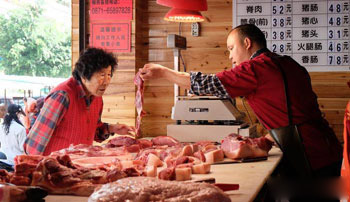
Photo: residents buying pork
On November 5, at the Jiaowu Alley farmers' market on Jiaochang Middle Road in Kunming. Standing at the entrance of the Yi family native pig shop, Bai Yang once again expertly launched into a folksy sales cry: "Yi family native pigs, authentic native pigs, tasty and affordable, green and safe."
Bai Yang is a typical post-85, and close friends jokingly call him "Pig Commander."
Villagers thought this kid was unreliable
As high-yield farming has been promoted in recent years, breeds such as Yorkshire and other Landrace pigs have gradually squeezed into the market, and the slow-growing black-haired native pigs have almost disappeared. However, after comparing flavors time and again, many people began to miss the taste of the old breeds. Bai Yang, who lives in Xichou County, Wenshan Zhuang and Miao Autonomous Prefecture, Yunnan, started raising "black native pigs" because of a single remark from a neighbor.
When he was 18 and just starting university, Bai Yang sold the family's ancestral home and started a computer business in Dali, earning his "first pot of gold." But after 2008, computer market prices became increasingly transparent, competition grew fiercer, and business became harder and harder. Financial investment, the grain industry, construction and decoration companies - Bai Yang moved through many industries, but business remained lukewarm.
After the "lean meat powder" scandal, many people turned pale at the mention of "pork," and Bai Yang thought back to the taste of the pork from his childhood hometown. Bai Yang recalled that in his hometown of Xichou County, every household once raised black-haired native pigs. At that time, one village alone had nearly 600 local native pigs and more than 20 breeding pigs, and other villages were about the same, with roughly one native pig per person. "Every time we slaughtered the New Year pig to drink paotang soup, ate the New Year's Eve dinner, or celebrated the Dragon Boat Festival, the aroma of native pork filled every village in my hometown."
"In 2013, I heard people in the village say that the old-breed pork from years past still tasted better, and that today's feed-fed pork was too coarse and just didn't taste the same. At that time I thought maybe I could get old-breed pig farming going," Bai Yang said.
To help more people preserve the taste of childhood, he decided to turn the black-haired native pigs of his hometown into an industry, beginning the conservation and breeding of native pigs and the industrialized development of high-end pork farming. But when Bai Yang excitedly told his family the idea, he met strong opposition, and some villagers even mocked him for having "wasted his university education."
"Friends said I was trying to ruin the family! Some also joked, 'Do you think you're the pork prodigy from Peking University? Too unreliable,'" Bai Yang said.
Figuring out feeding to make the pigs strong
"This old breed is actually very easy to raise, especially since it has good stamina and extremely strong cold resistance and disease resistance." Bai Yang said that after raising black native pigs for two years, he was close to becoming a professional veterinarian.
Feed formulation is also quite simple. Wheat bran plus corn, plus soybeans, and then green feed. Bai Yang said wheat bran builds the frame, corn builds meat, and soybeans add nutrition. "In years past, people didn't even have grain to eat, let alone pigs, so the pigs they raised always refused to grow. Now that grazing is better and there is grain to feed them, the old-breed pigs grow just as readily. Look, the pigs on this mountain have been fed for almost a year, and although they still weigh less than 200 jin, they are green, healthy, and the taste goes without saying."
Once he had farming experience, Bai Yang signed purchase agreements with farmers in his hometown, following a "company + farmers" model to expand the supply of live pigs: Bai Yang's company provides capital, breeding pigs, raising methods and veterinary services, while farmers are responsible for selling the pigs to the company after they are ready for market.
Gradually, pork production rose, but market sales channels had not fully opened up, which worried Bai Yang badly. "At the time there were more pigs, but nowhere to sell them," said Chen Xingzhou, who was in charge of sales at the company.
Bai Yang's black native pigs grew to more than 200 jin, but at the time pig buyers in Fengjie refused them, saying their bellies were too big and it wasn't worth it. It was like a bolt from the blue. He had never expected that the black native pigs he thought were hot commodities would be unwelcome. What was to be done with the pigs in the farmers' hands and at the base?
The market forced the young team to find a way to sell pigs
Bai Yang called his employees together to discuss. "The company's management team is all post-85, and quite a few are post-90. Everyone sat for three days but just couldn't find a suitable way out. In the end, everyone suggested slaughtering 15 pigs first and making them into cured meat and sausages to give away."
All 15 black native pigs were slaughtered and taken to Kunming for residents to taste. Everyone said they had once again tasted the flavor from many years ago: the meat was tender but not greasy, with a rich aroma. Some residents even asked us, "Why not open your own shop in the market?"
Just like that, everyone's thinking gradually opened up. Bai Yang and a group of recently graduated university students busily searched shop by shop in markets across Kunming, and in just over a year they opened 7 fresh meat direct-sales stores in Kunming's markets. Suddenly the native pigs had a sales channel, and the market opened up.
"At the time we never expected everyone to like these black native pigs so much! After the direct-sales stores opened, some residents told us, 'You could build the entire native pig industry chain and make some specialty gift boxes too.'" said Lu Chen, a post-85. Their company currently uses a secret smoking technique to make uniquely flavored native pig cured meat, has also registered a green brand, and has opened a cured meat and sausage processing plant. Now sales are getting better and better.
"Next I want to get an online store going, and also open restaurants related to native pigs. I also have an idea for Yi family native pig adoption. In the future, using ear tag and ear tag technology, and strictly following the national operating standards for organic pig farming, we will track and record each pig's pedigree, weight, epidemic prevention, feed and grazing conditions around the clock and at all times."
"If everything can get off the ground, people living in the city can adopt a piglet and remotely follow what it eats and drinks every day and in what kind of environment it happily grows for 365 days. In the end, of course, it will also become your most delicious dish, letting you recall the taste of childhood and relive childhood memories," Bai Yang said.