She never gave up on snake farming, and treated the snakes as if they were renminbi
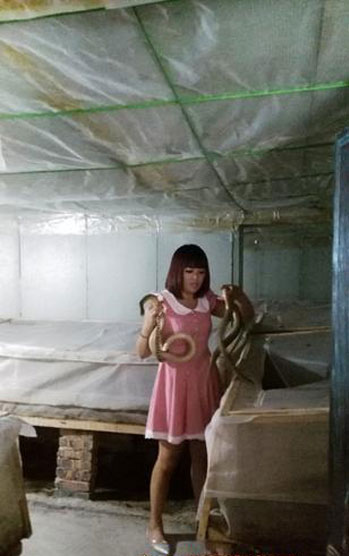
The place where Zhou Hongmei farms snakes
Two snakes over one meter long flicked their tongues and kept coiling around Zhou Hongmei's hands. The head of one of them even touched her neck and came close to her face. But to Zhou Hongmei, these snakes are like toys, and she is not afraid of them at all. On the contrary, they have also become the way for Zhou Hongmei to realize her dream of starting a business and getting rich.
Blazing a new trail: a post-85 woman gets rich by farming snakes
In Taiping Village, Yuying Town, Luojiang County, Zhou Hongmei built a three-story small building. The building was originally meant for people to live in, but now it has become a gathering place for snakes. More than 4,000 non-venomous snakes are kept here, mainly rat snakes, with a small number of king ratsnakes, commonly known as cauliflower snakes.
It is understood that Zhou Hongmei, born in 1986, once studied to be a chef and ran a restaurant and a nail salon. Later she returned home to start her own business raising rabbits, but due to market factors she ultimately lost money, so she decided to blaze a new trail and raise other animals.
"Once market sales are good, many people will follow the trend and raise rabbits, which ultimately causes rabbit prices to fall," Zhou Hongmei said. Farming snakes is not like that, because many people are still afraid of snakes, so very few raise snakes, and the market prospects should be good too.
Zhou Hongmei learned about snake farming through a TV program, then went to Guangxi for an inspection and bought more than 200 snakes to transport back to Deyang to raise. However, during transport, nearly all of the more than 200 died, and only 7 arrived safely in Deyang.
Not only that, Zhou Hongmei also suffered two setbacks. One was being scammed out of the money she used to buy snakes, and the other was that because workers were lazy and did not patch the holes in the snake house, many snakes "escaped from prison."
Repeated failures did not make her give up. Zhou Hongmei ultimately persevered, and once she started farming, it lasted three years.
Annual profit reaches 400,000; this year she plans to raise 10,000
When people see snakes, many keep their distance, and Zhou Hongmei is no exception. At first she was also very afraid.
"When I was little and picking tomatoes, I was frightened by a snake," Zhou Hongmei said with a smile. The biggest difficulty in snake farming is overcoming the psychological barrier, but as soon as she thinks that these snakes are renminbi, assets for starting a business and getting rich, she is no longer afraid, and by now she has gradually gotten used to it.
Even if she is bitten, Zhou Hongmei does not worry too much. "I have been bitten many times. Each time, washing with soapy water and disinfecting with alcohol is enough."
It is understood that steeping snakes in liquor can be used to treat rheumatism, while the snakes Zhou Hongmei raises are mostly sold as meat products to Guangdong and other coastal areas.
"The monthly investment is about 10,000 yuan," Zhou Hongmei said. The cost of snake farming is indeed high, but the profit is also relatively considerable. A three-jin snake can be raised in one year, and can be sold in as little as 10 months. It can sell for more than 300 yuan, with a profit of more than 100 yuan, and in good times it can even reach 200 yuan.
At present, Zhou Hongmei's farming area has reached 500 sq m, with more than 4,000 snakes raised, and annual net income has reached more than 400,000 yuan. But Zhou Hongmei is not satisfied with the status quo. She also plans to further expand the scale, raising 10,000 this year and 20,000 next year.
"I also have a farm in Deyang, and it is almost fully renovated now," Zhou Hongmei said. In the future, she will also use the newly established farming cooperative to introduce some snake breeds with low input and high returns, and lead more women friends into the special breeding industry to achieve common income growth and prosperity.