Nan Chong contractor switches to farming, drives a car to work in the fields
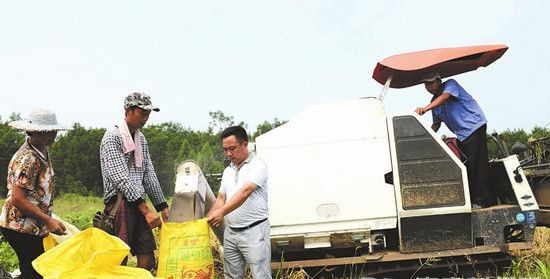
On October 27, at the grain collection site of the Sichuan Yingshan National Grain Reserve, a reporter saw a middle-aged man of medium height and slightly plump build pull up with a large truckload of rice. After inspection, weighing, and storage, he received the money handed to him by the staff.
"For nearly a week, I have been selling rice every day, more than 30 tons a day. In a little while, I will sell another two or three hundred tons of rice!" said this large-scale grain grower named Peng Xu to the reporter.
1 Returning home to start a business: a contractor switches to growing grain
Peng Xu was born in 1974 in Xingfu Village, Sanyuan Township, Yingshan County. After graduating from high school, he was hired to work in public security at the Sanyuan Township public security office. After working there for 5 years, carrying a dream of getting rich, he went south to Guangdong to seek his fortune. Because he had no specialized skill, he tasted all kinds of hardship. In 2003, Peng Xu took his wife to work at a coal mine in Henan. After a period of hard struggle, he later became a contractor. While digging up his "first pot of gold," he also accumulated some management experience.
In 2011, as the coal industry gradually declined, Peng Xu returned to his hometown and drove a taxi in the county seat. Often driving to the countryside, he found that a large number of young and middle-aged laborers in rural areas had gone out to work, and stretches of farmland had been left abandoned. Peng Xu felt that growing grain did not require a large investment and brought quick results. Although it did not make as much money as operating other industries, it did not carry major risks, so he developed the idea of returning to the countryside to grow grain.
When Peng Xu told his family about this idea, he received their understanding and support. However, when relatives and friends learned the news, they poured cold water on it: returning to be a farmer at such a young age, what kind of achievement is that? Could you really dig "golden eggs" out of the soil? "My ancestors for generations have all been farmers. Now that I am returning home to be a new type of farmer, I should feel proud," Peng Xu said. In recent years, the state has introduced incentive policies for large-scale grain growers, which made him even more determined to return home to grow grain.
He acted as soon as he decided. In December 2014, he transferred 4000 mu of land in 6 townships including Langchi, Xinghuo, Shuangxi, and Yongquan to grow grain.
2 Enduring hardships: large-scale farming yields a bumper harvest
"With so much land to farm, how do you manage to keep up?" Faced with the reporter's question, Peng Xu explained: "Thanks to the agricultural machinery subsidy policy, I bought 6 large tillers, 20 diesel engines and sprayers, and more than 30 sprayers. I use a rice transplanter to plant seedlings and a combine harvester to harvest rice. The whole process from planting to harvesting is mechanized, which improves labor efficiency. Professional plant protection teams also prevent and control pests and diseases on these transferred fields."
Peng Xu said that in January this year, he established a company engaged in growing crops such as rice and rapeseed. But the road of entrepreneurship was not smooth sailing. In May this year, because there was too little rain, Peng Xu had to keep pumping water with water pumps in order to plant seedlings on more than 1000 mu of fields in Xinghuo Town and Xiqiao Town. "That period was very hard. We had to pump water day and night. I had to drive to the fields at more than 5 o'clock every morning and did not return home until late at night. After a few hours of sleep, I had to start another day's work," Peng Xu said.
In late July this year, the county experienced continuous high temperatures and little rain, and some rice fields in Xinghuo Town dried up. Although he spent more than 50,000 yuan on water pumping fees, the rice still faced the prospect of total crop failure. Peng Xu lost his footing and went to the county water affairs bureau to report the situation. The relevant person in charge of the bureau decided to release water from the reservoir to rescue the dying rice. Because the water was replenished in time, the vast majority of the rice was saved.
During the autumn harvest season, the reporter came to Group 2 of Xinhe Village, Xiqiao Town, and saw large combine harvesters speeding through rice fields that stretched beyond sight, with "rice waves rolling" wherever they went. "My son works in Shenzhen. I suffer from rheumatoid arthritis and live at home with my wife. I rented more than 3 mu of land to Boss Peng and got 1200 yuan in rent. I planted 1.5 mu of crops myself. Good!" said Xian Zhongren, a villager in his sixties, to the reporter. This area used to have quite a lot of abandoned fields, and they were reclaimed with rotary tillers!
"When the rice matured in early September and I saw the heavy ears of rice, I felt especially gratified and thought that no matter how hard or tiring it was, it was all worth it," Peng Xu said. This year's rice harvest was excellent, with output of nearly 2000 tons.
3 Scientific development: growing pollution-free rice
"Peng Xu is a new type of farmer who drives a car to the fields and wears leather shoes to grow grain," said the relevant person in charge of the Yingshan County Agriculture and Animal Husbandry Bureau in this evaluation.
Peng Xu said that his company has a group of highly skilled agricultural technicians and an efficient management team. This year, he hired a professional manager to take full responsibility for coordinating all links in production and to inspect and urge whether each management post is carrying out its duties properly; a logistics manager to provide material support for frontline production; on-site management personnel to handle problems in production on the spot; county agricultural technology experts, plant protection station experts, and professional technicians from the soil and fertilizer station to check technical matters; a agricultural machinery team of more than 20 people to carry out tilling, seedling planting, and harvesting on a per-mu piecework basis, with timely payment after passing inspection; and nearly 40 field management personnel responsible for weeding, fertilizing, and water management.
Because the company operates well, the first year of grain growing achieved initial results. "Right now, I am selling the harvested rice through multiple channels. In addition, I am negotiating cooperation with Nanchong sellers and preparing to carry out online sales through e-commerce platforms. Now the national policies are good, and growing grain is sweet and motivating." Peng Xu plans to keep working hard. He said there is still quite a lot of abandoned land in rural areas, and he will also expand the scale of planting. Now, he is preparing to partner with others to transfer 4000 mu of land in Chengnan Town for large-scale grain growing.
Peng Xu said that people now have increasingly high requirements for grain, and pollution-free crops are highly sought after. "Next, I plan to follow standardized planting requirements and start with links such as seed selection, planting, and the use of fertilizers and pesticides to grow pollution-free high-quality rice," Peng Xu said. He not only wants to be a successful farmer, but also wants to lead more people to develop modern agriculture.