Porcupine farming made Wu Haifeng, a villager in Youyang, Chongqing, rich
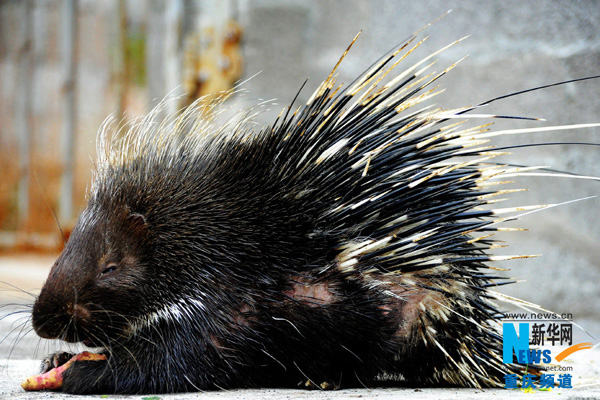
Porcupines eating food
A villager in Group 2 of Dali Village, Gongtan Town, Youyang Autonomous County, raises porcupines (also called spiny pigs). The head of the household is Wu Haifeng, and he gets very excited when talking about raising porcupines. He began raising porcupines in 2007, and it has now been 8 years. The intelligence of porcupines moves him, and porcupines have helped him realize his dream of becoming rich.
In 2007, when Wu Haifeng was 32 and working in Guangzhou, he found that porcupines sold extremely well in major restaurants, and the price was absurdly high. Aren't these just the spiny pigs from our hometown? People born in Gongtan, where the forest vegetation is very good, know spiny pigs very well. Aren't they the ones that cut down a large patch of corn in the mountains at night? Yes, why not catch a few and raise them? Surely that could make us rich too! Wu Haifeng immediately went home, brought in 4 groups of porcupines from elsewhere, and began raising them. After a year, the income from the porcupines he sold was less than 20,000 yuan, and the porcupines were very wild. When they saw their owner, they jumped and screamed, and sometimes even attacked people. His hands were covered with injuries, and Wu Haifeng felt very helpless.
"Porcupines are very intelligent animals. You have to get close to them when they are still piglets." When buying porcupine breeding stock in Hunan, a casual remark from the seller suddenly woke Wu Haifeng up. Starting in 2013, Wu Haifeng poured "love" into the porcupines. From the birth of the piglets to the porcupines being ready for market, he cared for them in every way.
"Newborn piglets are soft and warm, and after a few hours the quills on their bodies start to prick your hands." Wu Haifeng said that when standing watch beside a porcupine giving birth, the maternal quality in the porcupine's eyes can only be understood by people who raise porcupines. Giving the porcupine a dark environment, a suitable temperature, and a quiet delivery room is very important.
A porcupine gives birth two and a half times a year, with 1-3 young per litter. When a litter has 3, the weakest one must be transferred to a mother porcupine that has only given birth to one to be nursed. Porcupines identify their young by smell, so the owner must treat the scent of the suckling piglet, otherwise the piglet will definitely be "mistreated" in its "stepmother's" pen.
Quills pulled from a porcupine's body
In June of this year, 5 adult porcupines secretly "climbed over the fence" and ran away. A month later, 4 of them gradually "came home." When Wu Haifeng talked about this, his eyes filled with tears. "That afternoon, I was eating when suddenly a familiar oink-oink sound rang out. Then something touched my foot. I looked and saw it was one of the porcupines that had run away. I fed the rice from my bowl into the porcupine's mouth. After eating the rice, it lay down beside me and would not leave, so I carried it back into the pen. One still has not come back, but I expect it will come back too."
"To raise porcupines, you have to care for them with your heart." Wu Haifeng said that what porcupines like to eat, which season they go into heat, and when they give birth must all be recorded. Porcupines do not eat much, with a maximum annual feeding cost of 250 yuan. Handling the duels of males in heat is very important. Males defeated in a duel must be isolated, and kept without food so they become thin and their wounds heal well. Anti-inflammatory drugs must absolutely not be used.
"Right now I have 325 head in my pens, and every porcupine responds to my call. I have given them names. Whichever porcupine's name I call, that is the only one that dares come to take food from my hand." As Wu Haifeng spoke, he picked up a cut piece of bottle gourd, called out "Guai Guai Er," and only one porcupine in the pen raised its head and made a cooing sound. Presumably it was "Guai Guai Er."
"The year before last I sold by group, with 3 females and 1 male per group, 8,000 yuan per group, and I earned more than 60,000 yuan. Last year it was 10,000 yuan per group, and I earned about 120,000 yuan. This year I have sold more than ten groups, and the total can only be calculated at the end of the year. It should be more than last year!" Wu Haifeng especially stressed that every time he sells a group, he feels a bit heartbroken, because after all he has developed feelings for these pigs.
During the interview, Wu Haifeng took a total of 3 phone calls. One was from a restaurant in Guangzhou. They wanted to order 1,000 porcupines at a price of 100 yuan per jin of gross weight, and Wu Haifeng refused.
One was from Ren Jun of Shan'gan Township, Pengshui County. He said that after mentioning it in person so many times, this time Wu Haifeng must allot him 10 groups to raise, and he wanted to come pick up the goods tomorrow. Wu Haifeng told him to first come to the farm to get familiar with things, learn some techniques, and develop some feelings for the porcupines. He also repeatedly told him that the technical training was free.
There was also one from a doctor in Shandong, who asked him about the medicinal value of porcupines, and he answered one by one.
"We came to learn techniques, and Haifeng teaches very carefully!" Wu Wenjie, Wu Haijun, and Wu Xike from the same village then walked into the farm. They had been learning from Haifeng for some time, and had also brought in several groups from him and made a profit. By comparison, it is many times more comfortable than raising domestic pigs.
"Last year, the money I made from selling spiny pigs was 30,000 yuan more than from flue-cured tobacco. My investment was not much," said Wu Wenjie.
Wu Haifeng said that he plans to contract the stretch of stone forest behind his house, create a natural environment suited to porcupine survival, expand the porcupines' range of activity, and change pen raising to free-range raising. At an appropriate time, he could develop tourism and sightseeing, so that friends can come into zero-distance contact with porcupines and experience the intelligence of animals.
"Of course, founding a professional cooperative is my dream. I want everyone to get rich together. Raise porcupines yourself and experience the health that green food brings people." Wu Haifeng especially pointed out that friends who are interested in porcupine farming or who do not understand the medicinal value of porcupines can contact him.
Link:
Porcupine, also called the quill pig, which we locally call the spiny pig, is a type of rodent covered with sharp quills. The quills can be used to defend against predators. Porcupines are brown, gray, and white. Different porcupine species have quills of different shapes, but all are modified hairs with a layer of keratin on the surface. The quills embedded in the skin are in bundles, and the quills are mixed in with the hair.
The porcupine is a rare animal with high economic value. Because its meat is delicate and its flavor is delicious, it is deeply loved by people and is praised as a mountain delicacy. The porcupine also has high medicinal value. Its meat, brain, fat oil, heart, liver, gallbladder, stomach, and quills can all be used as medicine. It has effects such as lowering blood pressure, relieving pain, invigorating blood, dissolving stasis, dispelling wind, and dredging collaterals, and is mainly used to treat conditions such as stomach disorders, hemorrhoids and fistulas, malignant sores, cardiovascular sclerosis, and leukemia. Apart from medicinal use, porcupine quills are also a high-grade raw material for making floats and decorations.