Circular agriculture is down-to-earth, and ecological thinking helps farmers profit
Original title: Circular agriculture: the more down-to-earth, the more it benefits the people
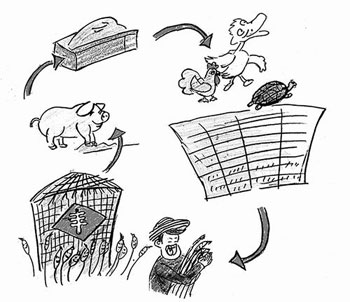
Circular agriculture
In rural China, every household has more or less practiced circular agriculture.
"Incorporate the ecological value of circular agriculture into policy content, and attention should be given to the large number of small-scale farmers who are already practicing ecological circular agriculture." This suggestion was made by the organizers recently at the "Symposium on the Implementation Effects of Circular Agriculture by Small-Scale Farmers," co-hosted by the College of Humanities and Development Studies of China Agricultural University and ActionAid (China).
What is China's current ecological circular agriculture policy? How should it be developed, and what is its development status? What difficulties does it face? A reporter from China Science Daily conducted interviews on these questions.
Tradition and the present
Circular agriculture is not a new thing, but elevating its development to a national strategy is something that has happened in recent years.
"In rural China, every household has more or less practiced circular agriculture," said Mo Xiugen, Policy and Program Director of ActionAid (China). For example, farmers pile animal manure in the fields to cover crops; in the Pearl River Delta, a sound ecosystem forms among "fish-mulberry-rice."
After China's economy experienced rapid development, agriculture and rural areas achieved great successes while also paying a serious price: excessive resource exploitation and consumption, massive pollutant emissions, shortages of agricultural resources, environmental pollution and ecological damage. "The constraints of agricultural resources and the environment are becoming increasingly tight, but the development of ecological agriculture has also ushered in new opportunities," said Sun Yufang, Director of the Resource Protection Division of the Agricultural Ecology and Resource Protection Station of the Ministry of Agriculture.
The 18th National Congress of the Communist Party of China put forward the strategic decisions of "synchronizing the four modernizations," "ecological civilization" and "Beautiful China," and agricultural development entered a new normal.
"Circular agriculture arose in rural areas, but it does not stop there; its sustainable development requires the guidance and support of national policies. It is precisely against this background that the state and governments at all levels have successively issued a series of policies to promote the development of circular agriculture," said Wang Zhen, a doctoral student at the College of Humanities and Development Studies of China Agricultural University.
Ecological civilization construction and sustainable agricultural development related to circular agriculture have been reflected in the Central "No. 1 Document." Relevant national departments have also successively issued documents such as the National Agricultural Sustainable Development Plan (2015-2030), the Plan for Tackling Prominent Agricultural Environmental Problems (2015-2018), and the Opinions on Accelerating the Transformation of Agricultural Development.
In 2007, the Ministry of Agriculture designated 10 cities (autonomous prefectures) to carry out circular agriculture demonstration city construction. In 2014, it launched the construction of 11 modern ecological agriculture bases covering different types of leading industries. In 2015, ecological circular agriculture projects in comprehensive agricultural development regions of 12 provinces were approved. Zhejiang Province, through provincial-ministerial co-construction, advanced ecological circular agriculture construction across the entire province.
"At present, circular agriculture policy has been advanced nationwide, and it has been implemented to varying degrees at both the national and local levels," Wang Zhen said. "The policies themselves show characteristics of being scattered yet gradually becoming more comprehensive, with pilot projects leading the way and coverage expanding. At the same time, there are also problems such as insufficient policy support, single forms and weak sustainability, and certain difficulties in technology extension."
Advancing according to local conditions
The Xintiandi Rice Planting Professional Cooperative, where Yuan Yong, Director of the Agricultural Service Center of Dongxi Town, Jianyang City, Sichuan Province, works, follows the path of circular agriculture, which he calls a new type of "comprehensive" cooperative. The establishment and development of this cooperative also received support from the College of Humanities and Development Studies of China Agricultural University.
Over the past 5 years, ecological technologies such as green pest control, production of environmentally friendly enzymes, comprehensive utilization of biogas slurry, no-till farming, composting and earthworm breeding have been continuously popularized; the scale of ecological planting of ratoon rice, ecological corn and ecological rapeseed has continuously expanded, with ecological corn yielding 915 jin per mu, 100 jin higher than the average yield; the ecological environment has gradually improved, and birds that could only be seen in nature reserves have been found in Shuanghe Village.
"There is no clear statement about who the main actors of circular agriculture are. Farm owners, small-scale farmers and cooperative organizations may all be main actors. Although the technical means they adopt differ, they are all practitioners who advance step by step and make agricultural development more sustainable," Sun Yufang said.
In her research, Sun Yufang found that in some provinces and cities, leading enterprises serve as the driving force for circular agriculture, while in others, farmers are the main force. "The development of ecological circular agriculture must be based on local realities, actively explore different models, give play to comparative advantages, and highlight construction priorities. It cannot simply adopt one model or a 'one-size-fits-all' approach," Sun Yufang said.
Song Yiqing, a researcher at the Agricultural Policy Research Center of the Chinese Academy of Sciences, agrees with this view. She said: "The diversity of circular agriculture is very important. It must be adapted to local conditions and based on farmers' needs. Farmers know what they need, and we should recognize them and give them support."
Qi Gubo, a professor at the College of Humanities and Development Studies of China Agricultural University, conducted field research in five villages distributed across Ningxia, Henan, Jiangxi, Sichuan and Guangxi, analyzed the economic efficiency of different circular agriculture models, and attempted to identify the significant factors affecting the economic efficiency of different circular agriculture models.
The research results show that, overall, the comprehensive efficiency and technical efficiency of circular agriculture operations of small-scale farmers in the surveyed villages were both effective. However, the operational effectiveness of circular agriculture varied greatly among farmers, meaning that small-scale farmers are not homogeneous; effective technical efficiency does not necessarily produce an effective input-output ratio; and there is great room for improving effectiveness.
The research results also show that the significant factors affecting the comprehensive efficiency of circular agriculture in these areas were: whether farmers had received technical training in sustainable agricultural models, whether they adopted crop rotation, and their subjective evaluation of whether local soil was polluted. However, household characteristics such as agricultural labor force and non-agricultural income had no significant impact on economic efficiency; whether the circular agriculture model received subsidies was also not significant. In addition, in several villages, most farmers implementing circular agriculture were cooperative members, and the form of cooperation and the implementation of circular agriculture were mutually causal and mutually reinforcing.
Participants also reached a consensus that farmers' cooperatives play an irreplaceable role in promoting the implementation effects of circular agriculture.
Letting farmers profit
In the 1980s, China put forward the concept of "ecological agriculture." Regarding its definition, there are differences between China and other countries. Ecological agriculture abroad pursues a single environmental goal and ecological benefit, emphasizing the self-maintenance of agricultural ecosystems.
"We pursue comprehensive benefit goals, including yield. High yield and high efficiency are basic elements of ecological circular agriculture. If yield declines, how far can ecological circular agriculture go? We do not completely abandon chemical fertilizers and pesticides, but emphasize scientific use and reasonable input," Sun Yufang said.
Aftab Alam Khan, International Advocacy and Policy Manager at ActionAid, believes that the transition from industrial agriculture to sustainable agriculture will not take effect instantly like turning off a light. "It needs 3 to 5 years or even longer. During this period, farmers need to receive some support and broaden channels for income growth. Letting farmers profit in the market and escape poverty will give circular agriculture more staying power."
Starting in 2000, Shanggula Tun in Guzhai Village, Mashan County, Guangxi, became one of the supported communities of the participatory action research project of the Agricultural Policy Research Center of the Chinese Academy of Sciences. Over the past 15 years, ecological circular agriculture and PPB (participatory plant breeding) in Mashan Guzhai have made good progress, with certain economic and ecological benefits.