Henan rice harvesters head south to Guangxi to harvest rice, traveling 30000 km in half a year
Original title: Meeting "rice harvesters" at a Guangxi village: tasting the changes of the times through occupational change
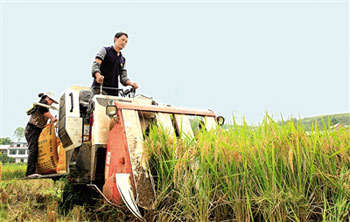
"In half a year, I crossed 13 provinces and autonomous regions, traveling more than 30000 km. Guangxi is our last stop. Once the rice is harvested, we'll head home for the New Year." When a reporter recently interviewed "rice harvester" Cheng Yingmin in Poling Village, Qingfeng Town, Gangnan District, Guigang City, Guangxi, he said this.
In some areas of China, when the crop harvest season arrives, factors such as tight schedules and insufficient manpower have given rise to "wheat harvesters" and "rice harvesters," people who take harvesting wheat and rice as a profession. This occupation once declined. In recent years, as urbanization has continued to accelerate, more and more rural young people have gone to cities to work, and the demand for "rice harvesters" has grown increasingly strong.
Cheng Yingmin's hometown is Chengzhuang Village, Huangdimiao Township, Linying County, Henan Province. In early May, like a migratory bird, he left home and began "going from place to place" to the rhythm of crops ripening. "First go to Sichuan to harvest rice, then to Hunan and Hubei, then back to Henan, Hebei and Shandong to harvest wheat, and when that's done hurry to Shaanxi and Gansu to harvest rapeseed, then go to the northeast to harvest soybeans." Guangxi was the last stop of his career as a "rice harvester" this year. From the northeast to Guangxi, passing through Henan along the way, Cheng Yingmin stayed in his hometown for only one day before setting off again. He knows well the principle that "crops don't wait for people." Missing a few days could mean a wasted trip. In less than two days he traveled more than 1000 km.
Unlike traditional "rice harvesters," Cheng Yingmin's equipment has been upgraded from a sickle to modern machinery. When the reporter met Cheng Yingmin, he was chatting with several fellow townsmen. His small truck carried a crawler-type harvester, which is almost standard equipment for every "rice harvester." "The two sets of equipment together cost more than 200000 yuan. When harvesting rice, unload the harvester; on the road, use the truck. It saves time and lets you take on more work," said "rice harvester" Li Zhuo, who came together with Cheng Yingmin.
Guigang is Guangxi's "granary." Mid-November is exactly when late rice matures, and in many townships trucks with "Yu L" and "Yu Q" plates can be seen gathered together. Shi Shuisheng, director of the Gangbei District Agricultural Machinery Bureau, introduced that during the peak harvest period, the number of "rice harvester" vehicles can reach as many as a thousand, with Henan people especially numerous. Cheng Yingmin's hometown produces many "rice harvesters." It was under the guidance of relatives and friends that he formally entered the trade two years ago.
"When there's work, we work day and night; when there's no work, we sleep more. That's our life." Cheng Yingmin's companion Cheng Xinwei has the typical characteristics of a Henan farmer: strong build and dark skin. At a glance, he is clearly good at farm work. Although accustomed to enduring hardship, Cheng Xinwei has never been able to adapt to life in the south without wheat-based food. "I can't stand eating rice all the time. If I had brought cooking gear when I came out, I could eat noodles." Like the others, Cheng Xinwei hardly ever leaves his vehicle. This is both convenient for watching over it and, more importantly, saves on lodging costs. Gas stations have become their veritable "base." During refueling breaks, they draw several buckets of water, enjoy a good wash, and change and wash their clothes.
Because mountainous and hilly terrain is prominent in its jurisdiction, Guangxi's agricultural development is subject to many constraints. Zhang Xiuyun, deputy director of the Supervision and Management Division of the Guangxi Zhuang Autonomous Region Agricultural Machinery Administration, introduced that every year during the harvest period, "rice harvesters" from other provinces bring modern equipment to Guangxi. Through the "Agricultural Machinery Cross-Regional Operation Service Express" information platform and mobile phone text messages, the autonomous region's Agricultural Machinery Administration promptly releases information on operation progress, diesel supply, weather and so on, providing good service for "rice harvesters."
With the spread of rural machinery and the increase in the number of "rice harvesters," the "rice harvester" industry is also facing competition. Cheng Xinwei has been a "rice harvester" for 4 years. In June this year he bought a new type of harvester, which can harvest about 50 mu a day. Calculated at a harvesting price of 100 yuan per mu, the daily earnings are considerable. "I want to make more money while I'm young, and after two more years I'll change trades," Cheng Xinwei said. (Reporters Sun Zhiping, Wu Xiaokang)