Shenzhen agriculture has become an engine for zero-gene seed development
Original title: The Second International Conference on Agricultural Genomics held in Dapeng New District, more than 300 top scientists discuss agricultural science and technology innovation
Give agriculture the wings of science and technology, give seeds a genetic motor
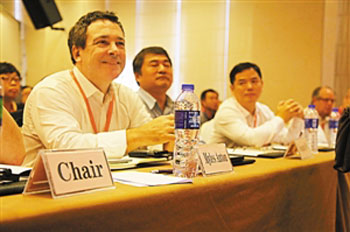
Conference chairman, Nature Genetics editor-in-chief Myles Axton.
Conference chairman, Vice Minister of Agriculture of the People's Republic of China, and President of the Chinese Academy of Agricultural Sciences Li Jiayang.
Fruit corn that can be eaten raw is about to hit the market.
The 17th China Hi-Tech Fair is in full swing in Shenzhen, and at the same time, a grand gathering of more than 300 experts and scholars in the field of agricultural genomics from around the world has also opened in Dapeng New District.
From November 16 to 18, the Second International Conference on Agricultural Genomics, hosted by the internationally renowned journal Nature Genetics, the Chinese Academy of Agricultural Sciences, the Chinese Academy of Sciences, and Fujian Agriculture and Forestry University, and co-organized by the Agricultural Genomics Institute at Shenzhen of the Chinese Academy of Agricultural Sciences, the Dapeng New District Management Committee, and Shenzhen Zhongnong Jingyue Biotechnology Co., Ltd., was held in Dapeng New District. Top academic leaders from more than ten countries and regions, including several Chinese and foreign academicians, delivered conference reports. Myles Axton, editor-in-chief of Nature Genetics and professor of molecular and cell biology at Oxford University, and Li Jiayang, Vice Minister of Agriculture of the People's Republic of China, President of the Chinese Academy of Agricultural Sciences, and academician of the Chinese Academy of Sciences, jointly served as chairmen of the conference organizing committee. Wu Yihuan, Vice Mayor of Shenzhen, attended the opening ceremony and delivered a speech on behalf of the municipal government.
More than 300 scholars and experts gathered
Genomics is a rapidly developing emerging discipline in the field of life sciences. It plays a leading role in basic biological research in agriculture and has also brought new opportunities for the development of the biological seed industry.
In 2014, the contribution rate of China's agricultural scientific and technological progress had increased from 20% in the early days of the founding of New China to 56%. According to researcher Qian Qian, director of the Agricultural Genomics Institute at Shenzhen of the Chinese Academy of Agricultural Sciences, at present, led by Chinese scientists and through international collaboration, the genome sequencing of about 70% to 80% of important crops such as rice, wheat, corn, and cucumber has been completed, and the functional traits of the genetic genes of these crops have been preliminarily grasped. The research level has already reached the international forefront.
On January 1 next year, China will officially implement the new Seed Law aimed at improving seed quality and safeguarding national food security. It clearly requires national research institutes and higher education institutions to focus on conducting basic and frontier applied technology research in breeding. Seed enterprises and research institutes are encouraged to jointly build technology research and development platforms, providing effective scientific and technological support for cultivating new varieties with independent intellectual property rights.
Against this background, this conference provided a display platform for the latest achievements in agricultural genomics and also built a cooperation platform for agricultural genomics technology and agricultural breeding. It is reported that the theme of this conference is "Give agriculture the wings of science and technology, give seeds a genetic motor." More than 300 scholars and experts from more than ten countries and regions around the world held discussions on six aspects including agricultural genomics, seed resources, and breeding. At the same time, the conference also invited relevant government departments and leading seed industry enterprises to participate in "industry-university-research" matchmaking negotiations.
A new calling card for Shenzhen's biological industry development
Since 2011, the statistical share of agriculture in Shenzhen's GDP has already been "zero," yet this time it attracted the most cutting-edge attention from the world's agricultural science and technology field. As China's national independent innovation demonstration zone and first national innovative city, Shenzhen has listed the biological industry and the life and health industry as strategic emerging industries and future industries respectively, giving them key cultivation and support, and striving to build an all-factor policy support system layout.
Around this goal, Shenzhen is accelerating the gathering of high-quality technology and industrial resources, accelerating the creation of an international biological valley, and striving to build a strong city in life science and technology, a major city in the life industry, and a world-class life and health industry base. At present, the scale of Shenzhen's biological industry has exceeded 100 billion yuan, and its gene sequencing output capacity has already accounted for half of the world's total.
Shenzhen is shifting from being mainly driven by information technology (IT) to being driven by both "information technology (IT) + biotechnology (BT)." Last September, after holding six consecutive IT leaders' summits, Shenzhen successfully held the first BT leaders' summit, thus opening the "IT+BT" dual-summit model and becoming a landmark event promoting the integrated and innovative development of the information technology and biotechnology industries.
Holding the world's top agricultural genomics conference at the same time as the annual national and international high-tech event is another model of the integrated development of information technology and production technology. The International Conference on Agricultural Genomics will also become a new calling card for Shenzhen's biological industry development.
In his speech, Li Jiayang highly praised Shenzhen's forward-looking development vision and its support for the development of the biological industry in recent years. He said that Shenzhen, which has no "three rural issues," is gradually possessing the most cutting-edge and most sophisticated scientific research achievements in biotechnology and the life and health industry.
A national-level biological seed industry center is gradually taking shape
In Dapeng New District, 356 out of 365 days a year have good air quality, and 76% of the land area is covered by forests. It is not only Shenzhen's ecological pure land, but also Shenzhen's youngest functional new district. At the time of its establishment, the municipal party committee and municipal government set the guideline of "protection first, scientific development, refined management, and upgrading the level" for Dapeng New District, requiring the new district to seek the greatest common denominator between economic development and ecological protection.
Around the construction of the "three islands and one zone" (biological island, life island, ecological island, and world-class coastal eco-tourism resort) and the Shenzhen International Biological Valley, the new district seizes the opportunity of the rapid development of the biological industry and the life and health industry, and advances the construction of projects including "one bank, one institute, two parks" - the China National GeneBank, the Agricultural Genomics Institute at Shenzhen of the Chinese Academy of Agricultural Sciences, the Shenzhen International Biological Valley Life Science Industrial Park, and the Marine Biological Industrial Park - reserving projects and providing important supporting platforms for the construction of the International Biological Valley.
Dapeng New District has become an important town in Shenzhen's biotechnology industry layout.
Its connection with biological agriculture began when the new district was about to be completed. On November 15, 2011, one day before the 13th China Hi-Tech Fair, the Agricultural Genomics Institute at Shenzhen of the Chinese Academy of Agricultural Sciences held an unveiling ceremony and officially settled in Dapeng New District. In 2014, the Chinese Academy of Agricultural Sciences decisively placed its second major project in the new district - the Agricultural Genomics Institute. This is the first national-level agricultural genomics institution, and it is also currently the world's only national-level public welfare research institute specializing in basic and applied research in agricultural genomics.