Light rail built in mountain orchards makes harvesting, fertilizing and watering easy
Original title: Citrus rides the light rail, fruit growers enjoy a life of ease
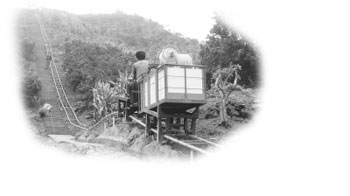
Self-propelled dual-track orchard transport machine equipped with spraying equipment
The citrus industry is a pillar industry in China's main producing areas and the "money purse" of fruit growers. However, because 90% of China's citrus is grown in mountainous areas with poor site conditions and a low level of mechanization in mountain orchards, its production is mainly done by manual labor, with very high labor intensity. In recent years, accelerating the mechanization of mountain orchards has become a consensus among all sectors. In particular, with the transport of production materials and fruit in mountain orchards as the breakthrough point, all parties have worked together, and this weak link has taken gratifying strides forward.
Yichang, Hubei: Mechanization enriches citrus growers
"I've been growing citrus for nearly 30 years, and now I've caught up with good times. Even my citrus orchard has a 'light rail' built in it. Transport, pruning, sprinkler irrigation, fertilizing, spraying, post-harvest processing and so on are all mechanized, and I've really tasted the 'sweet rewards'!" Whenever he talks with people about his "high-tech" citrus orchard, Chen Jiarong, a large-scale contracted operator at the Jinyingang Citrus Demonstration Farm in Yaqueling Town, Yiling District, Yichang, Hubei, beams with joy.
Chen Jiarong, 63 this year, began growing citrus in 1988 and can be considered an expert citrus grower. Today he contracts 15 mu of citrus orchard at the citrus demonstration farm. Although this year is an "off year," he estimates the yield will still be more than 60,000 jin. "Calculated at the current 1 yuan per jin, that's still more than 60,000 yuan in income," Chen Jiarong said rather proudly.
Of course, this 60,000 is not pure profit; costs such as pesticides, chemical fertilizers and labor still have to be deducted. But Chen Jiarong is not worried at all. "My citrus orchard is all mechanized, so these don't cost much."
In his citrus orchard, the reporter saw that dedicated tracks had been built following the contours of the mountain, with two deep grooves, a cart fitted with rollers, and a dedicated operation room. Chen Jiarong gave a demonstration: with just a light press of a switch, about 1,000 jin of citrus can smoothly come down the mountain, saving time and effort. Likewise, some production materials such as chemical fertilizers, pesticides and farming tools can also be transported to the fields through these rail cars.
It is understood that this rail transport cart was built using funds from a national agricultural subsidy project, and citrus growers do not pay any costs. This kind of transport cart has advantages such as low investment, simple operation, energy saving, and convenience and practicality. It not only reduces farmers' labor intensity but also improves work efficiency, and is deeply welcomed by local farmers.
Chen Jiarong also did some accounting for us. "In the past, fruit picking relied entirely on carrying on shoulders and backs, and labor costs were correspondingly high. At that time, the picking fee was 0.15 yuan per jin; now with the transport cart, it's only 0.10 yuan per jin. In the past, each person could carry at most 30 trips a day, and at most 100 jin per trip; now one cart can transport 1,000 jin. If calculated at an average of 100,000 jin per year, just on the item of picking and transport costs, I can save more than 10,000 yuan." Chen Jiarong said that in addition to his own citrus orchard, the rail cart can also serve surrounding farmers for transporting production materials.
The citrus orchard has not only achieved mechanized transport, but mechanized pruning has also been fully applied. "In the past, I alone could only finish pruning one mu of citrus trees in a day, and it took me and my son half a month to finish pruning all of them! Now mechanical pruning is much simpler; one tree is easily done in a minute and a half." Chen Jiarong's face broke into a broad smile.
At the Jinyingang Citrus Demonstration Farm in Yaqueling Town, technicians only need to lightly press a button and all the micro-sprinkler irrigation pipes in the orchard begin rotating 360 degrees to spray water with no blind spots. The citrus micro-drip irrigation equipment adopts the most advanced automated control equipment and can be operated remotely via mobile phones and computer networks. The related pipe network can carry out irrigation, fertilizing and pesticide application in a unified way, not only saving labor and water; the automatic spraying technology can also better enable the citrus trees to carry out photosynthesis, and can increase yield by about 20%.
Government policy and funding support are important guarantees for the development of citrus mechanization. Yiling District spends more than 3 million yuan each year on mechanization subsidies for the citrus industry, with a total exceeding 15 million yuan, mainly to subsidize grading and waxing machines, cultivating machinery, plant protection equipment, drainage and irrigation facilities, and so on. The government allocates more than 20 million yuan in fiscal funds each year for superimposed subsidies for citrus production machinery, centralized green prevention and control, brand promotion, market development, and support for citrus production professional cooperatives, and so on. According to incomplete statistics, during the "12th Five-Year Plan" period, the district government's special funds used to support the development of the district's citrus industry exceeded 120 million yuan.
The improvement in quality has made Yiling citrus sell well in 23 provinces (municipalities and autonomous regions) across China, and it is also exported overseas, selling to countries and regions such as Russia, Canada, Spain, Japan, Thailand and Southeast Asia. In October this year, Yiling District held the 5th China Yichang (Yiling) Citrus Festival, attracting Chinese and foreign merchants such as Russia's Frujak Industrial Company, Thailand's Sanfa Cold Storage Co., Ltd., Beijing Xinfadi and Carrefour for cooperation negotiations, with total sales of 395,000 tons, accounting for 43.8% of the district's total citrus output, and a total agreement value of 711 million yuan. Zhu Jiamei, Zhu Yongjie
Meizhou, Guangdong: Transport machines ease the labor shortage
Recently, the Guangdong Provincial Agricultural Mechanization Technology Extension Station held an on-site demonstration and extension meeting for mountain fruit production mechanization technology in Dabu County, Meizhou City, Guangdong Province. The on-site meeting focused on demonstrating mountain (slope) transport machinery and post-harvest processing mechanization technology developed by the national citrus industry system team, and also displayed and demonstrated mechanization technologies for mountain fruit planting such as land preparation, water-saving irrigation, hole digging, plant protection, pruning and post-harvest processing.
Meizhou City, located at the junction of Guangdong, Jiangxi and Fujian provinces, has seen a large outflow of young and middle-aged labor in recent years. During busy farming seasons, even a daily wage of 150-200 yuan still makes it very difficult to hire workers, and the "labor shortage" problem in mountain orchard operations is very prominent. To solve this problem, the city, relying on the Mechanical Research Office of the National Citrus Industry Technology System (teams from South China Agricultural University and Huazhong Agricultural University) and the Meizhou Shatian Pomelo Comprehensive Experimental Station, has carried out testing, demonstration and application of mountain orchard transport machines in counties (districts) such as Meixian, Pingyuan, Dabu and Wuhua. Through the comprehensive use of towed dual-track, single-track and trackless transport machines for mountain orchards, labor intensity has been greatly reduced and the shortage of rural labor has been alleviated.
The Shatian pomelo and honey pomelo high-yield area of Yang Shousheng, chairman of the Meisheng Fruit Professional Cooperative in Meixian District, Meizhou City, reaches 330 mu, and the orchard has a steep slope. The South China Agricultural University team from the Mechanical Research Office of the National Citrus Industry Technology System installed one fixed and one towed detachable dual-track transport machine for the orchard, and the Huazhong Agricultural University team installed one trackless transport machine for him. He said: "Each transport machine can carry more than 600 kg of fertilizer or pomelos in one trip, equivalent to the transport volume of 15 to 20 people walking one trip. This year, with the support of the Meixian District Agriculture Bureau, my orchard has newly installed 2 more towed dual-track transport machines for mountain orchards."
Dabu County Shunxing Planting and Breeding Co., Ltd. in Meizhou City is a leading agricultural enterprise producing honey pomelos. "Every honey pomelo picking and transport season, we have to search everywhere for workers. It uses a lot of labor, is highly labor-intensive and inefficient, and the amount of honey pomelos picked and transported is far from keeping up with the pace of sales. The labor shortage and high costs have affected the economic benefits of honey pomelo cultivation. In 2015, my orchard installed 7 towed dual-track transport machines for mountain orchards. Depending on the power, one transport machine can carry 300 to 600 kg per trip, and one day's transport volume can match the workload of 50 workers for 2-3 days. This labor-saving transport machine is especially suitable for steep mountain orchards. In addition to transporting fruit, it can also complete the transport of items such as fertilizers, pesticides and agricultural machinery. It operates by remote control, and the two ends of the track stop automatically, which is very convenient." said Deng Zhanhua, general manager of the company.