Leech Farming in Baodi, Tianjin: A Precious Medicinal Herb That Can Treat Stroke
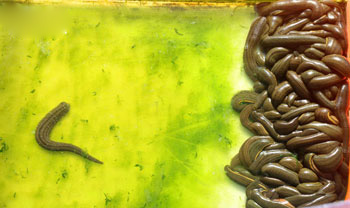
The leeches farmed by Gao Jianzhong are of high quality
Leeches have very strict requirements for their growing environment
When people mention leeches, everyone knows they are terrifying bloodsuckers to be avoided at all costs. In fact, the scientific name for the leech is Hirudo, and it is a precious medicinal herb with efficacy in treating stroke, high blood pressure, clearing blood stasis, amenorrhea, and traumatic injuries. Recently, a Northern Network new media reporter learned from Baodi District that, relying on its excellent ecological environment, the district has scaled up leech farming, turning bloodsuckers into "beneficial insects" and achieving unexpected results. Gao Jianzhong is one of the outstanding farmers in this field, and the Tianjin Hongteng Aquatic Technology Development Co., Ltd. he founded has become the country's first large-scale leech farming base.
Achieving Large-Scale Farming
To this day, a folk remedy for treating high blood pressure still circulates in Baodi - grinding dried leeches into powder and taking it with plain water. Gao Jianzhong often hears local villagers say this folk remedy has miraculous effects, and many people still use it.
With the in-depth development of the medicinal value of leeches, their enormous market potential has attracted many farmers. Currently, the annual demand gap for dried leeches on the domestic market is 300-500 tons (7-8 jin of fresh wet product yields 1 jin of dried product). Although the market prospects are good, artificial farming is extremely difficult. It is understood that wild leeches have nearly harsh requirements for their growing environment, so relying solely on catching wild leeches cannot meet market demand at all. Only large-scale farming can solve the demand for this "soft gold."
"Leeches lay eggs at the boundary between water and soil, in moist places with sufficient water. They will only lay eggs when the temperature is between 25°C-28°C and the humidity, moisture level, soil softness, and surrounding plant species all meet the conditions. The normal growth period is half a year, with two hatchings per year and one finished product per cycle." When it comes to leech farming, Gao Jianzhong talks endlessly.
Gao Jianzhong began small-scale trial leech farming in 2012, expanding from a few dozen mu to over a hundred mu. Now the annual output of dried product is forty to fifty tons, sold to pharmaceutical factories in Tianjin and Zhuhai and the Anguo medicinal herb market. However, compared with the enormous gap, Gao Jianzhong's leech output still seems relatively small. To achieve efficient farming, Gao Jianzhong once traveled to Sichuan, Northeast China, and other places for investigation. At that time, the scale, standards, and technology of the national leech farming field had not yet taken shape, but market demand was urgent. Through introductions from relevant departments, Gao Jianzhong found a Malaysian aquaculture expert, Professor Pan, and introduced leech breeding technology. "This year we established a 3,000-mu leech farming base. Under Professor Pan's guidance, we are doing leech breeding and hatching, and have begun large-scale farming in the leech breeding area."
Currently, through four models - water tank (net cage) farming, ground net cage farming, rice paddy three-dimensional farming, and factory-style cement pond farming - Gao Jianzhong has formed a leading enterprise in agricultural industrialization integrating breeding, production, processing, and sales, becoming one of Baodi's 12 major urban-type agricultural projects.
Science and Technology Support the Development of Urban-Type Agriculture
For large-scale leech farming, feed is the key. Currently, there is no leech feed on the market, and the leeches Gao Jianzhong farms mainly feed on river snails. The number of wild river snails is uncontrollable, and using them as feed is equivalent to "relying on the heavens for food," with no guarantee at all. To achieve large-scale farming, Gao Jianzhong cooperated with Tianjin Agricultural University to establish a research group to develop leech feed and solve the problem of large-scale leech farming.
Having achieved large-scale farming, Gao Jianzhong then turned to improving the efficiency of leech farming. Considering farmers' capacity to accept it, he promoted the three-dimensional farming model of planting rice in paddies and raising leeches alongside it among surrounding farmers. "This model has low input, high output, and is easy to promote. This model is not technically demanding, and the leeches farmed are of good quality. Farmers only need to simply arrange the rice paddy layout, dig channels, and set up water inlet and drainage." Gao Jianzhong said.
However, the rice paddy intercropping method of leech farming cannot guarantee output. For scientific and technological research and to increase surrounding farmers' income, in 2013, Gao Jianzhong's Hongteng Aquatic Company, with the help of the Baodi District Science and Technology Commission, established the first academician workstation in Baodi District's agricultural field, hiring rice expert and Chinese Academy of Engineering academician Chen Wenfu to solve the three-dimensional planting problem, and introduced several new rice varieties suitable for leech growth. Currently, forty to fifty farming households are trying rice-leech three-dimensional intercropping, increasing income by more than 1,000 yuan per mu compared to planting rice alone.
Not only has leech farming increased income, but Gao Jianzhong's leeches have also created a brand. "Some middlemen come specially to buy leeches from us. They report that although our leeches sell for more than those from the south, they contain higher levels of hirudin and have a higher wet-to-dry product ratio. We are currently applying for geographical indication protection." Currently, the pollution-free national geographical indication planting and farming area certified by the Ministry of Agriculture in Baodi District has reached 400,000 mu, accounting for one-third of Baodi's total 1.13 million mu of cultivated land.
Developing Deep-Processing Leech Products
After achieving large-scale leech farming, in addition to considering maintaining and steadily improving the degree of scale, Gao Jianzhong also wants to achieve deep processing of leech products. He said: "We are cooperating with the Institute of Traditional Chinese Medicine of the Chinese Academy of Sciences, preparing to increase the added value of leeches. Currently, the folk methods of processing leeches are boiling in hot water and processing with alum. With such processing, 20%-30% of the medicinal components of leeches are lost. Especially during the dog days of summer, if not processed in time, leeches will spoil. For the sustainable development of leech farming, we plan to do primary processing alongside farming. Using low-temperature dehydration to freeze-dry leeches, and through nanotechnology to make powder to sell to pharmaceutical factories. By doing some preliminary processing this way, the components of the leeches will not be lost, and at the same time, the enterprise can achieve high added value for its products."
In addition to continuous exploration in leech farming and deep processing, Gao Jianzhong also plans to comprehensively organize leech farming technology. He said: "The market demand for leeches is very large. We plan to produce CDs to promote leech farming technology nationwide. We expect to start making teaching materials for farming technology in April next year."
Hao Fuhong, director of the Baodi District Agriculture Committee, said in an interview with reporters that Baodi District has now established four industrial belts: the southern waterfront ecological industrial belt (with several townships rich in water resources doing farming); the northern advantageous vegetable industrial belt (strengthening Shigezhuang radish, Niudaokou yam, Xin'an Town cucumber, and Fangzhuang edible fungi), with vegetables able to be sold across the country; the eastern specialty industrial belt, with cold chain construction for the storage, transportation, and processing of scallions, garlic, and Tianying pepper, allowing farmers to sell at a good price after fresh storage; and in the west, a 100,000-mu high-efficiency facility agriculture area. Relying on these four industrial belts, Baodi District has been working on the refined development of modern urban-type agriculture led by leading enterprises. And the tiny leech has opened up another sky for urban-type agricultural development, allowing farmers' business acumen to find great opportunities.