She quit her job to become a farmer and carved out a new world through entrepreneurship
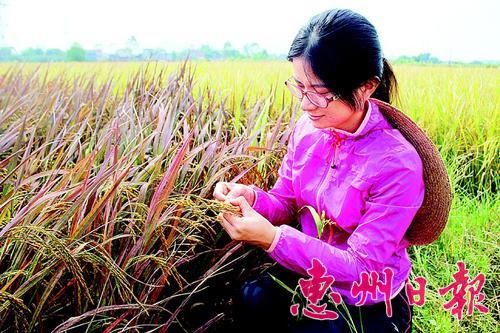
Li Huiwen is inspecting the growth of red rice paddies.
(Left) Red rice paddies, (Middle) White rice paddies, (Right) Black rice paddies.
It is once again the season for harvesting the late-crop rice. Amid the golden rice fields of Zutang Village, Pingling Town, Longmen County, a patch of deep red rice fields stands out particularly. Beside this red rice field, a woman dressed in a red top, wearing glasses on the bridge of her nose, with her hair in a ponytail and a straw hat hanging on her back, is carefully inspecting the condition of the rice ears. "This is red rice. It's growing very well and will be ready for harvest soon. We've already prepared the granary to store the rice." This woman is Li Huiwen, chairwoman of the Longmen County Huixing Rice Professional Cooperative (hereinafter referred to as the cooperative). With her quiet appearance and sweet smile, she does not look like someone who does farm work no matter how you look at her. "I used to be a teacher, then I quit to go into agriculture. I want more people to be able to eat the high-quality rice from Longmen." Faced with the reporter's questions, Li Huiwen explained.
More than 10 consecutive days spent rushing around at harvest sites
Li Huiwen, born in 1982, is a native of Pingling. Since the start of the late-crop rice harvest in Longmen County, Li Huiwen has been rushing around the rice harvesting sites.
The cooperative currently has 116 cooperative members, with a planting area of about 2,000 mu. There are nearly 5,000 cooperative farming households with order contracts, with a planting area of about 6,000 mu. In addition, some farmers who do not have a cooperative relationship will also bring their rice over. These rice planting areas are scattered across multiple townships in Longmen County. After the Double Ninth Festival, Li Huiwen had already been running around rural areas in various townships for more than 10 days. "I need to see how this year's harvest differs from last year's, and also ask the villagers about the quality of rice grown from different rice varieties, and how to improve in the future, and so on."
Because the mountain paths in the countryside are difficult to travel, and if you drive in, just turning the vehicle around can take half an hour, Li Huiwen rides her own motorcycle into the mountains to learn about conditions at the farmers' homes. Sometimes she chats with farmers until after 9 p.m., and only leaves after the rice harvest is finished. A few days ago, the temperature was relatively low. Although Li Huiwen was shivering from the cold, she still insisted on standing by the rice field and only left after the farmers finished harvesting the rice. "After the Chinese New Year this year, we will distribute seeds to the farmers. We need to find out clearly first so that we have confidence."
The red rice field that Li Huiwen inspected that day was a new variety that had only been trial-planted this year. "This is red rice. We only started trial-planting it in this village this year." Li Huiwen said with a smile. At first, some people did not understand red rice and thought something had gone wrong with this patch of rice, saying that too much pesticide had been used against pests, because even the rice leaves had turned red. Besides red rice, the cooperative also distributes black rice seeds to farmers. Now the black rice planted by some villagers has also matured and been harvested. "Red rice and black rice are types of brown rice. Although they are not as soft and smooth as white rice, they are highly nutritious and have the effect of preventing anemia. They can be promoted as 'health-preserving rice.'"
Growing up in the countryside, she has an emotional bond with rice
Li Huiwen was originally a teacher. In 2001, she began teaching at Pingling Middle School, where she taught subjects including computers, geography, and comprehensive practical activities, and was also appointed secretary of the school's Youth League committee. "When I was a teacher, I worked very hard. Whether in class or in student recruitment, I worked very conscientiously, and often did home visits at students' homes and did not get home until very late." She told the reporter.
After teaching for more than 9 years, she chose to resign. Speaking of why she wanted to give up her public post to become a "farmer," Li Huiwen said that she herself could not quite explain it clearly. She grew up in the countryside, grew up eating Longmen rice with its natural fragrance, and has an inseparable emotional bond with Longmen rice. Besides liking Longmen's rice, there was also the issue of food safety. Because her husband's family runs a rice business, she was often asked by relatives, friends, and students' parents one question: how can one buy rice one can trust?
This gave Li Huiwen the idea of trying her hand at agriculture. How could healthy and safe agricultural products be produced? She felt that Longmen's rice should make everyone feel safe. Just like that, Li Huiwen set foot on the path of agriculture, put down the chalk and began dealing with rice, and started exploring continuously.
When first entering the industry, she once mistakenly took in wet rice
When she first stepped into the threshold of agriculture, Li Huiwen was a complete outsider who understood nothing. She did not even know what varieties of rice there were.
She had not expected that rice had so many varieties. She placed several different types of rice purchased by her family, such as Simiao rice, Meixiangzhan, and Qisizhan, together for comparison. Some rice looked no different on the outside, but after being cooked into rice, its fragrance and taste differed greatly. So Li Huiwen compared the characteristics of various types of rice by reading books, and studied the differences in rice in terms of length, roundness and flatness, color, aroma, and so on. She learned through practice, the internet, and exchanges with farmers, and participated in various agricultural training sessions. Li Huiwen attended the "Sunshine Project" rural youth entrepreneurship training class held by the municipal agricultural technology promotion center twice in a row, and got to know quite a few rice growers.
As a newcomer just entering the industry, Li Huiwen also suffered losses. Because her husband's family had a rice processing factory, every year they had to purchase large amounts of rice to store for a year's processing. A farmer brought rice that had not been completely sun-dried to sell. Li Huiwen did not identify this and directly purchased it and stored it in the warehouse. "Fortunately, my family members were experienced and noticed something was off during sampling inspection. There was no other way but for the whole family to spring into action, move this rice out, and take it to the school playground to dry it in the sun again. If it had not been discovered in time and the rice had become moldy, the loss would have been huge."
Li Huiwen knew that only by continuous learning could she turn from a layperson into an expert. Now when Li Huiwen talks about rice, she speaks with great fluency. Only she herself knows the hardships involved.
She led the establishment of a cooperative for unified planting and sales
Through diligent study, Li Huiwen gradually became familiar with the growth conditions of rice. With greater confidence, in 2011, Li Huiwen led the establishment of the cooperative.
Li Huiwen's cooperative operates under the model of "processing factory + cooperative + farmers + base." Each year, the grain processing factory issues purchase orders to the cooperative according to market demand, and then the cooperative proposes planting volumes to farmers and signs purchase and sales agreements. To ensure quality, the cooperative uniformly selects high-quality rice seeds and distributes them free of charge to members for unified planting (for cooperative farmers, they are sold at half price); uniformly supplies production materials to members at below-market prices; uniformly sows; uniformly carries out field management and technical guidance, implementing unified prevention and control; uniformly harvests; uniformly purchases rice at prices higher than other high-quality rice on the market; and uniformly packages and sells it.
To encourage members to grow safe rice, the cooperative's purchase price for the rice grown by members is about 10% higher than local high-quality rice. Li Huiwen told the reporter that because the quality of rice was controlled from the source, the rice of cooperative members was of good quality. One year, while villagers were still drying rice in their courtyards, people from out of town drove over and "snapped up" the rice at high prices, causing them to purchase much less rice that year. Later, they gradually improved their purchase and sales contracts with farmers. When distributing seeds free of charge for planting, they also no longer simply did not collect a deposit as before. "For cooperative farmers we are less familiar with, we will collect a deposit first, and when it comes time to purchase, we will return the deposit."