Liuyang: 5,000 pigs achieve zero discharge and a balance between farming and breeding
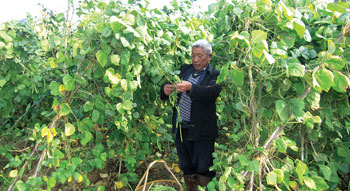
With the continuous advancement of the "balance between farming and breeding" model, vegetable cultivation has become an important industry in the village
For Cheng Zhanglong, head of the Lujue Breeding Cooperative in Shengping Village, Guankou Subdistrict, the most worrying issue now is not raising pigs, but growing vegetables.
As a major local pig farmer, Cheng Zhanglong's annual pig inventory has long remained at around 1,000 head. Starting in 2013, through the pairing of farming and breeding, his more than 1,000 pigs gradually achieved "zero discharge." To consolidate the effect of the "balance between farming and breeding," he is currently planning to expand the cooperative's vegetable planting area.
In Shengping Village, there are 43 other farming households like Cheng Zhanglong that have achieved "zero discharge" through the balance between farming and breeding. Since the village-wide promotion of the "balance between farming and breeding" began in 2014, 5,000 pigs in the village have now achieved "zero discharge," truly realizing that "fertile water does not flow into an outsider's field."
Investing more than 200,000 yuan to try the "balance between farming and breeding"
Yesterday, the reporter walked into Baini Group of Shengping Village. Under large steel-frame greenhouses, clusters of celtuce and cabbage were growing rapidly, a lush green expanse that was truly delightful. "Because the main fertilizer is fermented pig manure water, the vegetables grow even better." Cheng Zhanglong, busy checking the transport pipes, looked proud.
In 2007, attracted by the then booming pig farming market, Cheng Zhanglong built a farm in the village and expanded it through self-breeding and self-raising to an annual inventory of 1,000 head. "As the scale grew, so did the pollution." Cheng Zhanglong told the reporter that the pungent odor and pig waste drew complaints from villagers.
"If I don't find a solution, sooner or later I won't be able to keep raising pigs." Cheng Zhanglong was clearly aware of this fact. To reduce pollution, Cheng Zhanglong tried "dry-wet separation discharge technology" and other methods, but ultimately had to give them up because the workload was too great. In 2013, Cheng Zhanglong began a new attempt at pollution control. This time he transferred more than 150 mu of land for vegetables and invested a total of more than 200,000 yuan to build 11 new biogas digesters, 3 manure storage tanks, and more than 600 m of biogas slurry transport pipes, initially establishing the "balance between farming and breeding" model.
Village-wide promotion: 5,000 pigs achieve "zero discharge"
Solving the problem of farming pollution requires a development-oriented approach and properly adjusting the production relationship between the farming industry and the planting industry. If livestock manure produced by farming is used for crop production, it is a return to the biological chain. It can solve the pollution problem of the farming industry, solve the fertilizer needs of the planting industry, reduce the use of chemical fertilizers, and also produce organic and environmentally safe food. It is a good thing that achieves multiple benefits at once. This is the essence of the balance between farming and breeding.
"Pig manure and urine go into the biogas digester, the fermented biogas slurry is transported to the fields through pipes, and the biogas residue is made into granular fertilizer for sale." Cheng Zhanglong said that according to the allocation standard of 3 pigs per 1 mu of land, in the first year of operation, his more than 150 mu of vegetables basically did not need purchased fertilizer, and the vegetables grown tasted more refreshing. Pig manure water irrigated the vegetables, and the vegetable leaves could in turn feed the pigs, achieving a three-dimensional cycle.
From farm waste to fertilizer for organic vegetables, more and more villagers saw the economic benefits of Cheng Zhanglong's "balance between farming and breeding" model. To further expand the scale, in 2014, with the assistance of the Municipal Environmental Protection Bureau, the "balance between farming and breeding" model was officially promoted throughout the village and was included in Changsha's "balance between farming and breeding" project.
"Last year I raised more than 170 pigs and paired them with 10 mu of vegetables. Although pig prices were weak, the vegetables earned more than 70,000 yuan." Villager Wang Nanqi is a beneficiary of the "balance between farming and breeding." "Next, I also plan to continue optimizing vegetable cultivation to further improve the benefits of the 'balance between farming and breeding.'"
"At present, 44 farming households in the village have adopted the 'balance between farming and breeding' model, and more than 5,000 pigs have achieved 'zero discharge.'" A person in charge of Shengping Village told the reporter that with the continuous advancement of the "balance between farming and breeding," the village has also developed more than 200 mu of fruit cultivation and more than 200 mu of selenium-enriched rice cultivation. Next, while continuing to promote the "balance between farming and breeding," the village will further optimize the industrial structure and build a modern agricultural industrial base.