Ecological Farming Helps Pig Farmers Get Rich
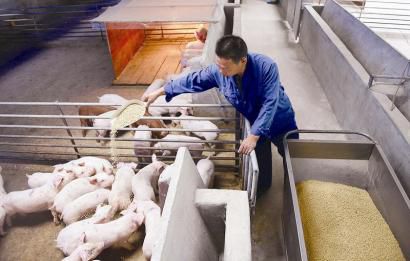
Wu Liekun is feeding the pigs.
Wu Liekun is a villager of Longlan Village, Xintang Town, Gangnan District, Guigang City, Guangxi. He had previously been working in Guangdong. In early 2014, at the urging of fellow villagers, Wu Liekun returned home and set up a pig farm. In less than a year, he earned nearly 300,000 yuan.
"While increasing income and getting rich, the living environment around the pig pens has improved noticeably, achieving a 'win-win' result," Wu Liekun said with a smile. In the past, the pig pens reeked terribly and the sanitary conditions were very poor, drawing many complaints from nearby villagers. Now, with the ecological farming method, not only has the environment of the pig pens improved, but all kinds of manure are recycled. With better sanitary conditions, fewer pigs get sick, and the meat quality has also improved.
Walking into Wu Liekun's pig farm, a large speaker is playing various kinds of music on a loop. The pig pens are divided into upper and lower levels, separated by a mesh frame in the middle. Unlike old-style pig farms, Wu Liekun's pig farm has clean floors and no pungent stench.
"Playing music is to get the pigs used to sound, so they won't be easily startled later," Wu Liekun explained. His pig pens use the "high-bed pig raising" automatic waste-cleaning model. The pigs sleep on mesh beds, and their waste is automatically separated. After fermentation, the manure is used as organic fertilizer, and the urine is used for biogas power generation. Pig farming waste is "squeezed dry and used up."
At present, Guigang City already has 126 large-scale farms using high-bed farming technology, 248 farms using livestock and poultry manure to produce biogas, and 423 farms using an ecological farming model that combines planting and breeding.
"Ecological farming is a broad concept. It includes both the ecology of the farming process and the ecology of the residents and the surrounding environment," said Liu Xiangdong, a doctor from Huazhong Agricultural University. Taking pig farming as an example, he said it is necessary both to keep the pig pens clean and sanitary so the pigs have a comfortable living environment, and to use dry-wet separation and anaerobic fermentation to comprehensively utilize livestock and poultry manure and improve the surrounding environmental ecology.
"What pig farmers worry about most is pigs getting sick and meat prices falling," Wu Liekun said. His first batch was 680 pigs, and his second batch was 750 pigs. Because he adopted the "ecological farming" method, the pig survival rate was above 99%. Now the 750 pigs he is raising are already the third batch. "I signed a purchase agreement with the company, adopting a guaranteed-price buyback method. Even though pork prices fluctuated sharply last year, each pig still brought a profit of around 200 yuan."
Huang Dingshou, chairman of Guangxi Yangxiang Co., Ltd., which signed the buyback agreement with Wu Liekun, said: "Ecological farming has a high technological content, and it is difficult for farmers to manage on their own. What the company provides is technical support and market guarantees." To strengthen its technical support capacity, the company cooperates with multiple research institutes to intensify pig breed improvement and control costs.
Huang Dingshou introduced that in order to reduce the risks for farmers, the company adopted the "company + farmer" and "company + family farm" models. The company is responsible for providing farmers with seedlings, feed, farming technology, veterinary medicine and epidemic prevention and health care, and order contract buybacks, while farmers are responsible for building the pens and providing labor. "In the past two years, the farming market has been sluggish, but the company insisted on purchasing pigs from cooperative farmers at guaranteed prices according to contract, ensuring that cooperative households could make a profit of more than 100 to 200 yuan per pig."
Speaking of future plans, Huang Dingshou said that Guigang City is constantly innovating ecological farming models and exploring the "company + cooperative" model to support poor rural households. The company is working with local cooperatives to build pig farms. One cooperative raises 1,000 pigs, and at the same time uses treated manure to grow a 100-mu ecological base. Each cooperative provides targeted assistance to 10 poor households. "For each poor household that works at the pig farm, the annual income can be more than 20,000 yuan."