Zhangjiakou migrant worker Liu Zhirong returns home to start a business and leads villagers to prosperity
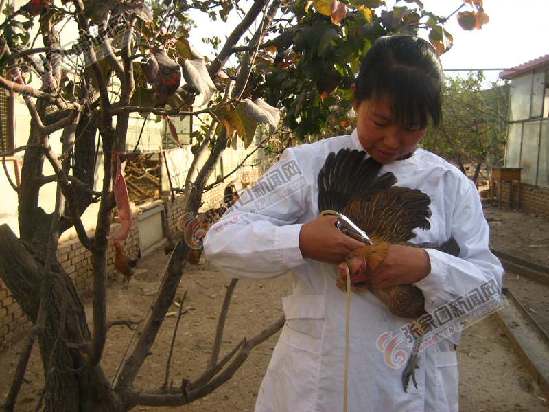
Liu Zhirong is injecting vaccines into the chickens.
Liu Zhirong is feeding the chickens.
To put her brother through university, the younger sister gave up her studies
Liu Zhirong's face is full of the tenacity and confidence of a woman born in the 1980s.
In order to put her brother through university, she once gave up the chance to attend university herself and resolutely went to Beijing to work.
Liu Zhirong is 28 years old this year and was born in Dacanggai Village, Xuanhua County.
Her shoulder-length hair brings out her delicate features.
Dacanggai Village is a natural village where people mainly rely on growing field crops such as millet and corn. With drought in nine out of ten years, income is meager.
In 2003, villager Liu Qinggui's son Liu Zhigang was admitted to Shijiazhuang Railway Institute, making life even harder for this family that relied solely on farming to make a living.
In 2004, daughter Liu Zhirong also received an admission letter from Hebei Management Cadre College.
For other families, having both children admitted to university would be a cause for great celebration. However, for Liu Qinggui, he could not feel happy about it at all. As the date for his daughter's university enrollment drew nearer day by day, in order to scrape together 5,000 yuan for her tuition, Liu Qinggui, who normally never smoked, squatted at the base of the wall those days, puffing away on cigarettes in silence.
"Dad, I won't go to university. Let's all work together to put brother through school." The clever daughter saw through her father's worries and comforted him.
On August 29, while many prospective university students were pulling their suitcases and heading off to register at university, Liu Zhirong quietly hid her admission letter behind her father's back, simply packed some clothes and daily necessities, shouldered her luggage, and boarded the train to Beijing.
The road of working in a foreign place is arduous, but it was far harder than Liu Zhirong had imagined.
Just think, a 17 or 18-year-old girl from a mountain town coming to a strange big city, how easy could it be to find a suitable job?
When she first arrived, Liu Zhirong worked as a waitress at a restaurant near Wangfujing in Beijing. Because she was willing to endure hardship and cherished this hard-won job, two months later she became the best among more than 10 waitstaff, with a monthly salary of over 2,000 yuan.
Although Liu Zhirong was earning a salary and could support herself, she was frugal and never spent a single cent carelessly. Every month, besides sending her brother's university living expenses on time, she saved the remaining money to help support the family.
Next to the restaurant where Liu Zhirong worked was a large supermarket, but she never once went in to buy herself a piece of clothing.
Returning home to start a business, building a chicken farm under the forest
On the eve of the Mid-Autumn Festival in 2008, Liu Zhirong quit her restaurant job and went to a large-scale breeding farm in the suburbs of Beijing to learn breeding techniques while keeping abreast of market conditions.
During this time, she met Gao Yongqing, a young man from Xiyulin Village, Qiaodong District, Zhangjiakou City, who worked as a technician at the farm.
At the end of 2008, Liu Zhirong, who had been a "Beijing drifter" for 4 years, and her boyfriend Gao Yongqing returned to their hometown hand in hand.
In 2009, Liu Zhirong and Gao Yongqing walked hand in hand into marriage.
After marriage, Liu Zhirong decided to make free-range chicken farming under the forest her entrepreneurial goal.
Caomao Mountain is located south of Xiyulin Village in Qiaodong District, with lush trees and fresh air.
At the foot of the mountain, orchards stretch in patches and pastures are lush. The excellent ecological environment makes it a great place for developing ecological farming.
In 2010, attracted by the investment promotion policies of Yaojiazhuang Town, Liu Zhirong sold her apartment in the city, raised 150,000 yuan from various sources, and with the support of the town Party committee and government, she built the "Nanshan Orchard Free-Range Chicken Farm" in the 20-mu orchard under Caomao Mountain contracted by her father-in-law Gao He. She registered the "Qingrong" trademark and began free-range chicken farming.
"In recent years, people's demand for free-range eggs has been increasing year by year, but most local chicken farmers operate on a free-range basis with small-scale farms. For most of the year, people eat mostly high-priced eggs from other places. The free-range chicken market has huge potential." Liu Zhirong said that as people's living standards improve, their requirements for food safety are also getting higher and higher. Free-range eggs, with their pollution-free, contaminant-free and natural green characteristics, are becoming increasingly popular in the market. But raising free-range chickens also carries great risks. Amid doubts from family and friends, she pinned her hopes on free-range chicken farming.
In 2010, Liu Zhirong purchased more than 5,000 chicks from the Beijing Yukou Hatchery. Six months later, the free-range chickens began laying eggs.
During that period, Liu Zhirong frequently traveled between the city's agricultural science institutions, animal husbandry and veterinary stations, and breeding farms, visiting, seeking advice, attending lectures, and learning about breeding management and disease prevention knowledge. She purchased books such as "Poultry Medication Guide" and "Complete Guide to Chicken Disease Diagnosis and Treatment," subscribed to related newspapers and periodicals, and adopted traditional free-range methods for breeding, with all-day lighting free-range raising, using wild fruits, insects, grass seeds as staple food, and corn, wheat, bran as supplementary feed. In the chicken coop, she used three-layer wooden frames as resting places for the free-range chickens at night. For chicks, she adopted scientific breeding techniques such as heater temperature control and humidity monitoring.
It happened that free-range eggs fetched a good price that year, and she earned 150,000 yuan that same year.
After striking her first pot of gold, Liu Zhirong was overjoyed. She tasted the sweetness of raising chickens for the first time, and also tasted the hardships of entrepreneurship for the first time.
In order to improve the quality of free-range eggs, Liu Zhirong started with chicken feed, preparing pure grain feed such as carrots, Chinese cabbage and corn, making the free-range eggs more natural and greener.
Introducing new breeds, "five-color free-range eggs" become popular in the market
In January 2012, Liu Zhirong saw a TV program in which some farmers sold five kinds of rice - red, black, purple, green and white - mixed together, called "five-color rice," at a price much higher than ordinary rice. She had a sudden inspiration: could she copy the "five-color rice" idea to her eggs to increase the profit margin of the chicken farm?
In February of that year, after investigation from multiple sources, she successively introduced five new breeds of chicks from Baoding - free-range chicken, silkie, Hy-Line Brown, Hy-Line White and Hy-Line Gray - 1,000 of each. She raised the five different breeds of chickens free-range.
Free-range chickens lay light green eggs, silkie chickens lay dark green eggs, Hy-Line Brown lays brown eggs, Hy-Line White lays white eggs, and Hy-Line Gray lays pink eggs.
From then on, the "five-color free-range eggs" in Liu Zhirong's chicken farm were born, and as soon as they entered the market, they were immediately favored by consumers.
She also packed the "five-color free-range eggs" in bamboo baskets, then wrapped them with plastic wrap. At 15 yuan per jin, they immediately became "gift eggs" and entered major supermarkets and shopping malls.
"Now, a supermarket in Xuanhua has agreed to carry the 'five-color free-range eggs.' I've also signed an order for 2,000 jin per month with a unit in Mentougou District, Beijing. The market prospects for 'five-color free-range eggs' are very promising." Liu Zhirong said happily when talking about the future.