How profitable is returning home to raise chickens? A migrant worker increases his annual income by 300,000
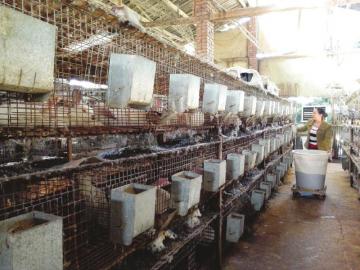
Zou Xingli feeding the rabbits
Getting up at 6 a.m. every day, loading more than 10 free-range chickens and over 100 chicks into a pickup truck, and taking them to town to sell has become the daily routine of Wang Jiubo, a villager from Jiazi Kou Village, Jiuzhi Town, Hejiang County, Luzhou, since the beginning of this year, and it is also the happiest "income" period of his day.
Having returned home more than 3 years ago, Wang Jiubo and his wife have successively raised rabbits and free-range chickens at home, and hatched and raised chicks. Comparing this with the 8 years he spent working away from home, Wang Jiubo frankly says that being back home feels steady and gives him a sense of belonging.
Statistics from the Luzhou Municipal Employment Bureau show that since January 2013, 5,194 migrant workers in the city have returned home to start businesses, with a total investment of 3.77 billion yuan, directly driving the employment of more than 40,000 surrounding villagers. The local government has also formulated various measures to actively create conditions for returned migrant workers to start their own businesses, opening up a "green channel" for migrant worker entrepreneurship.
Starting a breeding operation at home
A migrant worker earns 300,000 a year
3 years ago, Wang Jiubo, who had worked in Zhejiang for 8 years, and his wife Zou Xingli returned to their hometown - Hejiang Jiuzhi.
While away, the couple had no special skills and made money by transporting goods. In the second half of 2012, because business was difficult, and it happened that their hometown was undergoing development, and thinking they could take care of the whole family, Wang Jiubo discussed it with his family and decided to return home to develop.
Having their own land in their rural hometown is Wang Jiubo's advantage. Wang Jiubo's land is right next to the house. After returning home, the couple built a rabbit breeding base of more than 300 sq m on flat ground less than 50 m from home and began raising rabbits. After 3 years, now, every month, Wang Jiubo's rabbit breeding site can produce more than 1,000 rabbits, and there is no worry about sales.
Since the beginning of this year, Wang Jiubo and his wife have begun discussing developing another breeding business, so on another hillside plot near their home, flocks of free-range chickens run happily every day. Wang Jiubo introduced that since the beginning of this year, in addition to raising more than 20,000 free-range chickens, they are also hatching chicks. At present, there are more than 1,000 chicks at home waiting to be sold.
Zou Xingli did a quick calculation: since the beginning of this year, nearly 30,000 chicks have been sold, and sales of free-range chickens have also reached nearly 7,000. At a price of 8 yuan profit per chick and 15 yuan profit per free-range chicken, then this year, income from raising chickens alone would be 345,000.
Wang Jiubo said that next year, he will further expand the breeding farm. "Near my home, there are still several hundred mu of mountain forest. I plan to set up a Ningxia breeding farm here, specifically for raising free-range chickens."
What has returning home to develop brought him? Wang Jiubo frankly says, "Only those who have experienced working away from home know what it is like. Every day you eat in a hurry, and missing your child really cannot be stopped." Now, every evening, the whole family sits around the round table for dinner, happy and harmonious, something he would not have dared to imagine just a few years ago.
Returning home to learn skills
A construction worker starts a business and becomes a boss
On November 20, in the "Nine-Colored Sweet Yuan" orchard in Dadukou Town, Naxi District, Luzhou, the owner Yu Zongqin was building trellises for grapes together with other fruit farmers. For Yu Zongqin, being able to return to his hometown after years of drifting away and establish an orchard is the happiest thing possible.
Yu Zongqin is from Dadukou Town, Naxi District, Luzhou. In 2004, Yu Zongqin left home to work elsewhere and began working in the construction industry, moving from place to place across the country. However, after years of drifting away, he longed for the day when he could return to his hometown and have a career of his own.
In 2010, through an exam, he returned to Luzhou to participate in 3 years of full-time off-the-job training, studying a total of 21 subjects including agriculture and entrepreneurship. After completing his studies, Yu Zongqin no longer went out to work, but instead began starting his own business. After investigations from multiple sides, Yu Zongqin decided to invest in agriculture and began establishing an orchard in his hometown. "When I first came back, this land where the orchard now is was still an abandoned factory and wasteland. Thinking it was a pity for these plots to sit empty, I decided to take them over."
At first, Yu Zongqin did not have much land transferred to him, and he only planned to plant some grapes and do a little business. However, with later government support, the land he could dispose of grew more and more, eventually reaching a scale of 700 mu. So he began planting more fruits. Now, Yu Zongqin has built this 700 mu of land into an orchard and has also begun planting all kinds of fruits in it. "What I want is for the orchard to have fruit in all four seasons and to make it into an experiential picking base. Now sweet oranges, plums, watermelons, peaches have already been planted... after a while longer, they will all grow up."
/Reason analysis/
Government builds channels; development opportunities attract migrant workers to return home and start businesses
In Jiuzhi Town, the number of returned migrant worker entrepreneurs like Wang Jiubo has been gradually rising in recent years. Bai Zhengtao, a staff member of the Employment and Labor Security Service Center of Jiuzhi Town, introduced that since this year alone, more than 100 farmer entrepreneurial self-employed households have registered with the industrial and commercial office. Another observable data change is that the amount of loans applied for each year is also gradually climbing, several times higher than in previous years. The local government noticed that returned migrant workers' entrepreneurship mainly focuses on developing breeding industries. In order to build a better sales channel for entrepreneurs, it is considering starting construction next year in the town of a "large agricultural products wholesale trading market."
"Being nearby not only allows one to look after family, but everyone can also earn money at home, so why not do it?" Bai Zhengtao said. Taking Jiuzhi as an example, Jiuzhi Town faces Chishui, Guizhou across the river and is connected by a bridge. It is an important node for two-way connection between Sichuan and Guizhou, and it is also a national designated town pilot demonstration town, currently focusing on building itself into an important border trade and tourism town. In the development process, as urban traffic roads and infrastructure are continuously built and improved, the hometown environment is getting better and better, and more and more migrant workers choose to return to Jiuzhi.
Bai Zhengtao said that in recent years, the town's development has brought him many surprises, but what surprised him most is that originally Jiuzhi Town had a registered population of less than 7,000, but now nearly 30,000 people live in the town long term. "Many people, after returning home and making money, are willing to come to the town to buy houses," Bai Zhengtao said.
/Policy help/
A general trend; the government opens a "green channel" for entrepreneurship
According to statistics from the Luzhou Municipal Employment Bureau, as of now, Luzhou has more than 1.5 million people working elsewhere. According to preliminary statistics, since January 2013, 5,194 migrant workers in the city have returned home to start businesses, along with 501 farmer entrepreneurs, with a total investment of 3.77 billion yuan, directly driving the employment of more than 40,000 surrounding villagers.
"When investigating the entrepreneurship situation of returned migrant workers, we found that there are mainly 4 entrepreneurial models." A relevant person in charge of the Luzhou Municipal Employment Bureau introduced: First, the basic survival-oriented model. This type of entrepreneurship mainly appears as family workshops, small factories, small shops, small restaurants, and the like, with low requirements for capital, technology, and management. Second, the policy-guided and industry-driven model, using the different resources and different advantages of each district and county to carry out planting, breeding, and so on. Third, the entrepreneurship model of transforming from work away from home, where workers bring back technology, management experience, market customers, and orders, and some also bring back skilled workers, so the success rate of entrepreneurship is relatively high. Fourth, the "capable person + returned-home entrepreneurship mutual assistance" model, directly driving the employment of more than 100 surrounding villagers.
In addition, judging from the entrepreneurial industries of returned migrant workers, entrepreneurs in the primary industry and tertiary industry account for 86% of returned entrepreneurs. "So we also carry out targeted entrepreneurship training for returned migrant workers. For example, training for the primary industry and tertiary industry will correspondingly be much greater." the person in charge introduced.