Laping Village Broadens the Path to Prosperity with a Beautiful Industry
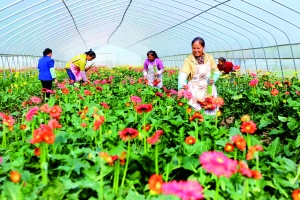
In the flower greenhouses of Laping Village, Xiaba Town, flower farmers are picking fresh flowers.
"In mid-July, the first crop of Gerbera jamesonii (African daisies) grew in these flower greenhouses. By this month, the village collective had earned nearly 160,000 yuan from selling Gerbera jamesonii." Recently, standing in front of the 40-mu flower greenhouses in Laping Village, Xiaba Town, looking at the flourishing flowers before him, village Party secretary Du Yingsheng could not help but recall the scene a year ago when the village held a general meeting of the members of the pollution-free vegetable association.
That was November 2014. Laping Village, which had just been rated a demonstration village for collective economic development, received a 900,000-yuan fiscal allocation from the Provincial Department of Finance. The result of the village committee members' discussion was to use this money to transfer 40 mu of land in Laping Village to build flower greenhouses for growing Gerbera jamesonii. "At the time, as soon as they heard that 300,000 yuan had to be raised to develop the flower greenhouse industry, more than 10 association members attending the meeting walked off without a second word." Du Yingsheng said.
In fact, in choosing this industry, Laping Village had a successful example to refer to. As early as 2012, due to industrial park construction, two flower farmers whose land was requisitioned in Dongfeng Town moved their flower greenhouses to Laping Village, and by transferring 40 mu of local villagers' land, they built 100 Gerbera jamesonii greenhouses.
Du Yingsheng had asked them about income matters - one greenhouse can plant 1,500 Gerbera jamesonii seedlings, and each seedling grows about 35 flowers. In the past two years, the average wholesale price of Gerbera jamesonii has been 0.4 yuan per stem. By calculation, the annual output value of one Gerbera jamesonii greenhouse is about 20,000 yuan, and one mu of land can build 3 such greenhouses.
For local farmers accustomed to growing rice and vegetables, this is an industry with surprisingly high returns. The trouble is that developing the flower greenhouse industry requires high upfront investment costs, including buying seedlings in Kunming, building greenhouses, digging drainage ditches, and so on. To build these 100 Gerbera jamesonii greenhouses, the upfront investment is at least 1.2 million yuan.
For Laping Village, apart from the 900,000 yuan of support funds allocated by the Provincial Department of Finance, the remaining 300,000 yuan was temporarily unaccounted for. Therefore, Du Yingsheng first thought of the village's pollution-free vegetable association.
12 years ago, in order to escape poverty and achieve prosperity, Laping Village had encouraged villagers to develop the vegetable planting industry. The pollution-free vegetable association was established at that time, with the purpose of uniting the village's vegetable growers, unifying vegetable sales prices, and opening up external sales channels.
More than ten years have passed. Although Laping Village's vegetable planting industry gradually declined, the association's more than 50 members, through years of hard work and struggle, became an important local force with advantages in capital and connections.
Mobilizing their enthusiasm and having them raise the remaining 300,000 yuan of development funds in the form of share subscription became the village committee members' initial idea. In November 2014, the general meeting convened by Laping Village with all members of the pollution-free vegetable association was held against this background.
But unexpectedly, the scene at the beginning appeared. "Of the more than 50 members attending the meeting, more than a dozen left on the spot." Du Yingsheng said that it was not that everyone did not know that growing Gerbera jamesonii could make big money; they simply did not agree with the village committee's idea of members subscribing shares and receiving year-end dividends. They advocated that after raising the funds, the 100 completed greenhouses should be distributed to members for contracting, with part of the profits handed over to the village collective each year. Du Yingsheng would not agree to this either. "The operating entity of the village collective economy must naturally be the village collective. Contracting them out to individuals would violate the original intention of collective economic development."
Because the issue of share subscription could not be resolved at the meeting, Du Yingsheng had no choice but to announce that interested members had to complete their subscription before December 30 of that year, and applications after the deadline would not be processed. As a result, after the prescribed deadline passed, the 300,000 yuan of development funds was still unaccounted for.
However, industry development does not wait for anyone. The coming warm spring, suitable for flower cultivation, also urged the Laping Village committee members to quickly find a way to solve the shortage of funds. One emergency solution was that the 10 village committee members of Laping Village took the lead in raising 200,000 yuan, and the village collective borrowed 80,000 yuan from the Xiaba Town credit union.
After a series of twists and turns, Laping Village's 100 flower greenhouses finally began construction in January of this year; in April, the first batch of Gerbera jamesonii seedlings was successfully planted; in mid-July, the first crop of Gerbera jamesonii grew; in November, the village collective earned nearly 160,000 yuan from selling Gerbera jamesonii... According to this momentum, Du Yingsheng estimates that all costs can be recovered by the end of next year. By then, the surplus money will be used to develop village-level public welfare undertakings, including the maintenance of the 11-kilometer-long Laping irrigation canal and the hardening of roads connecting 13 villager groups.
It is worth mentioning that recently 3 households of villagers successively approached the village committee members, hoping to apply for loans from the town credit union through their help to build flower greenhouses. "This is also the direction Laping Village strives toward after the collective economy develops, that is, to drive more farming households onto the path of flower industry development." Du Yingsheng said.