Native bee farming catches the internet express, industrialization efficiency greatly improved
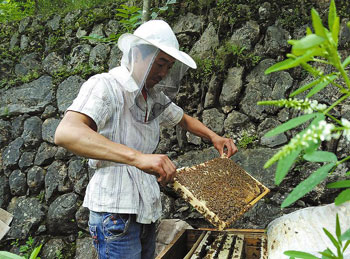
Han Xiao shows reporters the native bees he raises
Han Xiao's native bee farming achieves harmony between people and nature
A migrant worker returns home to raise bees
Sannong Zhitongche comprehensive report: Silkworms spin silk, bees make honey. When people talk about beekeeping, they call it a "sweet business." In March 2010, Han Xiao, a 23-year-old young man from Jiedao Village, Tianzhushan Town, Shanyang County, who was working away from home, happened to see news reports about encouraging and supporting farmers to develop Chinese bee (Apis cerana) movable-frame beekeeping in other places. Thinking that his grandfather and father had once kept Chinese bees, he wondered why not give it a try himself. He bought professional books and returned home to start his beekeeping business.
Although Han Xiao's grandfather and father had both kept Chinese bees, they knew nothing about advanced movable-frame beekeeping techniques. After the first year, of the 10 hives Han Xiao kept, only 3 remained, but he had gained a preliminary grasp of movable-frame beekeeping techniques. In 2013, taking advantage of his home being in the heart of Tianzhushan National Forest Park, Han Xiao built a standardized Tianzhushan Chinese bee breeding demonstration base. By 2015, the number of Chinese bee colonies he raised had grown to 372 hives, with annual income approaching one million yuan, and Han Xiao became a veritable "bee king" in the area.
Native bees take flight with the help of the internet
"Since May this year, as tourists to the Tianzhushan scenic area increased, I sold as much as 1,800 jin of honey in a single month." Speaking of recent sales, Han Xiao said cheerfully. "This is mainly thanks to online promotion and WeChat sales. The vast majority of customers who come to me to buy native honey are people from big cities elsewhere who found my information online or through WeChat on their phones."
Han Xiao said that in May this year, he set up his own Taobao website and posted information about his native bee farming through the site. Unexpectedly, just one day later, he received calls from customers in Wuhan, Shenyang and other places asking about the situation and reserving honey, and they transferred deposits to Han Xiao's account. Subsequently, Tianzhushan native honey opened for business one after another on WeChat public accounts, Weibo, Taobao, JD.com and other online platforms.
Han Xiao said: "Recently the price of native honey has risen. My online price has been adjusted to 79 yuan per jin, yet there are still many customers reserving native honey. Customers from other places such as Xi'an, Wuhan and Shenyang have also come to my door seeking to buy it. Native honey is in short supply."
Leading the masses toward common prosperity
Today's Han Xiao has become a "big figure" for miles around. Whenever beekeepers run into problems, they come running to him for advice. Seeing that Han Xiao earned a lot of money from native bee farming, farmers in the village were also eager to try. Farmers who had kept just a few hives of native bees rapidly expanded their farming scale, and even farmers who had never kept native bees before suddenly started raising dozens of hives. Meng Fanwen, a resident of Dawuchang Group, Jiedao Village, Tianzhushan Town, keeps 60 colonies of native bees. With better weather this year and an extended flowering period, he can harvest nearly 200 kg of honey, generating income of more than 20,000 yuan.
According to Han Xiao, the more than 370 hives of native bees he raises were all developed one hive at a time from wild bees on Tianzhushan Mountain. Apart from using his own timber to make more than 300 beehives, he made no other investment. Day-to-day management is also very simple: clean the beehives once a week, trim the honeycombs once a week, and nothing else needs human attention. "The biggest advantages of native bee farming are low investment, little labor, no worry about selling, and good returns," Han Xiao said with deep feeling.
"In 2014, one hive of native bees could produce eight or nine jin of honey, which could sell for more than 600 yuan. After costs, the net profit was around 400 yuan. This year, due to suitable climatic conditions and ample sunshine, the average yield per hive of native bees reached more than ten jin. Plus the honey selling price rose by more than two yuan per jin, so each hive yielded a net profit of more than 500 yuan. In addition, I can still sell more than 200 colonies of Chinese bees each year, so my income this year increased by more than 50,000 yuan compared with last year." Han Xiao calculated the detailed accounts for the reporter.
In 2015, many specialized Chinese bee farming households in Tianzhushan Town seized the business opportunity created by strong demand for native honey in the e-commerce consumer market and actively expanded native honey production and online and offline internet business. Chinese bee farming in Tianzhushan Town surged to more than 2,000 hives. From beekeeping income alone, the town's earnings increased by nearly 2 million yuan over the previous year, and native bee farming truly became a "money tree" for increasing the income of the people of Tianzhushan.
Native bee farming moves toward industrialization
In recent years, with the construction of the Tianzhushan tourism scenic area, expressways, and roads connecting towns and villages, the formerly isolated Tianzhushan Town has been connected by 4 roads in and out. Every summer, more city people come here to visit and escape the heat. As the most famous local specialty, native honey is deeply favored by visitors, who invariably buy several jin or a dozen-plus jin to take back when they leave.
As Shanyang County focuses on developing the Tianzhushan tourism industry, it has also driven the county's ecological leisure industry and e-commerce to heat up increasingly, with rapid development momentum. Native bee farming has gradually become a new industry for mountain farmers in the county to increase income and become prosperous. On June 1, the Shanyang County People's Government issued the "Implementation Opinions on Accelerating E-commerce Development" and the "Interim Measures for E-commerce Rewards and Support," which were implemented successively. In order to support mountain farmers in developing native bee farming and guide native bee farming toward industrialization and standardization, county departments such as poverty alleviation and trade unions have invited professional technicians from other places many times and held multiple sessions of Chinese bee farming training classes in 3 key towns including Tianzhushan, giving beekeepers hands-on explanations and passing on key techniques, so that they improved their knowledge of scientific breeding and scientific management. In particular, most people in the county's remote mountain areas have set their sights on native bee farming and formulated development plans, and the enthusiasm of bee farmers for breeding is rising wave after wave. In 2015, the county's native bee farming broke through the 10,000-hive mark.
A relevant person in charge of the Tianzhushan Town government introduced that native bee farming has maximized the local forest resource advantages and complements the burgeoning under-forest economy and ecological leisure industry. Combined with the push from the e-commerce industry, its development potential is enormous. The town has firmly grasped this major opportunity, using Tianzhushan Town's unique natural resources to guide villagers in developing native bee farming, and from one point to a broader area, radiating to surrounding mountain towns. While encouraging and supporting farmers to expand farming scale, it actively carries out technical training in native bee farming, further making the native bee farming industry bigger and stronger, striving to reach a farming scale of 6,000 colonies by the end of the "13th Five-Year Plan," with an annual output of 72 tons and annual sales of 10 million yuan, turning the small native bee farming industry into the leading industry for increasing income and bringing prosperity to the local people of Tianzhushan Town.