Post-80s Young Man Returns Home to Raise Sheep and Increase Income
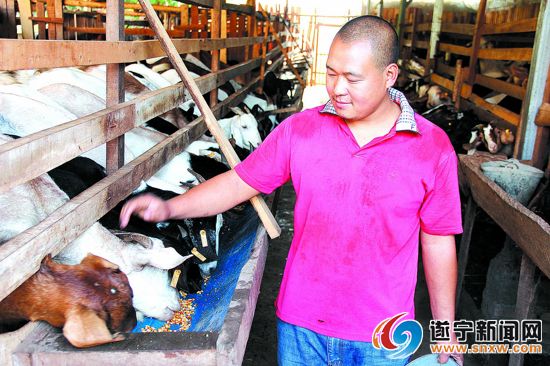
Wang Wancheng, a post-80s young man, is 31 years old this year and a native of Jintaishan Village, Xinxing Township. After returning home during the 2011 Spring Festival, he used his "first pot of gold" earned from working away from home to start a livestock breeding business. During the entrepreneurial process, he went through many setbacks, but never gave up his confidence in breeding. In 2012, he invested more than 200,000 yuan again to raise sheep. He learned while trying, and after 3 years of effort, he finally tasted success, made plans for his breeding business, and also intended to lead the surrounding villagers to prosperity together.
Returning Home to Start a Business in Breeding Becomes a Joy
As the setting sun faded its last trace of light, Wang Wancheng drove nearly 200 goats back home from the hillside. He counted the number again, carefully observed the condition of each sheep, put the sheep into the pen, and then ate dinner. This is the "homework" Wang Wancheng does every day, and it is also the joy of his life.
Although Wang Wancheng has only been raising sheep for 3 years, he has already become the largest specialized sheep-raising household in the village. "Now the sheep pen covers 160 sq m, with nearly 200 sheep. Choosing the path of raising sheep back then was really the right move." Wang Wancheng smiled as he told the reporter about his dream of returning home to start a business. Like other young people, he, from a rural background, set out early to work away from home, working in Guangzhou, Foshan and other places. With the hard-working spirit of a farm child, he earned his "first pot of gold." After returning home during the 2011 Spring Festival, carrying the "hard-earned money" from working away from home, he returned to his hometown and started a breeding business.
After Many Setbacks in Entrepreneurship, He Found a Way Out
Starting a business was never easy, and since Wang Wancheng had been working in the city for many years, he knew nothing about breeding. At first, the chickens, ducks and geese he tried to raise not only failed to make him money, but also caused him to lose 60,000 yuan. Seeing the money invested in breeding just "pop like a bubble," Wang Wancheng's family began to object, hoping he would use the money earned from working away from home to do some other business in the city and leave rural life to live in the city.
"Now rural areas have such good resources, and many farmers are returning home to start businesses. How could we not make money? I just don't believe that." Wang Wancheng said that after the setbacks of raising chickens, ducks and geese, he began market research on breeding and found that raising pigs carried greater risk, required large investment, had high costs, and pork prices fluctuated greatly, while manure caused serious environmental pollution. Relatively speaking, raising sheep had less risk, sheep eat grass, were not affected by changes in feed prices, and caused little environmental pollution.
Investing Again and Becoming a "Sheep Herder"
In February 2012, he decided to invest again, raise meat goats, make reasonable use of the barren hills and wasteland of his hometown, and adopt a free-range breeding model. He acted as soon as he decided: building sheep pens and buying breeding stock, Wang Wancheng became a "sheep herder" again.
At the beginning, Wang Wancheng drove the flock to the mountain to graze together, without separating males from females or adults from young. As a result, the ewes were "harassed" by the rams for a long time, and the reproduction rate was very low, while the lambs could not eat tender grass and grew very slowly. In order to learn breeding techniques, Wang Wancheng used online knowledge and consulted professional books to slowly explore breeding skills. "In summer there is plenty of grass, but the weather is hot, sheep like to bunch together, and they are prone to internal heat and disease, so attention must be paid to cooling the flock. When the sheep come back from grazing, do not rush them into the pen; let them stay in a shady place for a while before entering the pen, and every day feed the sheep salt water 3 times, with about nearly 1 kg of salt added for 100 sheep." Wang Wancheng introduced this to the reporter while taking out the professional breeding books from his home.
Finding a Sense of Achievement and Planning for the Future
"My meat goats are mainly raised on the hillside, growing by eating grass and grain, so the meat is tender, and therefore sales are relatively good." Wang Wancheng said that after more than 3 years of breeding, he had developed from the initial 50 meat goats to nearly 200 now, and the money in his pocket gradually increased, which gave him a sense of achievement. "Next, I plan to expand the scale, implement a half-grazing, half-pen breeding model, establish a sheep-raising cooperative, and lead the surrounding villagers to prosperity together." Wang Wancheng told the reporter with full confidence.