Growing Mulberries and Raising Silkworms Weaves a Path to Prosperity for Farmers in Qiongzhong, Hainan
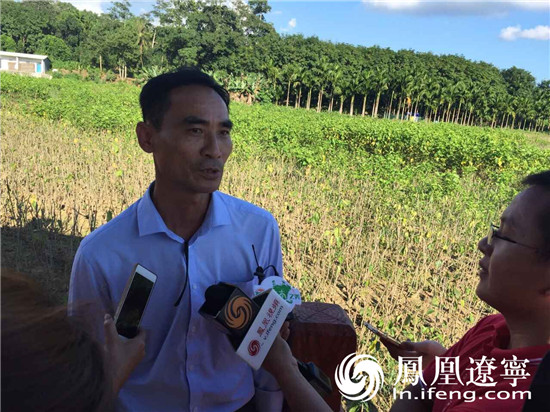
Chen Shijin, a sericulture technician in Lingjiao Village, is interviewed by Phoenix Omnimedia.
Lingjiao Village currently has more than 380 mu of mulberry trees for raising silkworms.
From "struggling around the line of mere subsistence" to "successfully putting several children through university" and moving toward a path of moderate prosperity, this is a true portrayal of the life of Chen Shijin, a villager in Lingjiao Village, Wanling Town, Qiongzhong Li and Miao Autonomous County, Hainan Province, over the past decade.
On November 19, the second Phoenix Omnimedia Hainan Tour, themed "Discovering the Beauty of Hainan," entered Lingjiao Village in Qiongzhong to gain an in-depth understanding of the village's "development story."
Chen Shijin is a sericulture technician in Wanling Town, Qiongzhong Li and Miao Autonomous County, Hainan Province, and one of the first people in Lingjiao Village to grow mulberries and raise silkworms.
In the past, Chen Shijin's family made a living by growing rice, found it hard to make ends meet, and had even less money to send their children to school.
In 2007, the Wanling Town government held free training courses for farmers on growing mulberries and raising silkworms. To mobilize farmers' enthusiasm, the government introduced a preferential policy: those who planted more than 4 mu of mulberry fields could receive a loan of 20,000 yuan from the government. Chen Shijin happened to be in town on business, and town officials had him attend the training.
"At the time I didn't really understand the techniques of growing mulberries and raising silkworms. I just happened to have no money to pay my children's tuition, so I thought of getting the loan to pay the tuition. That's how I began raising silkworms," Chen Shijin said with a smile.
At the very beginning, Chen Shijin did not know what raising silkworms involved, nor how much he could earn from it. When raising his first batch of silkworms, his techniques were poor and he made no money. He had wanted to dig up the mulberry trees, but town leaders arranged for technicians to provide guidance. Chen Shijin learned the techniques and made money that same year.
So why is sericulture in Qiongzhong so profitable? Hainan's climate is a major advantage. Silkworms can be raised inland for only 5 months, while in Hainan they can be raised for 10 months. With more time for raising silkworms, income naturally rises. At the same time, growing mulberries and raising silkworms requires little investment, has a short cycle, and brings quick results. Chen Shijin said: "My income has now increased about 6 times."
Chen Shijin said he has planted a total of 14 mu of mulberry fields. In 2013 and 2014, his annual income reached about 120,000 yuan each year. Compared with before, his income increased more than 6 times.
In the future, Chen Shijin plans to use the entire mulberry-silkworm chain to develop his sericulture business. While using mulberry leaves to raise silkworms, he also wants to make rational use of mulberry stems for comprehensive development.
From November 14 to 22, the nine-day "Discovering the Beauty of Hainan - Second Phoenix Omnimedia Hainan Tour" was launched in Haikou. The Phoenix Omnimedia reporting team set out from Haikou and traveled to Qionghai, Wenchang, Qiongzhong, Danzhou and Changjiang and other places to report and discover the beauty of Hainan.