Sichuan Yibin hairy crab farming: A man from Northeast China drives nearby villagers to prosperity
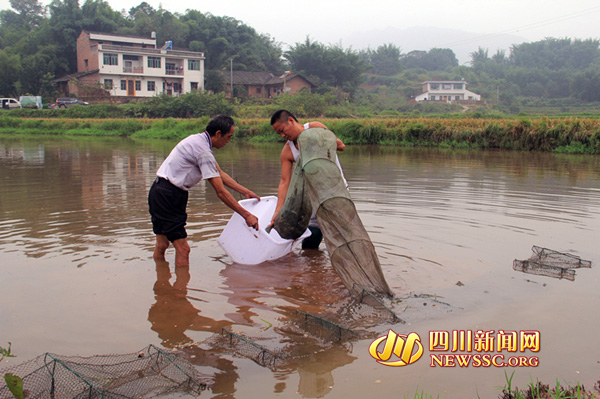
Workers are harvesting hairy crabs
Freshly caught hairy crabs
"Our cooperative now has more than thirty people. Next year we will also expand by 500 mu, so that more farmers can participate and we can drive the surrounding people to prosperity." Today, Wang Hongtao, president of the Hongtao River Crab Farming Association in Changning County, Yibin, told reporters.
As of now, the crabs farmed at Wang Hongtao's 1,100-mu hairy crab farm have already reached the dining tables of residents in Yibin, Luzhou, Zigong and other places. Wang Hongtao has also achieved sales revenue of more than 8 million yuan, and it is expected to exceed 10 million yuan for the whole year.
A man from Northeast China travels far to Yibin to farm crabs
Wang Hongtao is from Northeast China. In 2013, while traveling to the Shunan Bamboo Sea, Wang Hongtao spotted the local natural environment with green mountains and clear waters. "The mountains here are good and the water is good. There is no industry and no pollution. It is a good place to develop agriculture," Wang Hongtao said.
After several inspections, Wang Hongtao finally chose Laoweng Town, which has an excellent ecological environment and abundant water resources. The town is adjacent to the Shunan Bamboo Sea scenic area, has more than 20,000 mu of paddy fields, and possesses conditions for high-quality aquaculture. In early 2014, Wang Hongtao introduced Chinese mitten crab seedlings from his hometown of Liaoning, adopted ecological cultivation methods, and used corn as feed to farm pure natural Yibin-version hairy crabs.
The Chinese mitten crab is an economically important crab species, also known as river crab, hairy crab, clear-water crab, and hairy crab. It is a long-renowned delicacy in China. Its chelipeds are used for feeding and resisting enemies, and the inner and outer edges of the palms are densely covered with fine hairs, which is how the mitten crab got its name.
Wang Hongtao said that his hairy crabs are mainly meant to satisfy the market within Sichuan. In order to let the hairy crabs "settle down" in Yibin, the local government made Wang Hongtao's river crab farming base a key supported project and funded the repair of roads, field ridges, water channels and other infrastructure. After the hairy crabs successfully "moved" to Laoweng Town, they quickly adapted to the local climate and water sources.
Establishing a farming association to drive surrounding villagers to prosperity
"Because they are fed purely on grain, compared with crabs fed on feed, they are smaller and cannot fetch a good price." In the early stage of farming, Wang Hongtao encountered this worry. For this reason, the relevant departments of Changning County and Wang Hongtao jointly sought solutions.
After repeated experiments, we found that using co-cultivation technology of rice fields, lotus root fields, fish ponds and river crabs not only fattened the crabs, but also increased the yield and income of lotus root fields and rice fields, achieving multiple benefits at once. "We do not feed them feed; we use grain, so they can be called pure natural crabs," Wang Hongtao introduced. Laoweng Town is rich in water resources, and the river crabs are farmed in rice fields and lotus root fields, absorbing spring water that seeps from the mountains and the edges of bamboo forests.
Local aquaculture experts introduced that farming river crabs in rice fields is beneficial to rice growth and can also create a good ecological environment for the river crabs. The water in rice fields is shallow, and the water temperature rises easily, which readily breeds various small organisms and provides young crabs with abundant bait organisms. At the same time, rice also provides river crabs with an environment for shelter and concealment; the crawling movement of river crabs and their activity of ingesting benthic organisms play a role in loosening the soil and promote the growth of the entire lotus root plant; the feces excreted by river crabs contain nitrogen, phosphorus, potassium and other nutrients, playing a fertilizing role. This mutually beneficial relationship forms a reasonable ecological balance between rice and river crabs.
At present, Wang Hongtao's Hongtao River Crab Farming Association has more than thirty members. In addition to providing farming technical training to local people, Wang Hongtao has also provided job opportunities to relatives from near and far. "At the current scale of 1,100 mu, I rent it at a price of 400 yuan per mu, and nearby farmers also work for me. Every year I pay them tens of thousands of yuan in wages. These are all real income," Wang Hongtao said.
"We currently have two physical river crab stores, one in Changning County town and one in Nanxi District," Wang Hongtao said. This year their river crab output is more than 30,000 kilograms, and the association will also sell through the internet and online stores, shipping according to order quantities.
It is reported that next, Wang Hongtao will continue to expand the farming scale, further improve infrastructure construction, and develop rural tourism, so that tourists from all places can come to taste Laoweng hairy crabs and drive local people to increase their income.