Luo Guangxian raises pigs with mulberry leaves, forging a circular road to wealth through planting, breeding and construction
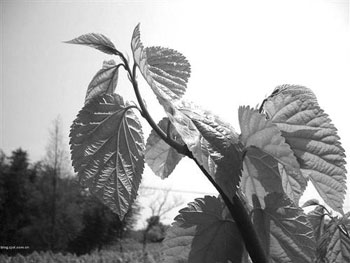
Mulberry leaves
Mulberry leaves, in most people's view, are used to raise silkworms. But in the view of Luo Guangxian of Group 5, Fengxiang Village, Shanling Township, Qianjiang District, mulberry leaves can be used not only to raise silkworms, but also to raise pigs. He broke through traditional thinking, planting mulberries and raising silkworms as well as pigs, launching a circular economy model of "planting, breeding and construction."
Getting rich by cocooning
Luo Guangxian is a true farmer. In 2008, the local government vigorously developed mulberry planting and silkworm raising, not only organizing large silkworm-raising households to visit and learn at sericulture demonstration gardens in other townships, but also sending professional technicians from the agricultural service center to give on-site guidance on mulberry garden construction, silkworm shed building and feeding management, and building greenhouses for each large silkworm-raising household.
Raising silkworms has low cost and high efficiency. Luo Guangxian seized this business opportunity, and so contracted 50 mu of land for planting mulberries and raising silkworms. He knew well that only with good silkworm-raising techniques can silkworm-raising efficiency be high. Therefore, whenever he had time, he would go to other townships to study and visit, and go to the rural library to look up silkworm-raising techniques.
As the saying goes: planting is gold, management is silver, and raising silkworms is the treasure bowl. This means that managing the mulberry garden well is the foundation, and only scientific silkworm raising can maximize efficiency.
To grow a good mulberry garden, after planting the mulberry seedlings, Luo Guangxian, in accordance with the technicians' requirements, conscientiously did the management and protection work of weeding, fertilizing, loosening the soil, fixing the trunks, whitewashing, and preventing and controlling diseases and pests, and the mulberry seedlings grew lush and green.
In aspects such as disinfecting the silkworm room and preventing and treating silkworm diseases, Luo Guangxian flexibly applied the knowledge he had learned, and ultimately relied on planting mulberries and raising silkworms to embark on the road to wealth.
Raising pigs with mulberry leaves
During the process of raising silkworms, Luo Guangxian summed up a principle: in late autumn the temperature is relatively low, the cocoon yield is also low, and the efficiency of silkworm raising is far worse than in the previous seasons. For this reason, he decided not to raise late-autumn silkworms anymore.
But Luo Guangxian noticed another problem: if late-autumn silkworms were not raised, the mulberry leaves would be wasted, and large expanses of lush green mulberry leaves would fall in vain, which was truly a pity.
How could these mulberry leaves be put to use? He kept pondering, and finally thought of a way to feed pigs with mulberry leaves. He also found online cases of farmers in other provinces and cities raising ecological pigs with fodder mulberry leaves, which further strengthened his idea.
It is understood that the mulberry tree contains 17 kinds of natural amino acids, 6 kinds of vitamins and 8 types of minerals. The protein content in mulberry leaves is as high as 36%, and they are also rich in crude fat, calcium, potassium, magnesium and other inorganic salts. The pork raised with mulberry leaves, after testing by a testing center, is generally higher in protein, amino acids and other nutrients.
So Luo Guangxian picked the surplus mulberry leaves and fed them to the fattening pigs. That year, after slaughtering the New Year pig, he unexpectedly found that the pork tasted better than before. "Practice has proved that raising pigs with mulberry leaves can indeed improve pork quality," Luo Guangxian said.
Energy saving and emission reduction
Right after that, Luo Guangxian built a pig farm and a biogas digester. At present, his pig farm has 100 head on hand and 200 head marketed per year.
The manure and sewage discharged from the pig farm are piped into the biogas digester, where fermentation produces biogas used for lighting and cooking; the excess residue and the pig manure that cannot all be contained are used to grow mulberry trees, which grow well and produce many mulberry leaves.
The wastewater and manure residue produced by the biogas digester are transported to the fields, fertilizing the land and being safe; the gas produced is used for lighting and cooking, saving energy and being environmentally friendly. Luo Guangxian said that the "planting, breeding and construction" cycle, on the one hand, develops sericulture planting, so that when the weather is warm more sheets of silkworms can be raised; on the other hand, the use of biogas saves energy and reduces damage to the environment.
"Mulberry trees managed with organic fertilizer produce large and plump mulberry leaves, and the soil is not prone to hardening," Luo Guangxian said. After building the biogas digester, he saved more than 10,000 yuan a year on energy costs alone.
Founding a cooperative
Luo Guangxian told this writer: "'Planting, breeding and construction' not only increases the economic income of farming households, but also protects the environment. In the future, more ordinary people will be encouraged to participate."
Now, Luo Guangxian's farm and sericulture operation have both reached a certain scale, and his techniques for raising pigs and silkworms are gradually maturing. Next, he plans to expand the scale of breeding, establish a professional cooperative for pig breeding (family farm) and a micro-enterprise for sericulture, and raise pigs together with other villagers, using manure to grow mulberry trees, raise silkworms and engage in organic vegetable planting.