Li Haiping, a Woman Expert from Baise, Achieves Prosperity Through Science and Technology
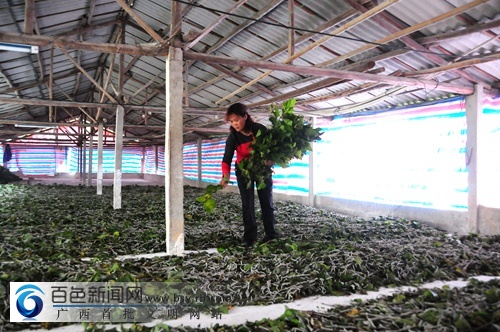
In the photo, Li Haiping is feeding silkworms
In the photo, Li Haiping is tending navel oranges
An ordinary rural woman, she is bold and quick-witted. Through ten years of hard work, she now operates on a scale with an annual income of over 500,000 yuan and fixed assets of over 1 million yuan, making her one of the largest three-dimensional agricultural planting and breeding bases in the county.
She is Li Haiping, a farmer from Du'an Township, Debao County. She dares to venture and dares to start a business. After graduating from junior high school, unwilling to spend her whole life guarding a few mu of barren land at home, she resolutely chose to start her own business. In 2006, she began contracting land in Bangxia Village, Nabu Village, Yandong Township, planting mulberry and raising silkworms, building pens to raise pigs, and reclaiming wasteland to plant fruit, launching a "pig-biogas-mulberry (silkworm)-fruit" three-dimensional agricultural ecological development model. She humbly studied and delved into her trade. When encountering difficulties, she did not become pessimistic, discouraged or retreat, but persisted in learning science and applying science, gradually expanding the scale of planting and breeding. In just a few short years, she became a widely known planting and breeding expert throughout the county, and successively won honorary titles such as "The Second Batch of Rural Practical Top-Notch Talents of Baise City" and "Advanced Individual in Science Popularization Work of Baise City."
Tiny Silkworms Carried Her Over the "Threshold" to Prosperity
Arriving at Li Haiping's mulberry field, a hundred mu of mulberry trees grow in neat rows. Although it is already early winter, under the warm winter sun, the mulberry leaves are still a lush green.
Planting mulberry and raising silkworms was the first industry Li Haiping developed after coming to Bangxia Village to contract land, and it was the tiny silkworms that carried her over the "threshold" to prosperity. That year, she started with 20,000 yuan borrowed from relatives and friends, planted 5 mu of mulberry trees, expanded to 8 mu the following year, and then increased year by year, reaching 100 mu today.
"Raising silkworms has a short cycle, low input, good sales channels and high returns. My silkworm cocoons are produced uninterrupted all year round." Li Haiping told this writer that she has already exceeded her expected target this year, producing a total of 140 sheets and 6,100 kilograms, with an income of 250,000 yuan.
"The early period was still quite difficult." Li Haiping said that she did not have enough experience in raising silkworms before, and a large number of technical silkworm-raising problems almost made her give up. It was the spirit of enduring hardship cultivated since childhood and that firm belief that kept supporting her. In recent years, through bold exploration, Li Haiping continuously took the initiative to consult agricultural technicians at the county and township levels and actively went out for study and training. Through learning, exploration and practice, Li Haiping summed up a set of scientific silkworm-raising techniques, so she continued to expand the contracted land, expand the silkworm rooms, and came to possess her own large-scale mulberry planting and silkworm-raising base. At the same time, she hired 12 local villagers to conscientiously do management and protection work such as weeding, fertilizing, loosening the soil, setting the stems, whitewashing and preventing and controlling diseases and pests according to the seasonal timing, so as to ensure the quality of mulberry leaves and silkworm babies. She also promoted her successful silkworm-raising techniques free of charge. Silkworm farmers from inside and outside the region and counties such as Jingxi, Tiandeng and Daxin came one after another attracted by her reputation to "seek advice," driving more than 100 silkworm-farming households to plant over 10,000 mu of mulberry trees.
The Pig-Raising Industry Is Even More Flourishing
In the large mulberry fields, a great deal of tender wild vegetables grew wildly. Why not make full use of this high-quality resource? In 2008, after Li Haiping achieved results in raising mulberry silkworms, she used the only "dowry" she had brought from her hometown, an old sow, to breed piglets, using the wild vegetables in the mulberry fields as pig feed for original ecological feeding, and built a biogas digester beside the pigpen, which both lowered costs and enabled resource recycling. For this reason, she built a pigpen and began her pig-raising business.
"I suffered from lacking technology. At that time, after the piglets were born, they always had loose stools and diarrhea, and within less than a month they fell one after another. Later, I sought help from the county animal husbandry bureau and learned techniques from books, newspapers and periodicals about pig raising, including technology, feed, epidemic prevention and sales." In addition, Li Haiping often went elsewhere to participate in training and observe and study at advanced pig farms.
Having stumbled before, Li Haiping, under the technical guidance of the county animal husbandry bureau, managed carefully and adopted a method combining Chinese and Western approaches to control and cure the piglets' yellow dysentery. The following year, with the financial support of the county Party committee and government, she had a standardized pig farm with functional zones such as a nursery room, fattening pig room, farrowing room and disinfection room, and that year she directly made a profit.
"If I had given up back then, even the old sow that accompanied me for many years would have been hard to keep." Li Haiping did not abandon her entrepreneurial dream because of failure. Instead, she investigated and analyzed the reasons for failure in many ways and got back on the road to prosperity through pig raising.
At present, Li Haiping's pig farm has 19 sows, 210 fattening pigs on hand, an annual slaughter of more than 170 fattening pigs, and an annual income of 160,000 yuan. Moreover, it has remained prosperous for several consecutive years. Her pig-raising business is flourishing and has provided 4 jobs for local people.
"If any household in the village intends to raise pigs, I am willing to give them piglets to feed." When talking about driving others to prosperity, Li Haiping's idea is simple and plain.
The Fruit Industry Has Begun to Take Shape
In the autumn harvest season, the 20 mu of navel oranges planted by Li Haiping also turned golden yellow, with heavy fruits hanging all over the branches and bending the branches down.
"This year is the first year the navel oranges have borne fruit. Do not judge it by its ugly peel; this is an original ecological green fruit."
"Silkworm waste, biogas residue and biogas slurry can be used as organic fertilizer for fruit, and the 20 mu of navel oranges also saved me a considerable amount in agricultural input costs." Li Haiping told this writer that she burns silkworm waste into ash, processes it together with biogas slurry and biogas residue into organic fertilizer, and irrigates and sprays the fruit trees with it, recycling it once again.
Li Haiping positions her planting and breeding base as a three-dimensional circular ecological agricultural park of "ecological breeding and green planting." Developing such three-dimensional circular ecological agriculture not only effectively solves the waste problem of the silkworm and pig farm, turning waste into treasure, but also saves costs for her planting and breeding base and brings new economic growth points.