Frog Farming in Rice Paddies: A Chemical Factory Boss Plays in the Mud and Raises a Field of Frogs
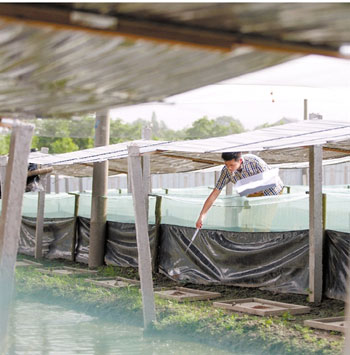
Wu Chuanyi feeds the black-spotted frogs.
In Chengshan Village, Heping Town, Changxing County, Wu Chuanyi, a frog farmer in his 30s, squats on the muddy ground beside a frog pond. As soon as he lifts a wooden board, dozens of frogs leap out and dart into the nearby ditch. After a few "plop, plop" sounds, the frogs within a dozen meters around all stir into motion.
Wu Chuanyi is not tall, wears a clean shirt, and has hardly any mud on him, making it hard to associate him with a traditional farmer. But judging by his feeding technique, he is clearly very experienced.
Wu Chuanyi himself cannot say exactly how many frogs he raises. He only says he has two plots of land, one 80 mu and one 120 mu. These two farms belong to Zhejiang Changxing Chuangyi Ecological Agriculture Development Co., Ltd., located in Chengshan Village, Heping Town, Changxing, Huzhou, about 5 km apart. Wu Chuanyi's daily work is to drive back and forth between the two sites, overseeing the operations of the farms.
"Business at chemical factories has become harder and harder in recent years, and the pollution is heavy. But black-spotted frogs can catch large numbers of pests, and their economic returns are better than ordinary bullfrogs and American frogs." That is how Wu Chuanyi explains his original motivation for farming frogs. In 2010, he gave up his chemical factory and the hundreds of thousands of yuan in annual returns it brought, returned to his hometown to develop aquaculture, and later began planting "frog rice fields."
To learn the techniques, Wu Chuanyi studied frog farming through the internet, television and other channels, and personally traveled to Sichuan, Hunan, Jiangsu and other places to investigate. Through constant exploration, he gradually found the knack, developing advanced and scientific farming methods such as flowing-water hatching, co-stocking tadpoles and adult frogs in the same pond, and efficient artificial domestication and feeding with pellet feed. He also rationally planned the breeding base, dividing it into different zones such as a flowing-water hatching area and a frog spawn hatching area.
After several years of exploration, Wu Chuanyi's green industry developed rapidly. In 2013, the per-mu benefit of the frogs raised at the breeding base reached 30,000 yuan, and Chengshan Village became a veritable frog village.
At one of Wu Chuanyi's farms, we see that in addition to the hatching area, there is also a rice paddy of about 20 mu. This is exactly the "frog rice field" that Wu Chuanyi began experimenting with in May of this year.
From the outside, the "frog rice field" looks no different from ordinary farmland, except that it has extra ditches, where the frogs hide in the water, and a net more than half a meter high is set up around the paddy field. About four or five meters above the rice field, there is a larger net covering the entire 120-mu farm, forming a relatively enclosed space.
The rice nurtures the frogs, and the frogs protect the rice. This mixed farming method forms a small-scale ecological balance. Apart from some biological pesticides that simply cannot be avoided, the "frog rice field" eliminates all conventional pesticides. In addition, the paddy field does not use too much fertilizer, relying mainly on organic fertilizer, doing its best to be ecologically friendly and improve the quality of the rice.
At present, half of the "frog rice" in the experimental field has already been harvested, and before the end of the month, the other half will also be fully harvested. In terms of per-mu yield, the rice is about 700-plus jin and the black-spotted frogs 500-plus jin. Compared with growing rice or raising frogs separately, this yield is relatively small, but in terms of comprehensive benefits, this model far exceeds traditional agriculture, and the per-mu benefit is expected to approach 20,000 yuan. "Most importantly, after it is launched on the market, the concept of 'frog rice' will be very popular." Just as when he first started his business, Wu Chuanyi is full of confidence in his green industry.
On the way back, Wu Chuanyi received a phone call from a farmer in the village asking him to share his experience. After hanging up, Wu Chuanyi told the reporter that his greatest wish now is to optimize his model of raising frogs and growing rice, making it simpler and more efficient, so as to help more farming households become prosperous.