Snakes raised in Guangxi sell well, transported out by the truckload
Original title: Qin Yunchang of Bohua Village, Sandu County: Once a migrant worker, now a snake farming king
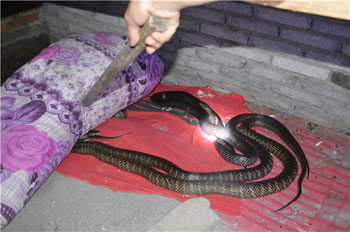
The snake curls up under the quilt to hibernate.
The skin shed from the snake's body.
In order to get rich, Qin Yunchang of Podi Group, Bohua Village, Zhoutan Town, Sandu County took an unusual path. While working away from home, he learned snake farming techniques, returned to his hometown and set up a snake farm, becoming a locally famous "snake farming king" and embarking on an extraordinary road to wealth. Recently, the author visited Qin Yunchang's snake farm.
Qin Yunchang's snake farm covers about 200 sq m and has six or seven dozen snake boxes. Each snake box is about one meter tall and covered with wire mesh on top to prevent the snakes from "escaping." These snake boxes hold a total of 3,000-4,000 jin of snakes.
Speaking of how he became involved with snakes, Qin Yunchang said that more than ten years ago he worked at a snake farming base in Guangdong. Seeing that snake farming offered a large profit margin, Qin Yunchang, who was only a keeper at the time, secretly made up his mind: bring snake farming techniques home and build his own snake farming base in the future. After more than two years of "stealth learning," Qin Yunchang gradually came to understand the snakes' living habits and mastered a great deal of snake farming knowledge and business experience. In 2004, Qin Yunchang returned to his hometown to start a business. He personally built a 60 sq m snake house. It was in this small snake house that he struggled and gained experience, opening his road to wealth through entrepreneurship.
Qin Yunchang told the author that raising snakes is different from raising poultry such as chickens and ducks. Without six or seven years of exploration, it is very difficult to fully grasp the snakes' living habits. Moreover, many snakes are nationally protected animals, and famous snake species especially may not be domesticated at will. They must pass strict approval by the relevant departments and meet the feeding conditions and technical standards before they can be domesticated. Therefore, fearing neither "high mountains nor long roads," he asked one department after another and handled one procedure after another. Finally, in 2012, he completed all the materials and obtained the first wildlife domestication and breeding license in Sandu County, becoming a legal and truly worthy snake farming king. After that, Qin Yunchang set about expanding the snake house, and from then on began his path of large-scale snake farming.
"Building a snake house requires strict science. Snakes fear cold and heat, so in summer it must be kept ventilated, and in winter the snakes must be kept warm." Qin Yunchang said that snakes are cold-blooded animals, and their living environment must be maintained at around 28°C and must not exceed 31°C. The food snakes eat is also very particular: it needs quail freshly hatched and never fed, transported from Guangxi. Around October each year, snake meat is at its fattest and most delicious, but from December to April of the following year the snakes enter hibernation. As long as the snakes are "covered with quilts" and kept warm, there is no need to feed them.
At present, Qin Yunchang's snake farm mainly raises three kinds: water snake, flower snake and cobra. Among them, water snakes and cobras fetch higher prices. The market price of water snake is 120-170 yuan/jin, cobra is 100-150 yuan/jin, and flower snake is 80-100 yuan/jin. The skin shed from the snakes' bodies is also a great "treasure." Snake skin can be sold as medicinal material, and one jin of snake skin also brings in 70 yuan. According to Qin Yunchang, a snake's breeding cycle is two to three years, and it can grow to about 3 to 4 jin. After deducting feed costs, and calculated at current market prices, one snake can yield a net profit of more than 200 yuan. Over a year, his snake farm can net 80,000 to 90,000 yuan without any problem.
When asked whether he had ever been bitten by a snake, Qin Yunchang held out his deformed little finger and said with a smile: "Of course I've been bitten. At the time it gave me a real fright. Fortunately, it was treated in time, and now there is no major problem." Qin Yunchang told the author that the biggest difficulty in raising snakes is overcoming the psychological barrier. But when he thinks that these snakes are renminbi and assets for starting a business and getting rich, he can only work hard to overcome it. Now that he has dealt with snakes for a long time and mastered their habits, he feels there is nothing to be afraid of.
Qin Yunchang never worries about selling the snakes he raises. Besides selling them to restaurants and hotels in surrounding counties and cities such as Dushan, Libo and Duyun, they are sometimes also sold as far away as Guangxi and other places. During the peak sales season for snake meat, they must be ordered in advance to be available. Now he is calculating that, if funds permit, he will expand the scale and make the snake farm better and larger. (Pan Xiaoyuan)