Raising one sheet of silkworm eggs requires 600 kg of mulberry leaves
Original title: Chen Qingguo of Fengdu: Raising one sheet of silkworm eggs requires 1200 jin of mulberry leaves
"In past years, my family always had a lot of mulberry leaves left over from raising silkworms, and when the next batch of silkworms came along, the leaves had aged and were wasted for nothing. This year, I accepted technical assistance, and after all the late-autumn silkworms had spun their cocoons, the mulberry leaves had just been fully picked, achieving the maximum farming benefit." Chen Qingguo, a villager from Renhe Village, Huwei Town, Fengdu County, said recently.
Applying sufficient base fertilizer to the mulberry trees
Chen Qingguo's family mainly makes a living from farming. Besides working the land, raising silkworms is their main source of income. But in recent years, because his family had no careful plan for raising silkworms, their income was greatly reduced, and they were therefore registered as a poor household. At the beginning of this year, the county science and technology association paired up to assist the village. After investigating and understanding the causes of his family's poverty, the assistance team members decided to help him escape poverty through technical support.
"We first investigated and assessed the situation of his family's mulberry planting, precisely calculated the annual output of mulberry leaves, and only then formulated an assistance plan for how many sheets of silkworm eggs would be suitable to raise." the assistance team member said.
Raising silkworms is just like raising pigs and sheep: to get good returns, you must provide them with enough high-quality feed and ensure they eat their three meals a day until full. For this reason, the assistance team members told him that mulberry leaves are the silkworm babies' feed; only by managing and protecting the mulberry trees well and making them flourish can you raise more silkworms, raise them well, and guarantee increased income.
Under the guidance of the assistance team members, Chen Qingguo took advantage of early spring, exactly when mulberry trees sprout and put out branches, and transported the family's livestock and poultry manure to the mulberry garden, applying sufficient base fertilizer to each mulberry tree to ensure ample nutrition and lay the foundation for raising healthy silkworm babies.
Precise calculation brings high returns
As the saying goes, "The plan for the year lies in spring." Raising spring silkworms is the main event of the whole year; whether it is done well or poorly, whether production increases or not, all depends on this. "Your family has more than 900 mulberry trees, large and small. It is estimated that spring can produce 10,000 jin of mulberry leaves. Calculating on the basis that raising one sheet of silkworm eggs requires 1200 jin of mulberry leaves, your family can raise 8.5 sheets of spring silkworm eggs." the assistance team member told him.
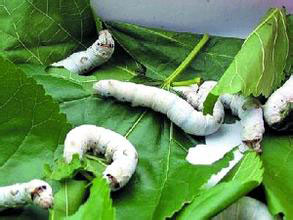
Previously, Chen Qingguo worried that there would not be enough mulberry leaves, and in the best year he raised at most 5 sheets of spring silkworm eggs. Now the number was suddenly increasing to 8.5 sheets, and he did not feel confident, but thinking that the assistance team members were giving him advice, he had no choice but to brace himself and give it a try. Under his careful rearing, the silkworm babies smoothly completed the growth process from the first to the third molt. When they woke from the fourth molt, their appetites gradually increased, and each time they ate mulberry leaves they did so especially quickly, even making a "rustling" sound like light rain. He and his wife picked mulberry leaves from morning to night, bustling with joy.
Hard work pays off. Watching each silkworm baby finish its last bite of mulberry leaves, its whole body becoming translucent, experience told Chen Qingguo that this was a sign they were about to spin silk and form cocoons. Looking back at his own mulberry garden, he found that the mulberry leaves on the trees had all been picked, leaving only a few tender leaves at the tips of the branches, and he could not help letting out a long breath of relief.
"The assistance team members calculated so accurately. For the following summer silkworm eggs, autumn silkworm eggs, and late-autumn silkworm eggs, I raised them all according to the quantities they calculated. The four batches of silkworms throughout the year produced more than 3200 jin of cocoons in total, and the income from selling cocoons was about 30,000 yuan, an increase of more than 40% compared with previous years." Chen Qingguo said happily.
Mulberry garden management and protection must be in place
After selling the last season's late-autumn silkworm cocoons, the assistance team members, following the principle of "helping one mount the horse and escorting one part of the way," continued to guide him technically in comprehensively transforming the mulberry garden, promptly eliminating aged mulberry trees, and replanting a batch of high-quality improved mulberries. They also did a good job of plowing the land, fertilizing and cleaning the garden, and pruning branches.
"After the Start of Winter, I also followed the techniques taught by the assistance team members and promptly painted the tree trunks with lime slurry, and carried out bud grafting on some wild mulberry trees. At the same time, I applied sufficient base fertilizer to ensure the fertility needed for the mulberry trees to joint and sprout in early spring." Chen Qingguo said. He now finally understood that only when mulberry leaf output goes up can the number of silkworms raised and income be increased, and only then is there hope for his family to escape poverty. (Correspondent Li Dayuan)