Forage grass suits farming households that lack labor, and harvesting it multiple times brings good returns
Original title: Lacking labor, grow forage grass; multiple harvests bring good returns
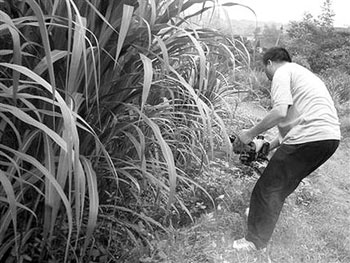
Gao Linyun is cutting forage grass.
Poverty alleviation profile
Overview: Although Gao Linyun, a villager of Shilong Village, Gaojia Town, Fengdu County, has planted more than 15 mu of land, his family's income falls short of its expenses because of a lack of labor, and they were registered as a poor household.
Breakthrough: Taking into account that the local area has a beef cattle farm with 10,000 head that needs to buy large quantities of forage grass and straw, the poverty alleviation task force drew up a targeted assistance plan for Gao Linyun's family.
Path: The county science and technology association organized a science and technology poverty alleviation team to visit his home, give on-site guidance to Gao Linyun on forage grass cultivation techniques, and provide high-quality forage grass seed.
Vision: Calculated at 8 tons of forage grass harvested per mu per year and a minimum purchase price of 420 yuan per ton, the gross income from Gao Linyun's 15 mu of land will exceed 50,000 yuan.
"This patch of forage grass should be left standing until it is harvested after the Winter Solstice. At that time the temperature is the coldest of the year, the growth of green feed is hindered and it is relatively scarce, so it can fetch a good price." Recently, Gao Linyun, a villager of Shilong Village, Gaojia Town, Fengdu County, said as he took this correspondent to visit his forage grass field.
Drawing up a targeted assistance plan
Gao Linyun's family has 5 members. His father is advanced in years, his wife is frail and often ill, and of the two children, one is in university and one is in senior high school. Although he has planted more than 15 mu of land, his family's income falls short of its expenses because of a lack of labor, and they were registered as a poor household.
After the village-stationed task force visited to learn the specific situation, and taking into account that the local area has a beef cattle farm with 10,000 head that needs to buy large quantities of forage grass and straw, it drew up a targeted assistance plan for his family.
"Linyun, considering the reality that your family lacks labor, we suggest you consolidate your land to grow forage grass. After one sowing it can be harvested many times, and the forage grass can be sold directly to the cattle farm. What do you think?" The village-stationed task force had a heart-to-heart talk with Gao Linyun and did the accounts for him: calculated at 8 tons of forage grass harvested per mu per year and a minimum purchase price of 420 yuan per ton, the gross income from 15 mu of land would be more than 50,000 yuan.
Teaching sowing techniques on site
Action followed words. The county science and technology association organized a science and technology poverty alleviation team to visit his home and give on-site guidance to Gao Linyun on clearing, plowing and ridging the land, applying enough base fertilizer, preparing the soil, and then sowing high-quality forage grass seed such as sweet sorghum, hybrid giant napier and ryegrass.
"Fengdu is located in the hinterland of the Three Gorges reservoir area, with a warm and humid climate and a short period of extremely cold weather in winter. Forage grass varieties from the north can all grow smoothly in our county, and most tropical grass species can overwinter smoothly." While explaining, the technicians demonstrated sowing techniques, and strongly recommended that Gao Linyun grow sweet sorghum, saying that this forage grass variety is sown in March of the same year, can be harvested after the end of May, generally grows to 2 m tall, and the first cut can yield more than 5 tons per mu, with 2-3 cuts possible in a year.
In view of the lack of labor in Gao Linyun's family, the technicians focused on teaching him the cultivation techniques for annual forage grass, winter annual forage grass and perennial forage grass. The technicians pointed out that for annual forage grass, since it is harvested in the year it is sown, spring sowing must be carried out. Winter annual and perennial forage grass, however, can be sown outside the usual season.
"Sowing forage grass is just as important as it is for crops. If full stands and strong seedlings cannot be achieved, it will affect the harvest of the whole plot of land for a year. Given our county's climate and soil conditions, the main sowing method for forage grass is drilling, followed by broadcasting and dibbling." The technicians said this and also set requirements for the sowing depth of different seeds.
Strengthening management to ensure increased returns
After the seeds emerged, the technicians promptly taught Gao Linyun field management techniques, mainly including removing weeds, applying topdressing, irrigation and drainage, and pest and disease control. Because these techniques are much the same as those for growing other crops, Gao Linyun learned them as soon as he was taught and understood them as soon as they were pointed out. Together with his diligence and hard work, drop after drop of sweat brought lush growth of the forage grass.
In the blink of an eye the forage grass harvest period arrived, and the technicians came to the site again to give technical guidance, requiring Gao Linyun, when cutting the forage grass, to make sure it benefits the regrowth of the forage grass, the safe overwintering and green-up of perennial or winter annual forage grass, and has no effect on the next year's yield and lifespan. "In short, forage grass is like crops: when it is time to harvest, you must hurry to harvest. Harvesting too early affects the yield, and harvesting too late affects the regrowth of the next cut."
Facts have proved that growing forage grass has become an effective way for Gao Linyun to escape poverty and become prosperous, and this year a net income of 50,000 yuan from selling forage grass will be no problem for his family. (Text/Photos by correspondent Li Dayuan)